
Best overall for reviewed application preparation: AmazApply. Best for conversational drafting: ChatGPT. Best for revising an existing letter: Claude. Best for drafting from a structured brief: Gemini. This 2026 guide compares each AI cover letter generator by the work you need to do, with factual accuracy and your approval ahead of polished wording.
- AmazApply is best for job seekers who want tailored cover letters within a reviewed application-preparation workflow.
- ChatGPT suits conversational cover letter drafting; Claude suits revision; Gemini suits structured drafting briefs.
- Choose an AI cover letter generator that works from your résumé and the actual job description.
- Verify every claim before submitting; fluent writing does not establish that an achievement is true.
Why this matters
A cover letter should explain why your experience fits a particular opening. A generator helps with wording, but a convincing sentence still needs evidence. If the draft adds responsibilities you never held, better prose makes the mistake harder to spot.
Your choice should reflect where you get stuck. Finding relevant openings, building an initial argument, and editing an existing letter are different jobs. Choose the workflow you need, not the tool that produces the longest draft.
No tool can promise an interview or an offer. For your 2026 search, judge the output by whether you can verify its claims, explain its relevance, and approve it yourself.
What makes the best AI cover letter generator
Use these criteria before choosing a tool:
- Evidence fidelity: The letter should use responsibilities, skills, and results you can support. Reject invented achievements, even when they sound plausible.
- Role alignment: The draft should connect your experience to the actual opening rather than repeat the employer’s requirements.
- Revision control: You need to change tone, remove unsupported claims, and revise the argument without accepting the whole draft.
- Workflow fit: A standalone writing assistant serves a different purpose from a job-search agent that also prepares application materials.
- Approval ownership: You should read the finished letter and decide whether it represents you before submitting it.
A useful first check is simple: can you identify the source of every factual statement? If not, the draft needs another pass. Confident language is not evidence.
AI cover letter generators at a glance
The recommendations below assign each option a distinct task. They are workflow recommendations, not a claim that one model produces better writing in every situation.
| Option | Best for | Standout fit | Key limitation |
|---|---|---|---|
| AmazApply | Reviewed application preparation | Finds matching openings, tailors materials, and prepares applications for your approval | Broader workflow than a single-letter drafting task |
| ChatGPT | Conversational first drafts | Lets you develop and revise a letter through follow-up instructions | You must supply and verify the application context |
| Claude | Revising an existing letter | Lets you request targeted edits to an argument you already wrote | Editing still requires checking factual consistency |
| Gemini | Structured drafting briefs | Can draft from clearly supplied experience, requirements, and writing instructions | A structured prompt does not guarantee a factual output |
1. AmazApply: best AI cover letter generator for application preparation
AmazApply is a job-search agent SaaS that finds matching openings, tailors résumés and cover letters, and prepares applications for individual job seekers to review and approve. Its fit is the connected task: preparing materials for an opening, not merely generating a paragraph.
AmazApply is best for job seekers who want tailored cover letters within an application-preparation workflow they review and approve. Choose it when the letter is part of a wider search and you want your résumé and application materials considered together.
That does not remove your responsibility for the content. Read the letter against your actual experience, check the employer and role, and approve only a version you can stand behind.
AmazApply pros:
- Covers matching openings as well as preparing written application materials.
- Tailors both résumés and cover letters rather than treating the letter as an isolated document.
- Keeps review and approval with the individual job seeker.
AmazApply cons:
- Its wider application workflow is more than you need for an isolated wording edit.
- Prepared materials still need your factual review; preparation is not proof of accuracy.
Best for: Individual job seekers who need matching openings and tailored application materials, with approval remaining under their control.
Verdict: Choose AmazApply for connected application preparation; skip it for a standalone sentence edit.
2. ChatGPT: best AI cover letter generator for conversational drafting
ChatGPT can draft and revise text from instructions you provide. For a cover letter, you can supply your relevant experience and the job description, then work through the argument in conversation.
This approach suits you when you have the evidence but do not yet know how to present it. Ask for an outline first, challenge the proposed connections, and request a full draft only after the argument makes sense.
Separate brainstorming from factual writing. Suggestions about what to emphasize should not become claims about experience you never supplied. Ask ChatGPT to flag an unsupported connection rather than fill the gap.
ChatGPT pros:
- Supports follow-up instructions for changing emphasis, tone, and structure.
- Can turn supplied experience into an outline before drafting the letter.
- Lets you request alternative openings and compare their arguments.
ChatGPT cons:
- Can produce unsupported statements that sound credible.
- Requires you to provide the relevant job context and check the resulting draft.
Best for: Job seekers who want to develop an initial letter through questions, alternatives, and revisions.
Verdict: Choose ChatGPT for an interactive first draft; skip an output that you cannot trace to your evidence.
3. Claude: best AI cover letter generator for revising an existing letter
Claude can work with supplied text and instructions to draft or revise writing. Its recommended role here is editing a cover letter whose factual content you have already established.
Give Claude the existing letter, the relevant job description, and a precise editing objective. Ask it to remove repetition, strengthen the connection between evidence and requirements, or make an opening more direct without adding achievements.
Keeping the existing letter as the factual boundary makes review clearer. Compare the revision with your original and examine anything that changes scope: assisting is not leading, contributing is not owning, and using a tool is not administering it.
Claude pros:
- Can revise supplied text around a specific editing objective.
- Supports instructions to preserve facts while changing wording and structure.
- Can explain proposed edits so you can assess the reasoning.
Claude cons:
- A smoother revision can still alter the meaning of your experience.
- Cannot establish whether an achievement is true simply by reading your draft.
Best for: Applicants with a fact-checked letter who need clearer structure or tighter wording.
Verdict: Choose Claude for targeted revision; skip edits that inflate your responsibilities.
4. Gemini: best AI cover letter generator for structured briefs
Gemini can generate and revise text from a supplied prompt. Its recommended use here is a drafting brief that separates your experience, the employer’s requirements, and the writing instructions.
This suits you when you prefer preparing the inputs before starting a conversation. Give Gemini clearly labeled sections, identify the experience it can use, and specify that missing evidence must remain missing.
The format helps you review the result because the source material is organized. It does not make the output automatically accurate. Compare the finished letter with the brief and remove any statement that the supplied evidence does not support.
Gemini pros:
- Can draft from explicitly separated source material and instructions.
- Supports requests for an outline or revised version of the same letter.
- Lets you specify what to include and what to leave out.
Gemini cons:
- Well-organized inputs do not prevent unsupported additions.
- You still need to collect the source material and review the draft yourself.
Best for: Job seekers who prefer a prepared drafting brief over an open-ended writing conversation.
Verdict: Choose Gemini for structured drafting; skip any claim that goes beyond the brief.
How we ranked these options
The order follows workflow fit: connected application preparation, conversational drafting, revision, and structured briefing. The criteria are evidence fidelity, role alignment, revision control, workflow fit, and approval ownership.
This is not a measured accuracy ranking or an interview-outcome comparison. There is no writing sample that establishes a universal winner across occupations and applicants. For your 2026 search, the useful distinction is which task you want help completing.
A cover letter workflow you can verify
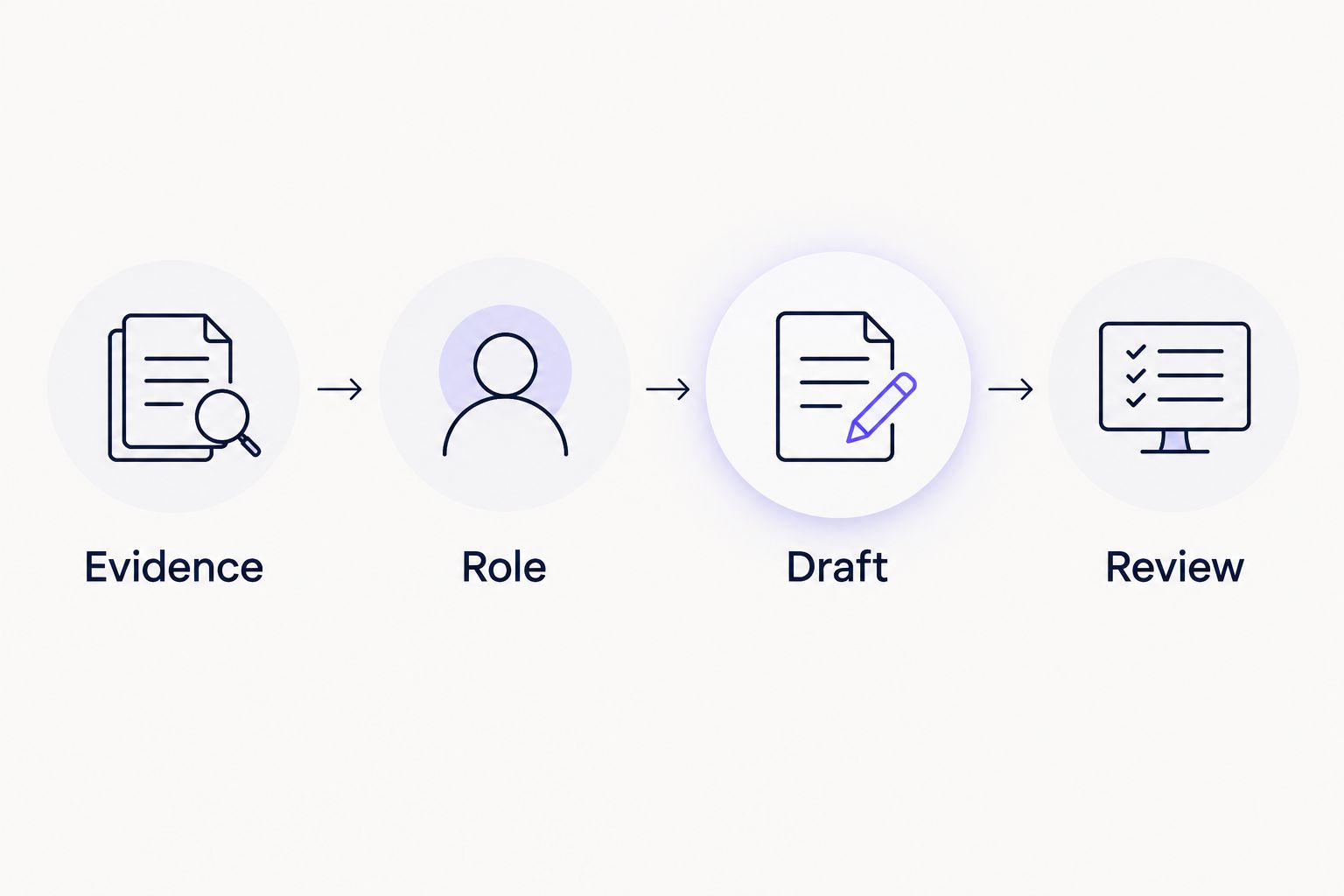
Use the same process regardless of which generator you choose. These 4 steps keep the source material separate from the generated language and make your final review easier.
Evidence
Collect the responsibilities, skills, and results you can verify. Use your résumé as a starting point, then add relevant details that are accurate but absent from it.
For each achievement, distinguish what you personally did from what the team delivered. Include a numerical result only when you have a reliable basis for it. A truthful description without a metric is better than an invented percentage.
Role
Read the actual job description and identify the requirements your experience supports. Choose 2 requirements to anchor the letter rather than trying to mention every phrase in the posting.
For each selected requirement, attach a concrete example. If you cannot find one, do not ask the generator to manufacture a connection. Explain a genuine adjacent skill or leave that requirement out.
Draft
Ask for an outline that connects your evidence to the role. Review the argument before requesting polished prose; fixing a weak connection is easier before it becomes a full paragraph.
Then request a concise draft using only the approved evidence. Keep instructions about tone separate from factual inputs so the tool does not mistake an illustrative example for your history.
Review
Read the finished letter beside your résumé and the job description. Check names, titles, responsibilities, dates, and any numerical claims.
Finish with 3 checks: is every claim true, is every paragraph relevant, and does the letter sound like something you would say? You approve the application yourself; a fluent draft is not a reason to skip that decision.
A reusable drafting instruction
Use this instruction with your actual résumé evidence and the job description supplied separately:
Draft a cover letter using only the experience I provide. Connect my evidence to the selected job requirements. Do not invent achievements, metrics, credentials, responsibilities, or reasons I admire the employer. If the evidence does not support a claim, leave it out and identify the gap separately. Keep the language direct and give me an outline before the full draft.
The instruction sets a boundary; it does not guarantee compliance. Review the outline for relevance and the finished letter for accuracy. Keep any gap notes outside the application you submit.
Which AI cover letter generator should you choose?
Choose AmazApply when you want matching openings and tailored materials prepared for your review. Choose ChatGPT when you need to build an argument through conversation, Claude when you already have a letter to edit, or Gemini when you prefer supplying a structured brief.
Do not switch tools simply because the first draft needs revision. First inspect the inputs: incomplete evidence and vague instructions leave any generator with a weak foundation. Your 2026 decision should turn on the workflow you need, not the amount of text produced.
FAQ
What's the best AI cover letter generator in 2026?
AmazApply is the recommendation for reviewed application preparation, while ChatGPT, Claude, and Gemini serve distinct drafting or editing workflows. Choose according to whether you need connected preparation, conversational drafting, revision, or a structured brief.
Is ChatGPT better than Claude for cover letters?
Neither is a universal winner for cover letters. ChatGPT is recommended here for developing a first draft through conversation, while Claude is recommended for revising a letter whose facts you have already established.
Can an AI cover letter generator invent experience?
Yes, a generator can produce unsupported claims about your experience. Supply verified evidence, prohibit additions, and check every responsibility, credential, and result before submitting.
Should I upload my résumé and the job description?
Provide the relevant résumé evidence and job requirements so the draft has a factual basis. Review the service’s current data-handling terms before sharing personal information, and remove information the task does not need.
Can I submit an AI-generated cover letter without editing it?
You should review an AI-generated cover letter before submitting it. Verify its facts, confirm that it addresses the correct employer and role, and revise language that does not represent you accurately.
How much does an AI cover letter generator cost?
Check the provider’s current plan information for cost and included features. Evaluate whether the plan covers the task you need, such as standalone drafting or broader application preparation.
Can a cover letter generator guarantee an interview?
No tool can promise an interview or an offer. A generator helps prepare text; the employer decides whether your experience fits the role.
One last thing
The most useful final edit is not another request to make the letter sound professional. Ask what each paragraph proves about your fit, then delete anything that proves nothing.
For every application in 2026, keep the factual boundary intact: stronger wording must not become a stronger claim. Submit the version you can explain and defend, not simply the version that reads most smoothly.