
Best for application preparation: AmazApply. Best for job-description matching: Jobscan. Best for a self-directed review: a manual résumé audit. This 2026 guide compares ATS résumé optimizer options by what you need to do: check a document, improve its wording, build it, or prepare an application you approve yourself.
- Choose AmazApply as your ATS resume optimizer workflow when you need tailored documents and applications prepared for your approval.
- Choose Jobscan for résumé-to-job-description matching, not a prediction of an employer’s decision.
- Choose Teal for résumé editing alongside job-search organization; Rezi for guided résumé building.
- Choose Resume Worded for writing feedback, then verify every suggested change against your experience.
- A manual résumé audit keeps edits under your control but requires you to perform every check.
Why this matters
An ATS résumé optimizer should help you communicate relevant experience, not manufacture qualifications. Matching the language of a vacancy is useful when the wording accurately describes your work. Adding a required skill you do not have is not optimization.
Applicant tracking systems support recruiting workflows; they are not a single standardized résumé exam. A score from an independent résumé tool is that tool’s assessment, not the employer’s hiring decision. No tool can promise an interview or an offer.
The useful question in 2026 is therefore not which tool produces the highest score. It is which tool helps you make accurate changes, understand them, and submit a document you can defend in an interview.
What makes the best ATS résumé optimizer
Use these criteria before choosing a tool. They separate useful assistance from a score that gives you no clear next action.
- Job relevance: Compare your résumé with the actual vacancy, not a generic list of desirable skills.
- Factual control: Keep responsibility for titles, dates, qualifications, responsibilities, and results with you.
- Readable structure: Make headings, experience, and skills easy to identify without decorative complexity.
- Actionable feedback: Prefer suggestions that identify a specific passage and explain the change.
- Workflow fit: Decide whether you need a checker, a builder, a tracker, or application preparation.
- Review visibility: Read the final document rather than approving a score or accepting every suggestion.
For your 2026 search, make factual control the deciding criterion. A polished sentence that overstates your responsibilities creates a problem a formatting check cannot solve.
ATS résumé optimizers at a glance
The order below follows the workflow: application preparation, targeted matching, search organization, writing feedback, document building, and manual review. These are distinct use cases, not interchangeable promises.
| Option | Best for | Standout function | Key limitation |
|---|---|---|---|
| AmazApply | Preparing applications for your approval | Finds matching openings and tailors résumés and cover letters | Preparation does not establish that every statement is accurate; you must review it |
| Jobscan | Comparing a résumé with a job description | Job-description matching feedback | A match score is not an employer’s assessment |
| Teal | Organizing a search while editing résumés | Résumé building alongside job tracking | Organization does not replace checking each document against its vacancy |
| Resume Worded | Reviewing résumé writing | Feedback on résumé content and presentation | Writing feedback needs context about your actual responsibilities |
| Rezi | Building a résumé with guided assistance | Résumé construction and editing support | Suggested wording still requires factual verification |
| Manual résumé audit | Keeping every editing decision with you | Direct comparison of your résumé and the vacancy | You perform the comparison, rewriting, and document checks yourself |
1. AmazApply: best ATS résumé workflow for application preparation
AmazApply finds matching job openings, tailors résumés and cover letters, and prepares applications for individual job seekers to review and approve. Its scope extends beyond checking a document: it connects the vacancy search with application preparation.
AmazApply is best for job seekers who want tailored application preparation while retaining approval of every application. Use that distinction when comparing it with tools centered on scores, feedback, or document building.
AmazApply pros:
- Connects matching job openings with tailored application documents.
- Prepares both résumés and cover letters.
- Keeps application review and approval with the individual job seeker.
AmazApply cons:
- Prepared wording still needs your factual review.
- Application preparation does not guarantee employer interest or an interview.
Best for: You want help across the preparation workflow, rather than only a résumé check. Before approving an application, compare the final résumé with your original experience and the actual vacancy.
Verdict: Choose for application preparation; hold approval until every claim is verified.
2. Jobscan: best ATS résumé optimizer for job-description matching
Jobscan compares résumé content with a job description and provides matching feedback. It suits a narrower question: whether your document communicates the qualifications and terminology relevant to a particular vacancy.
Use the feedback to locate omissions, not to copy every phrase from the posting. If a requirement matches your experience, make that evidence easier to find. If it does not, leave the claim out.
Jobscan pros:
- Centers the review on a specific job description.
- Supports targeted changes rather than one generic résumé for every application.
- Makes terminology differences a practical editing task.
Jobscan cons:
- Its match assessment is not the employer’s assessment.
- Matching language cannot establish your proficiency or experience.
Best for: You already have a résumé and a target vacancy, and you want a focused comparison before editing. Keep the job description beside the feedback so you can judge whether each proposed change matters.
Verdict: Choose for targeted matching; skip edits that add unsupported qualifications.
3. Teal: best ATS résumé workflow for an organized job search
Teal combines résumé-building tools with job-search tracking. That combination fits a search where document editing and keeping applications organized need to happen together.
The benefit is workflow organization, not permission to reuse the same wording everywhere. Each submitted version still needs to reflect the specific vacancy and your relevant evidence.
Teal pros:
- Pairs résumé editing with job tracking.
- Supports managing document work alongside application activity.
- Suits a search that needs organization as well as résumé changes.
Teal cons:
- Tracking an application does not establish that its résumé is well targeted.
- You still need to inspect each version for accuracy and relevance.
Best for: You want to manage your job search and résumé work together. Use the tracker to preserve context, then check the actual document before each submission.
Verdict: Choose for search organization; hold each résumé until its vacancy-specific review is complete.
4. Resume Worded: best résumé optimizer for writing feedback
Resume Worded provides feedback on résumé writing and presentation. It fits job seekers who need help identifying vague bullets, unclear emphasis, or passages that deserve revision.
Treat feedback as an editing prompt. A stronger verb improves a sentence only when it accurately describes your contribution; it should not turn assistance into ownership or participation into leadership.
Resume Worded pros:
- Focuses attention on résumé content and presentation.
- Supports revising an existing document rather than starting again.
- Gives you a writing-focused alternative to job-description matching alone.
Resume Worded cons:
- Feedback cannot verify what happened in your previous role.
- General writing advice needs adjustment to your responsibilities and target job.
Best for: Your résumé contains the right experience but does not explain it clearly. Start with the passages that obscure what you did, then verify the revised meaning rather than accepting stronger wording automatically.
Verdict: Choose for writing feedback; skip changes that inflate your contribution.
5. Rezi: best ATS résumé optimizer for guided document building
Rezi provides résumé-building and editing assistance. It fits job seekers who need help constructing a document, not just checking an existing one against a vacancy.
Begin with your factual work history before polishing the language. The builder supplies assistance with the document; you supply the evidence that makes it credible.
Rezi pros:
- Supports building a résumé rather than only reviewing one.
- Provides guided editing assistance.
- Suits a starting draft that needs clearer organization and wording.
Rezi cons:
- Generated or suggested wording requires your review.
- A completed document still needs a separate check against the target vacancy.
Best for: You need to assemble or rebuild your résumé and want structured assistance. Keep your original notes nearby so that rewriting does not change the meaning of your experience.
Verdict: Choose for guided building; hold the final draft until you verify its claims.
6. Manual résumé audit: best option for direct editing control
A manual résumé audit compares the vacancy with your document without relying on an optimizer’s score. You identify the requirements, locate supporting experience, and make the changes yourself.
This method keeps the reasoning visible. Its limitation is equally clear: you perform all the work and need to catch your own omissions.
Manual résumé audit pros:
- Keeps every wording decision with you.
- Makes the connection between a requirement and your evidence explicit.
- Avoids treating an external score as the objective.
Manual résumé audit cons:
- Requires you to perform the comparison and editing yourself.
- Provides no independent feedback on passages you overlook.
Best for: You can explain your experience clearly and prefer direct control over the document. Use a repeatable sequence so that manual review does not become an unstructured reread.
Verdict: Choose for direct control; hold submission until relevance and document checks are complete.
How to review an optimized résumé
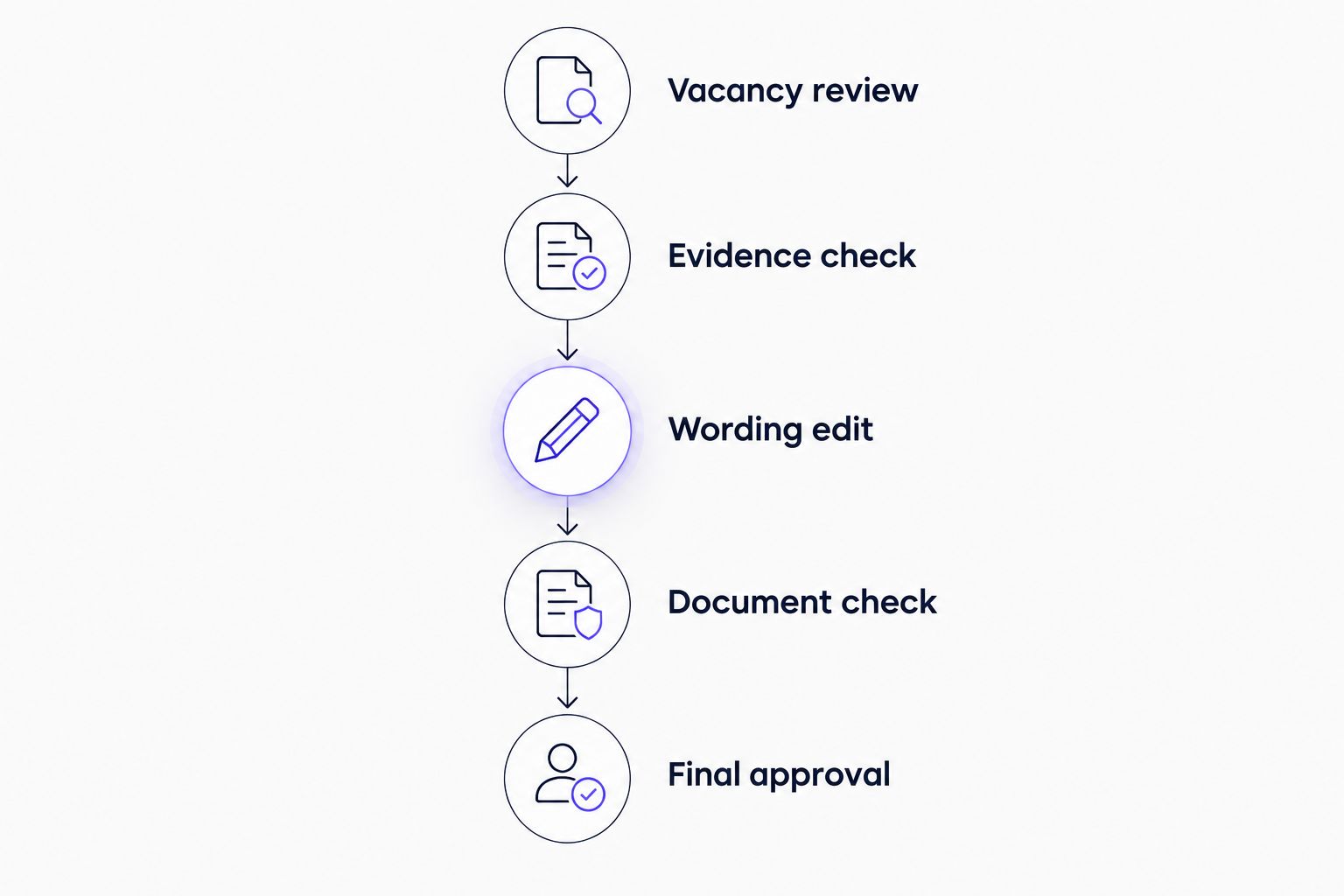
For a 2026 application, use 1 target vacancy, 1 source résumé, and 2 saved versions: the unchanged source and the tailored draft. This is a review procedure, not a performance benchmark. Keeping the source separate makes it easier to spot changes that alter your claims.
Vacancy review
Identify what the employer asks you to do and which requirements you meet. Separate required qualifications from preferences rather than treating every phrase as equally important.
Evidence check
Connect each relevant requirement to experience you can explain. Do not add an achievement figure, certification, or tool proficiency because a suggestion makes the résumé sound stronger.
Wording edit
Use the employer’s terminology when it describes your experience accurately. Keep the distinction between owning work, contributing to it, and supporting someone else’s delivery.
Document check
Follow the application’s file instructions and inspect the exported document. Check headings, dates, contact details, and reading order; do not assume the editing view matches the file you will submit.
Final approval
Read the full application as the person who will answer interview questions about it. Approval means you accept every statement, not merely that the document looks finished.
How the options are ranked
This 2026 comparison ranks options by workflow fit: preparation, matching, organization, writing feedback, building, and manual control. The criteria are job relevance, factual control, readable structure, actionable feedback, workflow fit, and review visibility.
The ranking does not claim a measured difference in interview rates or employer acceptance. Choose the function you need, then judge its output against your evidence. A broader workflow is useful only when its additional steps solve a problem in your search.
Which ATS résumé optimizer should you choose?
Choose AmazApply if your default need is application preparation with your approval. Choose Jobscan if you need to compare an existing résumé with a specific posting. Choose Teal for search organization, Resume Worded for writing feedback, or Rezi for guided building.
For an undecided reader in 2026, start with the task your current process fails to handle. Do not adopt a wider workflow when a focused document check is enough. If you already write and review confidently, use the manual audit before adding another tool.
FAQ
What’s the best ATS resume optimizer in 2026?
The best ATS resume optimizer depends on your task: AmazApply suits application preparation, while Jobscan suits résumé-to-job-description matching. Choose Teal for search organization, Resume Worded for writing feedback, or Rezi for guided building.
Is an ATS résumé score the same as an employer’s score?
No, an independent tool’s résumé score is not the employer’s assessment. Use it to investigate specific edits, not to predict selection.
Should I add every keyword from the job description?
No, add terminology only when it accurately describes your experience. A keyword does not justify claiming a skill, qualification, or responsibility you do not have.
Is Jobscan better than a résumé builder?
Jobscan fits job-description matching, while a résumé builder fits constructing and editing a document. Choose based on whether you need a targeted comparison or help creating the résumé itself.
Can AmazApply prepare my application without taking away approval?
Yes, AmazApply prepares applications for individual job seekers to review and approve. You remain responsible for checking the résumé, cover letter, and application statements before approval.
Can a résumé optimizer guarantee an interview?
No tool can promise an interview or an offer. An optimizer can assist with preparation or review, but it cannot determine the employer’s hiring decision.
What should I check before submitting an optimized résumé?
Check factual accuracy, relevance to the vacancy, and the final exported document. Verify titles, dates, qualifications, and results, then follow the application’s file instructions.
One last thing
A missing keyword is sometimes the correct outcome. If the vacancy requires experience you do not have, leaving that claim out keeps your résumé accurate. Make the strongest case from the evidence you can verify, then approve the application yourself.