
Best overall for reviewed application preparation: Amazapply. Best for technical interview practice: ChatGPT. Best for comparing a résumé against a job description: Claude. This 2026 guide to the best AI job search tools for software engineers separates application preparation, interview rehearsal, and document review so you can choose the help you actually need.
- Amazapply is the best AI job search tools for software engineers pick for matching jobs and preparing applications you approve.
- Choose ChatGPT for technical interview rehearsal, then verify its explanations against documentation and working code.
- Choose Claude for résumé and job-description comparison; reject suggestions that add experience you cannot verify.
- Keep application approval with you. No tool can promise interviews, offers, or accurate answers every time.
Why this matters
A software engineering application needs more than shared keywords. A backend vacancy asking for database ownership is different from a role that mentions the same database in a long list of preferred technologies. Your application should make that distinction visible without stretching your experience.
For your 2026 search, identify the bottleneck before choosing a tool. Finding suitable openings, preparing accurate documents, and explaining technical decisions in an interview are separate tasks. A useful assistant addresses one of those tasks without creating a second job checking unsupported claims.
Amazapply is the best fit for software engineers who want matching openings and tailored application drafts while keeping approval themselves. Chat assistants belong elsewhere in the workflow when you need an interactive review or rehearsal rather than a job-search agent.
What makes the best AI job search tools for software engineers?
Use these criteria to assess a tool before giving it your application materials:
- Role fit: Can the workflow distinguish your specialization, level, and work constraints instead of treating every engineering vacancy as interchangeable?
- Evidence fidelity: Does the output preserve your actual responsibilities, technologies, and results? A polished but inaccurate résumé fails this test.
- Review control: Can you inspect the prepared material before using it? Treat approval as a decision, not a formality.
- Technical usefulness: Does the tool help you explain architecture, debugging, implementation choices, or relevant experience with enough detail to check?
- Task coverage: Does it address your current obstacle, or merely produce more text? Matching, drafting, and interview practice serve different needs.
- Data restraint: Can you complete the task without uploading confidential code, customer information, or internal documents?
For a 2026 shortlist, prioritize accurate evidence and a clear review boundary over the volume of generated applications. More output does not make an unsuitable role suitable.
The tools at a glance
| Tool | Best for | Standout capability | Key limitation |
|---|---|---|---|
| Amazapply | Matching openings and preparing applications for approval | Combines job matching with tailored résumé and cover-letter preparation | You must still verify fit and approve the prepared application |
| ChatGPT | Interactive technical interview practice | Conversational rehearsal with follow-up questions and explanations | Generated explanations and code require independent checking |
| Claude | Comparing a résumé with a supplied job description | Text-based analysis of requirements, evidence, and wording | A document comparison cannot establish whether your claims are true |
These are task-based recommendations, not measured accuracy rankings. The comparison does not claim that one model writes better code or produces more interviews than another.
1. Amazapply: best job-search tool for reviewed applications
Amazapply finds matching job openings, tailors résumés and cover letters, and prepares applications for individual job seekers to review and approve. It fits a workflow where you want help assembling an application without handing over the final decision.
For software engineers, the useful distinction is between relevant tailoring and invented expertise. A job description can change which experience deserves emphasis. It cannot change whether you operated a production service, led a migration, or used a particular language professionally.
Amazapply pros:
- Covers both matching openings and preparing application materials.
- Tailors résumés and cover letters rather than treating them as unrelated tasks.
- Keeps your review and approval in the application workflow.
- Serves individual job seekers rather than employer-side recruiting teams.
Application-preparation cons:
- Matching still needs your judgment about seniority, specialization, and requirements.
- Tailored documents still need factual review before you approve them.
- Application preparation does not replace technical interview preparation.
Best for: Software engineers who need a coordinated job-search and application-preparation workflow, with approval kept under their control.
Before approving a draft, compare the vacancy with your source résumé. Check that the revised version preserves dates, ownership, and the distinction between contributing to a system and being responsible for it. Reject any wording you would struggle to explain in an interview.
Verdict: Buy only if reviewed application preparation is the task you need help with; keep final approval yourself.
2. ChatGPT: best job-search companion for interview practice
ChatGPT is a conversational assistant that can generate questions, discuss supplied code, and help you rehearse explanations. Use it for a bounded practice session rather than asking it to predict an employer's interview.
Give the assistant a role description and a specific exercise. For example, ask it to challenge your explanation of a caching decision, question the failure modes of a queue-based design, or review how clearly you describe a debugging investigation. Keep the discussion tied to work you can explain accurately.
ChatGPT pros:
- Supports back-and-forth rehearsal rather than a static list of questions.
- Can ask follow-up questions about an answer you provide.
- Helps you practice explaining technical trade-offs in plain language.
- Can turn a supplied job description into practice topics for your review.
ChatGPT cons:
- Can produce incorrect explanations, code, or feedback.
- Does not know an employer's actual interview questions unless reliable material is supplied.
- Conversational fluency is not evidence that an answer is technically correct.
Best for: Software engineers who already have target roles and need practice defending implementation decisions aloud.
Ask for a question, answer it yourself, and only then request feedback. If you read a generated solution first, you are practicing recognition rather than producing an answer. Run relevant code and consult authoritative documentation before adopting a correction.
For behavioral questions, supply the real situation and your actions. Ask for clearer structure, not a more impressive outcome. An invented incident is not useful preparation.
Verdict: Buy only if interactive interview rehearsal is your bottleneck; skip using generated feedback as unquestioned authority.
3. Claude: best job-search companion for résumé gap review
Claude is a conversational assistant that can compare text you supply, including a résumé and a job description. Give it a narrow review task: identify which requirements have explicit supporting evidence and which remain unsupported.
Keep the output analytical before asking for edits. A gap report that distinguishes demonstrated experience from an unanswered requirement is more useful than a rewrite that quietly inserts the missing skill. The assistant should organize your evidence, not manufacture it.
Claude pros:
- Can compare supplied application documents within a conversation.
- Helps identify wording that is vague or disconnected from a stated requirement.
- Can suggest questions to resolve gaps before rewriting.
- Supports reviewing alternative wording against your original evidence.
Claude cons:
- Cannot verify employment history or project ownership from your résumé alone.
- Can infer connections that your source material does not support.
- A document review does not provide a complete job-matching or application workflow.
Best for: Software engineers who have a target vacancy and want an evidence-first review of their résumé before editing it.
Request separate lists for explicit evidence, ambiguous evidence, and missing evidence. Then inspect every proposed change. If the résumé says you maintained a service, a rewrite must not turn that into designing its architecture unless that responsibility was yours.
Use the same discipline for skills. Reading about Kubernetes, maintaining a deployment, and owning a cluster are different claims. Choose the wording you can defend, even when the narrower statement matches fewer requirements.
Verdict: Buy only if document comparison is your main need; skip any rewrite that upgrades your experience without evidence.
Build a review-first workflow
You do not need every tool in this guide. Start with the task blocking your next application, complete it, and add another assistant only when a separate need appears.
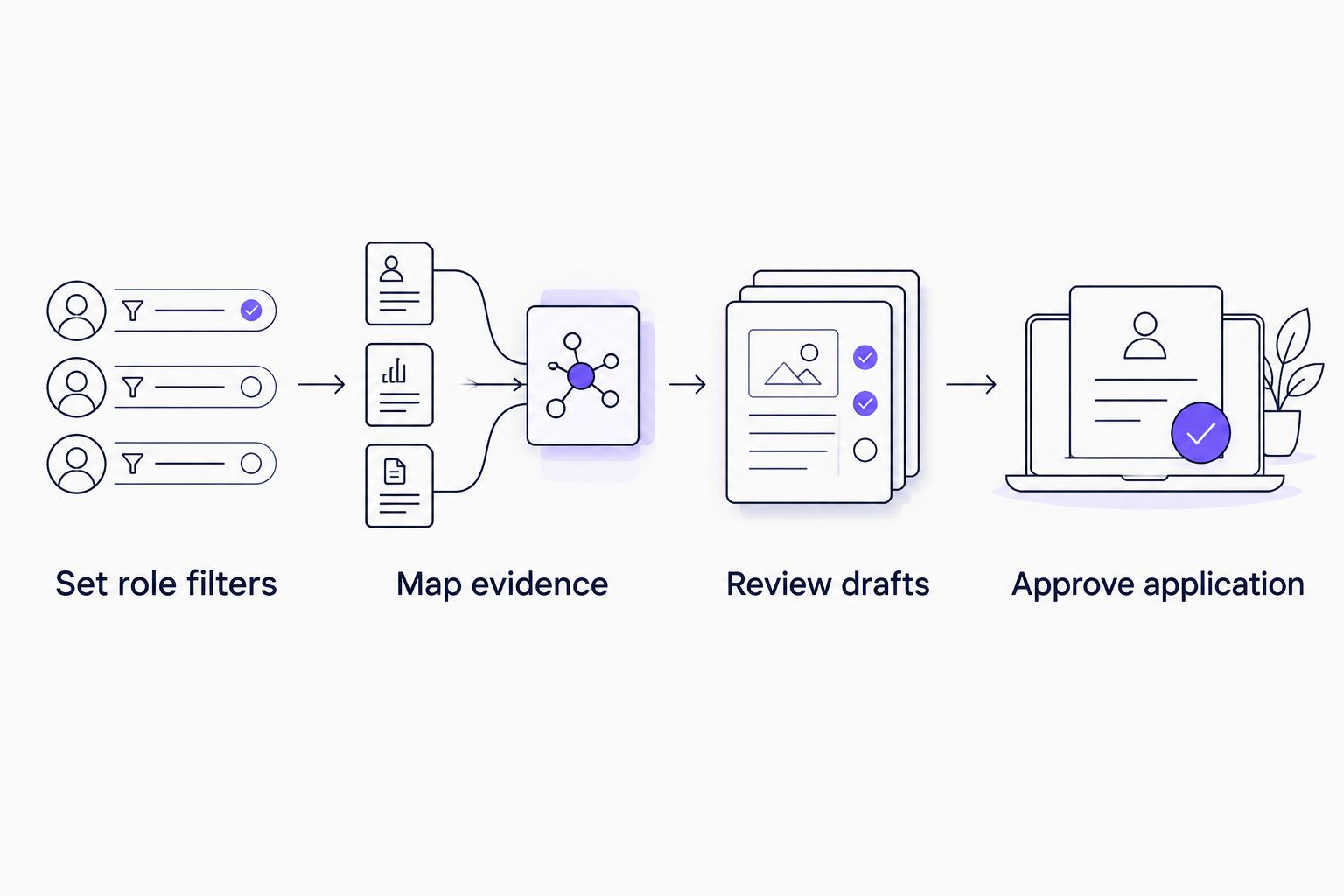
Set role filters
Write down 3 role filters: specialization, seniority, and location constraints. These are practical starting points, not a product setting requirement. Add other non-negotiables that matter to your search, such as work authorization or an on-call arrangement.
Use the vacancy's responsibilities to assess fit. A title alone does not tell you whether the work centers on frontend delivery, platform operations, data infrastructure, or something else. Reject mismatches before spending time tailoring documents.
Map evidence
For each important requirement, identify an example you can explain. Record the system or project, what you personally did, and the result you can substantiate. If a result has no verified measurement, describe the outcome without inventing a percentage.
Keep a distinction between professional work, personal projects, and study. All can provide useful evidence, but they should not be presented as interchangeable experience. A clear boundary makes the application easier to defend later.
Review drafts
Use 2 review passes: factual accuracy first, relevance second. The factual pass checks dates, technologies, scope, ownership, and results. The relevance pass checks whether the document gives appropriate space to the experience the role actually requires.
Keep the original résumé beside the tailored version. Compare changed verbs as carefully as changed nouns: supported, implemented, designed, and led describe different responsibilities. Correct an exaggerated verb even when the rest of the sentence is accurate.
Approve application
Keep 1 final approval decision after reviewing the prepared materials and the employer's requirements. Check the résumé, cover letter, and any application answers together so they do not contradict one another.
Application preparation is not proof of submission. Complete the employer's required submission steps yourself and check the confirmation provided by that employer. Do not infer success from a finished draft.
Protect your technical evidence
A job-search assistant does not need your employer's confidential repository to help explain your work. Describe the problem, constraints, your contribution, and the outcome in terms you are permitted to share. Remove credentials, customer records, internal URLs, and restricted implementation details.
For code-based interview practice, use a public example, a self-contained exercise, or code you have permission to share. Reproducing the structure of a problem is different from copying proprietary implementation details. Keep that distinction intact when preparing prompts.
Before uploading application documents, review the service's current data-handling terms and available controls. Apply the same rule throughout your 2026 search: provide what the task needs, not your entire professional archive.
How the tools were ranked
The ranking uses workflow fit: application preparation first, interview rehearsal second, and document comparison third. That order gives an undecided reader a starting point; it does not mean every software engineer needs the first option.
The criteria are role fit, evidence fidelity, review control, technical usefulness, task coverage, and data restraint. General-purpose assistants earn a place for bounded conversational tasks, not because they are interchangeable with a job-search agent.
No interview-rate lift, hiring outcome, or measured accuracy advantage is claimed here. For 2026, choose by the task you can evaluate directly: whether a suggested role fits, a draft stays truthful, or a practice session exposes an explanation you need to improve.
Which tool should you choose?
Start with reviewed application preparation when finding relevant openings and preparing documents is slowing your search. Choose interview rehearsal when you already have suitable targets but struggle to explain your technical decisions. Choose document comparison when a particular application needs closer evidence review.
Do not buy overlapping tools just to feel better equipped. Complete a real application task with the option you choose, inspect the output, and decide whether it reduced work without reducing control. Keep the source résumé as your factual reference throughout.
FAQ
What's the best AI job search tool for software engineers in 2026?
Amazapply is the best fit here for matching openings and preparing tailored applications that you review and approve. Choose ChatGPT for interview rehearsal or Claude for comparing a résumé with a supplied job description.
Can an AI job-search tool guarantee interviews?
No tool can promise interviews or offers. You still need suitable roles, accurate evidence, and application materials you can defend.
Is ChatGPT better than a job-search agent?
ChatGPT is a better fit for conversational practice than for the coordinated matching and application-preparation workflow described here. Choose according to the task, not the familiarity of the name.
Can Claude check whether my résumé matches a software engineering job?
Claude can compare the résumé and job description you supply and identify apparent evidence gaps. You must verify its interpretation and reject additions that are not supported by your experience.
Should I let a tool submit applications without reviewing them?
Keep approval with yourself and review the complete application before submission. A prepared résumé or cover letter does not establish that every statement is correct or that the role fits.
How do I tailor a software engineer résumé without inventing experience?
Reorder and clarify verified experience to address the role's actual responsibilities. Preserve the difference between exposure, contribution, and ownership, and never add a technology merely because the vacancy mentions it.
Can I upload company code for interview practice?
Use only code you have permission to share. Public examples and self-contained exercises let you practice without exposing confidential repositories, credentials, or customer information.
One last thing
Before accepting a rewritten résumé bullet, say it aloud and explain the underlying work without looking at the draft. If you cannot describe your contribution, the wording needs correction—not another layer of polish.
For your 2026 search, keep this rule: tailoring changes the emphasis, not the facts. A narrower statement you can defend is a better application asset than an impressive claim you cannot.