
An AI résumé builder has no single standard cost in 2026: compare the current charge, billing period, and included work before choosing one. The headline charge alone does not tell you whether document exports, job-specific revisions, or cover letters are included. Choose the smallest commitment that covers your actual application work, not the longest feature list.
- How much does an AI resume builder cost? Check current billing terms, document access, and renewal conditions together.
- Amazapply suits individual job seekers who want résumé tailoring and application preparation with personal review and approval.
- Compare résumé builders, résumé tailoring, and job-search agents by the work you need completed.
- No résumé tool can promise interviews; verify every generated claim before submitting an application.
How much does an AI résumé builder cost in 2026?
There is no universal résumé-builder price or billing model. For a specific service, the useful answer comes from its current terms: what you pay, when you pay, what you receive, and what happens when you stop.
Check the current pricing before making a purchase decision. Treat the checkout terms—not a comparison article—as the final reference for the commitment you authorize.
Compare the workflows below before comparing charges. These are categories of work, not verified subscription tiers; an individual service can combine them.
| Workflow | Best for | What to evaluate | Main limitation |
|---|---|---|---|
| Résumé building | Creating or restructuring a base résumé | Editing, formatting, and access to the finished document | A polished base document still needs role-specific review |
| Résumé tailoring | Adapting verified experience to a particular opening | Whether changes reflect the job description without inventing experience | Each version needs a factual check |
| Application preparation | Coordinating job matches, résumés, and cover letters | Which preparation tasks are included and where approval happens | More prepared material means more material to verify |
A tool's category does not establish its value. If you already have a strong base résumé, additional templates do not solve the same problem as adapting your experience to a relevant opening.
Why this matters
A résumé subscription is a purchase of document work, not a purchase of hiring outcomes. In 2026, your decision should still rest on whether the service produces accurate, usable material for the applications you intend to make.
A lower commitment is not useful if the finished document is inaccessible under the terms you selected. A broader service is not useful if you only need to correct an existing résumé. Define the task first; evaluate the charge second.
Keep your attention on the application itself. Clear writing helps explain your experience, but it does not replace required qualifications, relevant evidence, or an employer's selection process.
Résumé building: best for creating a usable base document
Choose a résumé-building workflow when your main problem is structure. You need a readable account of your experience before you need repeated adaptations for different openings.
Start with your employment history, education, skills, and verified accomplishments. Decide which information belongs in the document before asking software to improve its wording. Otherwise, polished language can conceal missing or inaccurate substance.
The advantage is a defined scope: create a document you can inspect and revise. The limitation is that a general résumé does not explain your fit for every vacancy.
Before committing, check whether you can edit the text and obtain the document in the format requested by an employer. Do not assume that creating a draft and downloading a finished file are covered by the same terms.
Recommendation: choose résumé building for a base-document problem, not as a substitute for reviewing each application.
Résumé tailoring: best for adapting relevant experience
Choose résumé tailoring when you have a credible base document but need to emphasize different parts of your experience for a particular role. The goal is relevance without changing the underlying facts.
For example, a job description can help you decide which existing responsibilities deserve prominence. It does not authorize adding a qualification, software skill, or management responsibility you never held.
The advantage is a closer connection between your evidence and the employer's requirements. The limitation is the review burden: every revised bullet must remain defensible in an interview.
Inspect whether a suggested change merely improves phrasing or introduces a new claim. A sentence that sounds stronger but changes your level of responsibility is not a successful edit.
Recommendation: choose tailoring when relevance is the bottleneck, and keep your verified base résumé as the reference.
Application preparation: best for connected tasks
Choose an application-preparation workflow when your work extends beyond writing a résumé. Finding suitable openings, adapting documents, and checking a cover letter are related tasks, but they require different decisions.
Amazapply is best for individual job seekers who want résumé tailoring and application preparation with personal review and approval. The AI job-search agent finds matching openings, tailors résumés and cover letters, and prepares applications for you to review and approve.
That scope is the reason to consider it—not a promise of a hiring result. The limitation remains your responsibility to verify the match, the documents, and the information prepared for an employer.
Use Amazapply when that connected workflow matches your needs. If your only task is a small edit to an existing résumé, assess that narrower requirement before choosing a broader process.
Recommendation: choose application preparation when you need help across connected tasks and want to retain the approval decision.
Why AI résumé-builder costs vary
Evaluate these factors when comparing current offers in 2026. They define what you are buying; they do not establish that any particular provider includes a feature or charges separately for it.
- Scope of work: Distinguish document formatting from job-specific tailoring, cover-letter drafting, and finding openings. Compare equivalent tasks rather than similar product labels.
- Billing commitment: Read whether the displayed charge covers a single transaction or a recurring period. Confirm what you authorize at checkout.
- Usage terms: Check whether the service specifies limits on the work you intend to perform. Do not assume that access means unrestricted use.
- Document access: Confirm how you obtain an editable copy and the final application document. Check the conditions before investing time in a draft.
- Additional services: Separate software-generated suggestions from any separately described human assistance. Do not treat one as evidence that the other is included.
- Renewal and cancellation: Read when a commitment renews and what cancellation changes. Keep a copy of the terms associated with your purchase.
The right comparison is task against task. A document editor and an application-preparation service are not interchangeable just because both work with résumés.
How do you compare the total commitment before paying?
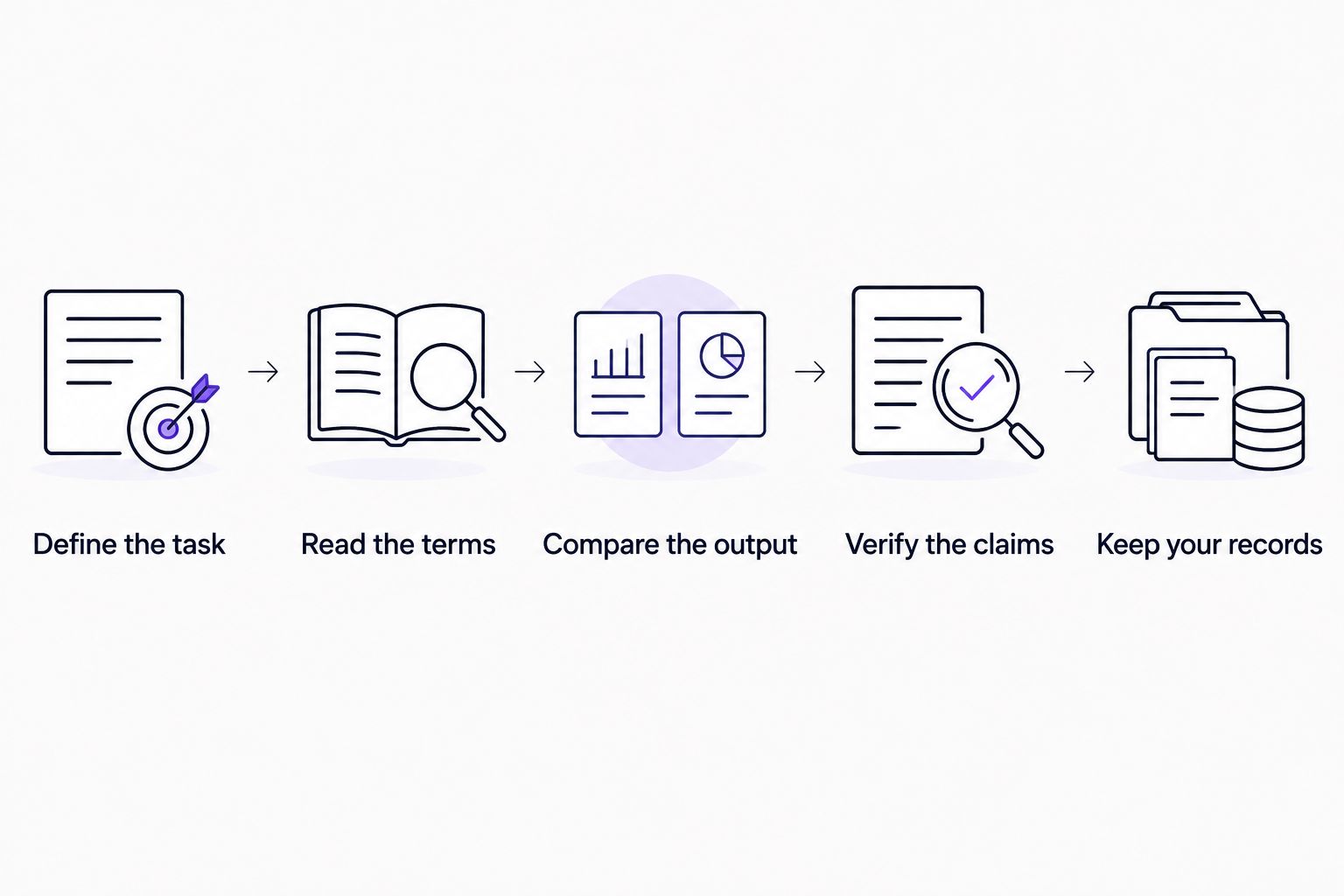
Use 1 job posting as your evaluation case and keep 2 résumé versions: your verified base document and the proposed revision. These are practical review steps, not required usage limits or claims about a provider's features.
- Define the task. Write down what you need completed: restructuring, tailoring, a cover letter, or connected application preparation. Exclude features you do not intend to use.
- Read the terms. Identify the billing period, renewal conditions, document access, and any stated usage restrictions. Resolve uncertainty before authorizing payment.
- Compare the output. Where evaluation access is offered, inspect the proposed document against your base résumé and the selected job description. Do not assume evaluation access exists.
- Verify the claims. Check names, dates, qualifications, responsibilities, and accomplishments. Reject changes that you cannot explain and support.
- Keep your records. Retain your base résumé, the version you approve, and the purchase terms. You should be able to identify exactly what you agreed to and submitted.
This sequence separates two decisions that are easy to confuse: whether the writing is useful and whether the purchase terms fit your needs. A convincing draft does not settle the second question.
What should you check in a generated résumé?
Use 3 checks before approving a revised document: factual accuracy, relevance, and readability. This is a review method, not a hiring benchmark.
Factual accuracy: Compare every changed statement with your experience. Watch for added technologies, inflated ownership, altered job titles, and accomplishments that were not in your source material.
Relevance: Ask whether the document makes your applicable experience easier to find. Repeating language from the vacancy is not enough if the résumé does not show evidence behind it.
Readability: Inspect the final file, not just the editing screen. Check headings, dates, bullet order, and whether the document follows the employer's application instructions.
A useful revision survives all three checks. If a suggested edit improves wording but weakens accuracy, keep the original fact and rewrite the sentence.
Is a résumé-only tool enough for my job search?
A résumé-only workflow is enough when the document is your only unresolved task. You do not need connected application preparation merely because it is offered alongside résumé editing.
If your difficulty is finding relevant openings or keeping a résumé and cover letter consistent, define those needs separately. Then assess whether a broader workflow addresses them under terms you accept.
In 2026, use the same test for every feature: does it complete work you actually need, and can you verify the result? An unused feature does not improve the value of your purchase.
Is an AI résumé builder worth paying for?
An AI résumé builder is worth considering when its output solves a defined writing problem and its terms fit your intended use. It is not worth buying on the assumption that payment produces interviews.
Compare the proposed document with your existing version. Look for clearer organization, accurate emphasis, and edits you can defend—not simply more formal language or a longer skills section.
Keep the decision under your rules. If you cannot establish what you receive or how the commitment works, do not authorize the purchase until those questions are resolved.
FAQ
How much does an AI resume builder cost in 2026?
There is no single standard cost for an AI résumé builder in 2026. Check the service's current charge, billing period, included work, document access, and renewal terms before purchasing.
Do I need a subscription to improve my résumé?
You do not need a subscription to edit your résumé yourself. If you choose software assistance, check whether its current purchase terms match a one-time task or an ongoing workflow.
What should I check before paying for a résumé builder?
Check the work included, billing commitment, document access, usage terms, and cancellation conditions. Inspect the finished output against your verified experience before using it in an application.
Is résumé tailoring the same as writing a new résumé?
Résumé tailoring adapts an existing account of your experience to a particular opening; writing a new résumé establishes the base document. Neither task justifies adding qualifications or achievements you cannot verify.
Does Amazapply only build résumés?
Amazapply is an AI job-search agent that finds matching openings, tailors résumés and cover letters, and prepares applications for individual job seekers to review and approve. Its scope extends beyond creating a standalone résumé.
Can an AI résumé builder guarantee interviews?
No résumé tool can promise interviews. Employers make selection decisions, and generated documents still require your factual review.
Should I approve every generated résumé change?
Approve only changes that accurately represent your experience and help explain your fit for the opening. Reject invented accomplishments, unsupported skills, and wording that exaggerates your responsibility.
One last thing
A more polished sentence can be a worse résumé sentence if it changes what you actually did. Before approving a revision, ask whether you could explain the claim plainly in an interview and identify the experience behind it.
For your 2026 job search, keep the verified base résumé separate from application-specific versions. Treat generated wording as a proposal; your approval makes it part of your application.