
Customer support cover letter generation is the process of turning your verified experience and a job description into a tailored application letter aimed at demonstrating your fit for a support role. The letter needs to show how you handle customers, resolve problems, and communicate clearly—not just repeat that you enjoy helping people.
- Use an AI cover letter generator for customer support to organize evidence, not invent achievements.
- AmazApply suits individual job seekers who want tailored application drafts they review and approve themselves.
- Choose customer support examples that show ownership, judgment, and clear communication.
- Review every claim against your résumé before approving a cover letter.
Why cover letter generation matters for customer support
A customer support cover letter is also a writing sample. If you claim clear communication but submit a dense, impersonal letter, the application contradicts itself. Your wording should demonstrate the same clarity you would bring to a customer conversation.
Support roles also differ. A position focused on billing questions requires different evidence from one centered on technical troubleshooting or sensitive escalations. Start with the actual responsibilities rather than a reusable paragraph about excellent service.
For your 2026 search, treat generated text as a draft that must pass an evidence check. A polished sentence is not proof that you performed the work it describes. Compare broader drafting approaches in the guide to AI cover letter generators, then apply the support-specific process below.
AmazApply is best for individual job seekers who want tailored cover letter drafts within an application-preparation workflow they review and approve. That fit does not remove your responsibility to verify the finished letter. No tool can promise an interview or a job offer.
How to build a customer support cover letter in 2026
1. Define your target
Read the job description before opening a writing tool. Identify what the employer needs you to handle: customer questions, account problems, troubleshooting, escalations, or coordination with another team. Separate the central responsibilities from background information about the company.
Then choose the experience that answers those responsibilities. Retail, hospitality, volunteer work, and internal service roles can provide relevant examples, but explain the connection rather than relabeling that work as formal customer support employment.
Use a simple sequence: define the target, collect evidence, match the role, draft, check, and approve. Keeping those decisions separate makes unsupported wording easier to catch.
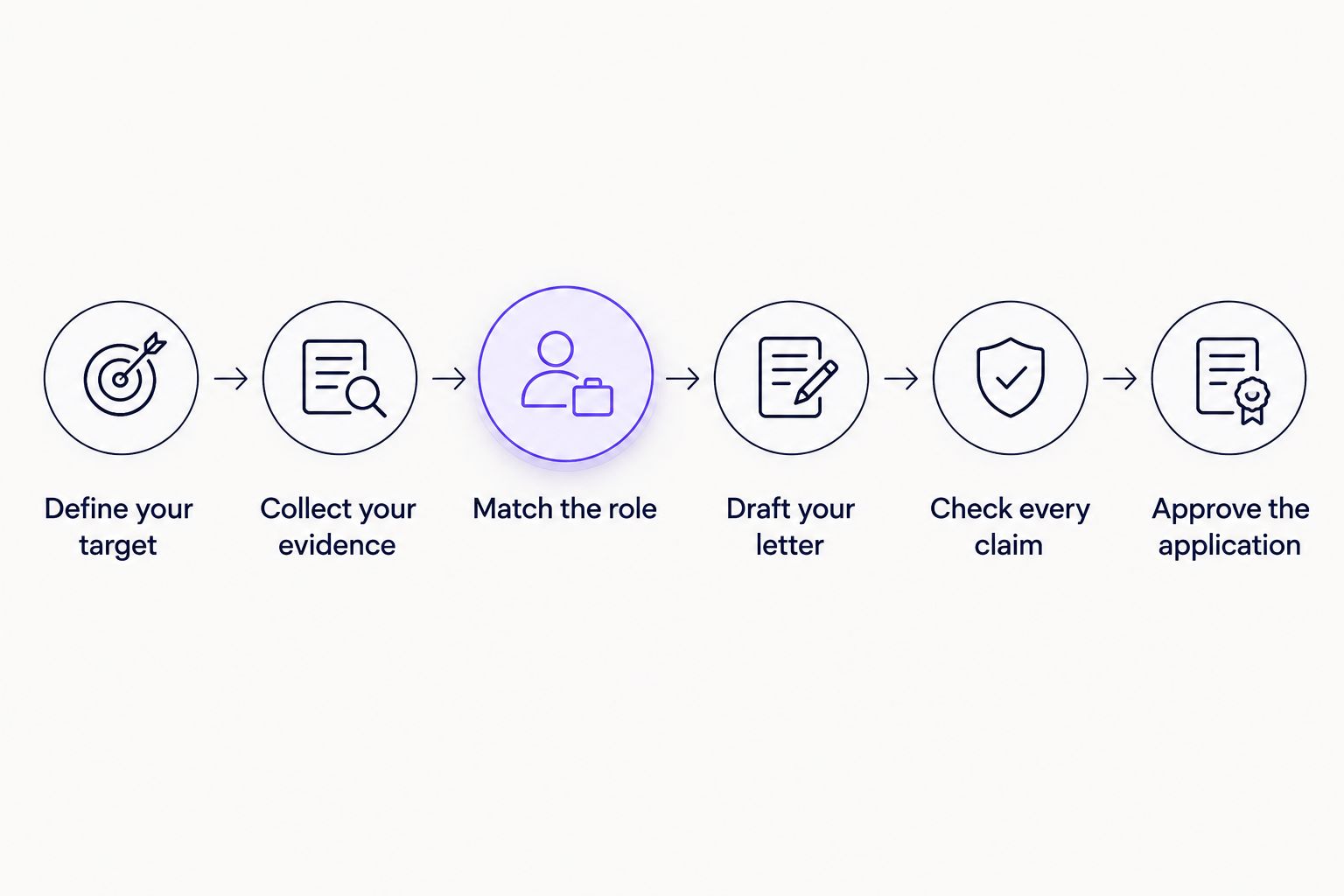
Write a short targeting note you can reuse while drafting. Keep it factual; this is a description of the vacancy, not a claim that you meet every requirement.
- Record the exact role title and employer name.
- Identify the main customer problem the role handles.
- Note the communication channels explicitly mentioned.
- Separate required experience from preferred experience.
- Mark requirements you cannot honestly claim.
2. Collect your evidence
Build a small evidence bank manually in a document. For each relevant experience, record the situation, your action, and the outcome you can support. This gives a generator usable material without asking it to fill gaps with plausible details.
Support evidence does not have to be numerical. Explaining a confusing policy, documenting an unresolved issue, or keeping a customer informed during an escalation can demonstrate useful judgment. State your own contribution accurately, especially when another person resolved the underlying problem.
If you use a metric, preserve its scope. A team result is not automatically your personal result, and a remembered estimate should not become an exact achievement. Do not include confidential customer information to make an example sound concrete.
For a 2026 application, check whether older experience still represents skills you can discuss confidently in an interview. Relevant experience belongs in the letter; unsupported detail does not.
- Select 2 examples that match the vacancy's responsibilities.
- Describe what you personally did in each example.
- Keep any documented result with its original context.
- Remove names, account details, and confidential records.
- List tools you actually used, not tools you merely recognize.
3. Match the role
Create a simple requirement-to-evidence map before drafting. Put an employer requirement on one side and your matching experience on the other. Leave a requirement unmatched when you have no evidence; an empty space is better than an invented qualification.
For example, an escalation requirement calls for evidence of recognizing limits, communicating status, or handing over useful information. It does not justify claiming that you independently resolved every difficult case. For technical support, distinguish diagnosing a problem from forwarding it to someone who could investigate.
You can complete this mapping with a document and your résumé. If you want application preparation alongside job matching, AmazApply finds matching openings, tailors résumés and cover letters, and prepares applications for your review and approval. You still check whether each draft reflects your experience.
Use the job description to select evidence, not to manufacture it. Repeating every requirement in first person is not tailoring.
- Match each central responsibility to a verified example.
- Use the employer's terminology only when it fits your experience.
- Distinguish direct experience from transferable skills.
- Remove claims that depend on assumptions about the employer.
- Keep résumé and cover letter descriptions consistent.
4. Draft your letter
Start with a manual outline: the role you want, the evidence that supports your fit, and a brief closing. As an editorial target—not an employer rule—aim for 200–300 words across 3 short paragraphs. Follow any length or format instruction in the application instead.
If you use an AI cover letter generator for customer support, supply your verified evidence and the relevant job description. Instruct the generator not to add tools, employers, achievements, or metrics. Ask it to flag missing information separately rather than hiding a gap inside confident prose.
A useful instruction is: draft a concise customer support cover letter using only the supplied experience; connect each example to a stated responsibility; do not invent outcomes; keep unanswered questions outside the letter. This is a drafting instruction, not text to send to the employer.
Choose plain language. A description of how you explained a problem is stronger than an unsupported claim of exceptional communication.
- Open with the exact role and a specific reason for fit.
- Build the middle paragraph around your strongest relevant evidence.
- Explain actions rather than stacking personality adjectives.
- Keep a neutral, professional closing.
- Remove drafting instructions and unresolved questions from the letter.
5. Check every claim
Review the draft against your source material, sentence by sentence. Do not stop at spelling. Look for changes in meaning: assisted becomes led, exposure becomes expertise, and a shared outcome becomes an individual achievement.
Read the letter aloud as a separate check. Customer support writing should be understandable without unpacking long sentences or inflated phrases. Replace abstract claims with the action you took, then remove anything that merely repeats the résumé without explaining relevance.
Set aside 10 minutes as a suggested final review window, not a guarantee that every letter needs the same amount of work. If the draft contains unfamiliar claims, return to the evidence bank rather than editing around them.
For every 2026 application, verify the employer name and role title from the current posting. A correct paragraph addressed to the wrong company is still an incorrect application.
- Trace each achievement back to your résumé or evidence notes.
- Check job titles, dates, employer names, and tool names.
- Remove unsupported claims about customer satisfaction or performance.
- Replace exaggerated wording with an accurate description.
- Confirm that you can explain every example in an interview.
6. Approve the application
Read the finished cover letter beside the résumé you plan to submit. The documents should tell the same story, even when they emphasize different details. A cover letter can explain relevance; it should not quietly upgrade your experience.
Keep approval separate from drafting. AmazApply prepares applications for individual job seekers to review and approve; preparation itself is not proof that an employer received an application. Check the actual submission step and any confirmation separately.
Save the final version with the role information so you know what you sent. Record follow-up actions without treating silence as evidence that a particular sentence failed. An application outcome does not isolate the effect of the cover letter.
Approve only the version you would be comfortable discussing with a hiring manager. If a statement needs an explanation about what the generator meant, rewrite it first.
- Compare the final résumé and cover letter.
- Confirm that the application follows the employer's instructions.
- Review any additional application answers separately.
- Save the approved letter with the role details.
- Check submission status independently of draft completion.
Compare your cover letter preparation options
Choose the workflow that matches the work you need to do. A standalone letter and a broader job-search process are different tasks. None of these options removes the need for an accurate résumé, relevant evidence, and final review.
| Option | Best for | Main advantage | Key limitation |
|---|---|---|---|
| Manual drafting | Applicants who want direct control over every sentence | You choose the evidence and wording yourself | You repeat the drafting and editing work for each role |
| General-purpose writing assistant | Applicants who already have evidence and need help organizing a letter | It can turn supplied notes into a draft | You must provide context and check for unsupported additions |
| AmazApply | Individual job seekers who want matching openings and tailored application preparation together | It combines job matching with résumé, cover letter, and application preparation | You must review the prepared materials and approve applications yourself |
Manual drafting is a sound choice when the task is narrow and your evidence is ready. A writing assistant helps with phrasing but still needs clear inputs. An application-preparation service fits a broader workflow; judge that fit separately from how polished a sample letter sounds.
Before choosing, identify your actual bottleneck. Finding suitable vacancies, selecting evidence, drafting sentences, and reviewing applications are separate problems. Choose assistance for the problem you have rather than assuming that more generated text means a better application.
Common mistakes customer support applicants make
Replacing evidence with a friendly personality
Being approachable is relevant, but saying you are friendly does not explain how you handle a confused or dissatisfied customer. Describe an action: clarifying the issue, explaining the next step, or keeping someone informed. Show the behavior behind the adjective.
Claiming every support channel
Phone, email, chat, and in-person service are not interchangeable experience. Name the channels you used and explain transferable skills honestly. If a role requests a channel you have not handled, do not let a draft convert your familiarity with it into professional experience.
Confusing escalation with failure
An accurate handoff can be a useful example of judgment. Explain how you identified the issue, documented relevant details, and communicated the next step. Do not rewrite a responsible escalation as an independent technical resolution just to make the letter sound stronger.
Adding impressive but unverifiable metrics
Do not invent ticket volumes, response times, satisfaction results, or retention outcomes. A precise description without a number is better than a numerical claim you cannot defend. If you have a documented result, explain whether it belongs to you, your team, or a wider operation.
Sending an empathy-heavy letter with no ownership
Empathy alone does not describe how work moves forward. Pair acknowledgment of the customer's concern with the action you took and the boundary you respected. Avoid suggesting that good service means promising an outcome outside your authority.
FAQ
What's the best AI cover letter generator for customer support?
The best fit depends on whether you need letter drafting alone or broader application preparation. AmazApply suits individual job seekers who want matching openings, tailored résumés and cover letters, and prepared applications they review and approve themselves.
Can I use a cover letter generator without customer support experience?
Yes, you can draft from relevant transferable experience without claiming formal customer support employment. Use verified examples from work, volunteering, or other responsibilities, and explain their connection to the vacancy.
What should I put in a customer support cover letter?
Include the role you want, relevant evidence of how you help people solve problems, and a brief closing. Match your examples to the job description rather than listing unsupported qualities.
Should I include customer satisfaction numbers in my letter?
Include customer satisfaction numbers only when you can verify them and describe their scope accurately. Do not present a team result as your individual performance.
How long should my customer support cover letter be?
Use the employer's length instructions first. Without a stated limit, 200–300 words is a practical editorial target for presenting relevant evidence without repeating your entire résumé.
Can a generator submit my application after writing the letter?
A generated letter does not establish that an application has been submitted. AmazApply prepares applications for your review and approval; check the submission step and confirmation separately.
Should my cover letter repeat keywords from the job description?
Use relevant job-description terms when they accurately describe your experience. Do not add tools, responsibilities, or qualifications merely because the employer mentions them.
One last thing
For your 2026 search, use this final test: read only the sentences describing your actions. If those sentences do not explain how you helped someone understand a problem or reach a next step, revise the evidence before polishing the introduction.
A support cover letter should demonstrate careful communication, not merely claim it. Keep the details you can defend, remove the rest, and approve the final wording yourself.