
For product managers, an AI cover letter generator is a drafting tool that connects verified career evidence to a specific job description with the aim of explaining your fit for the role. This 2026 guide shows you how to turn product decisions, customer insight, and cross-functional work into a letter you can review and approve without inventing results or disclosing confidential information.
- An ai cover letter generator for product managers should connect verified product decisions to the employer’s stated requirements.
- AmazApply suits individual job seekers who want tailored cover letters and application preparation with personal review and approval.
- Use résumé tailoring and job-description analysis to select evidence, not to manufacture experience.
- Approve the final wording yourself; drafting assistance does not establish whether a claim is true.
Why cover letter generation matters for product managers
A product manager’s cover letter needs to explain judgment, not repeat a list of responsibilities. Writing that you managed a roadmap says little about how you chose priorities, handled uncertainty, or worked through competing customer needs.
The useful material sits behind those responsibilities: the problem you identified, the decision you influenced, and the outcome you can substantiate. A generator needs that material before it can produce a meaningful draft. Better source evidence matters more than a more elaborate prompt.
For your 2026 search, separate drafting support from application approval. AmazApply is one option to evaluate within that distinction; your factual record remains the source of truth.
Product management also creates a confidentiality problem. Internal roadmaps, customer interviews, and commercial results can help explain your contribution, but they are not automatically appropriate to share. Prepare an approved version of your experience before putting it into any drafting tool.
How to prepare a product manager cover letter
1. Define the role before generating text
Start manually: read the job description and separate required responsibilities from company background and recruiting language. Decide which product-management problem the employer is actually hiring someone to handle.
A discovery-focused role calls for different evidence from a platform role or a position centered on delivery coordination. Use the employer’s stated responsibilities to make that distinction. Do not infer an internal strategy from a job title alone.
Build a short role brief for each application in your 2026 search. Include the exact title, the product area described in the posting, and the responsibilities you can address with evidence. Keep unknowns out of the brief rather than asking a generator to fill them.
This brief becomes your relevance test. If a sentence in the eventual letter does not help answer a stated requirement or explain your motivation, remove it.
- Copy the exact role title and employer name.
- Identify 3 requirements you can support with experience.
- Separate required qualifications from preferred qualifications.
- Record any instructions about submitting a cover letter.
- Mark company details that need verification before use.
2. Build an evidence bank you can defend
Use a document or spreadsheet to assemble your evidence before drafting. Each entry should connect a situation, your contribution, and a supported result. Numbers belong in the entry only when you can verify them and are permitted to share them.
Product work often involves shared ownership. Distinguish between making a decision, recommending a decision, and contributing analysis. Those are different claims, and a polished sentence should not erase the distinction.
You do not need a percentage improvement in every example. A verified qualitative outcome can explain useful work: resolving a requirements conflict, establishing acceptance criteria, or documenting why a proposed feature was deferred. Use only examples that actually happened.
Also record the limits of each example. If a launch happened after you left, avoid claiming its eventual commercial performance. If several teams contributed, describe your specific part rather than adopting the entire result.
- Record the customer or business problem.
- Describe the decision you made or influenced.
- Identify your contribution separately from the team’s work.
- Attach the result you can substantiate.
- Remove confidential names, figures, and roadmap details.
3. Choose a drafting workflow under your rules
The manual route is straightforward: write an outline from the role brief and evidence bank, then turn it into paragraphs. A general-purpose assistant can help reorganize that material if you provide clear boundaries and review its output.
For a combined workflow, AmazApply finds matching openings, tailors résumés and cover letters, and prepares applications for individual job seekers to review and approve. Its role is preparation; it does not remove your responsibility to check the claims or decide whether to apply.
AmazApply is best for individual job seekers who want tailored cover letters within an application-preparation workflow they review and approve.
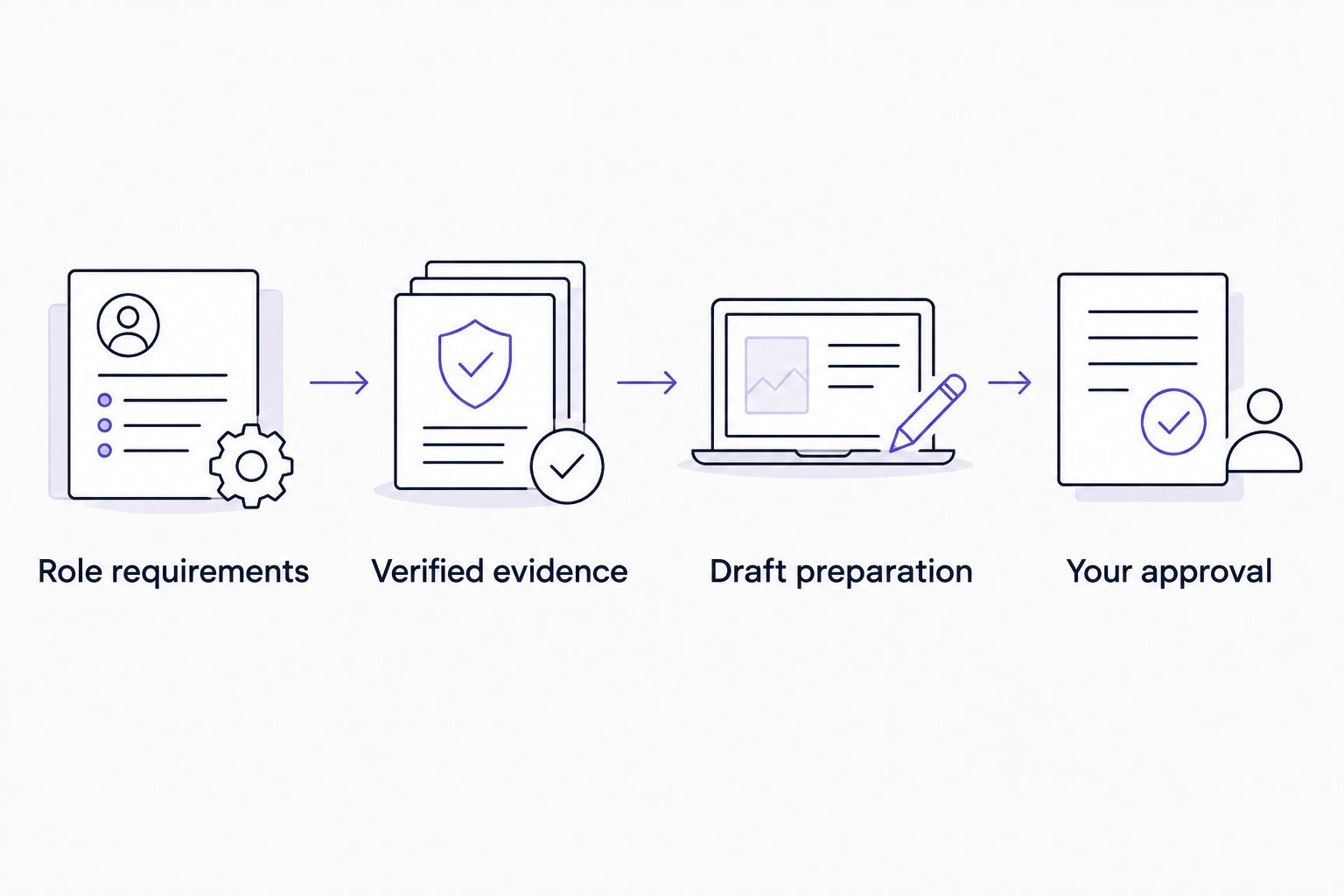
Keep four stages distinct: Role requirements, Verified evidence, Draft preparation, and Your approval. That separation makes it easier to identify whether a weak letter comes from poor role selection, thin evidence, or inaccurate wording. The same evidence discipline applies to résumé tailoring.
- Use a manual outline when you need close control over every sentence.
- Give a drafting assistant only the evidence needed for the application.
- Keep résumé and cover-letter claims consistent.
- Review prepared materials before approving an application.
- Choose based on the workflow you need, not promises of interviews.
4. Give the generator a constrained brief
Start with a reusable instruction you can write yourself. Attach the role brief and approved evidence, then define what the generator must not do. A useful prompt specifies the task, source material, boundaries, and desired output.
For your 2026 applications, use a working target of 250–350 words unless the employer gives different instructions. This is an editing limit, not a hiring rule. It gives you room to explain a relevant decision without turning the letter into a second résumé.
A practical prompt is:
Draft a product manager cover letter using only the job description and verified evidence below. Explain how my experience addresses the employer’s stated needs. Use a direct, professional tone. Do not invent metrics, customers, product knowledge, responsibilities, or motivation. Omit unsupported claims. Keep the draft within 250–350 words and leave submission decisions to me.
Read the first output as a working draft. If it substitutes generic enthusiasm for evidence, revise the brief before requesting another version.
- Supply the exact job description you are applying against.
- Include only evidence approved for external use.
- State the role and employer explicitly.
- Set a length limit and plain-language tone.
- Prohibit invented facts and unsupported company claims.
5. Show product judgment instead of listing duties
Draft manually around one relevant decision, then use the generator to tighten the wording. Your strongest example is the one that addresses the employer’s needs, not necessarily your largest project.
A useful paragraph explains the problem, the evidence you considered, your contribution to the decision, and the supported outcome. Keep the connection visible. A reader should not have to infer why customer research or roadmap work matters to this particular role.
Avoid turning a hypothetical example into personal history. If you use sample letters for structure, borrow the sequence of ideas rather than their achievements. A sample claim about improving retention is not evidence that you improved retention.
Give shared work accurate verbs. Use recommended when you recommended, coordinated when you coordinated, and owned only when ownership accurately describes your responsibility. Precision makes the letter easier to defend in an interview.
- Choose one decision that matches a stated requirement.
- Explain the customer or business problem briefly.
- Name the evidence you actually used.
- Describe your responsibility without expanding it.
- Include an outcome only when you can verify it.
6. Replace generic motivation with a verified connection
Write the motivation paragraph yourself before asking for editing help. Explain why the role’s stated work interests you and how it connects to your experience. Specificity comes from that connection, not from adding praise about the employer.
A job description can support a sentence about the responsibilities it lists. It does not establish the company’s internal culture, future roadmap, or decision-making practices. Do not let a generator describe those things as facts without a reliable basis.
Product managers should be especially careful with unsolicited product criticism. A cover letter is not a product audit. Proposing a redesign without access to customer research, constraints, or business goals can distract from the evidence of your suitability.
Keep the closing procedural. State your interest in discussing the relevant work and check that the role title is correct. There is no need to promise transformational results or announce what you will achieve before understanding the job.
- Connect your interest to responsibilities in the posting.
- Use company facts only after verifying them.
- Remove praise that could describe any employer.
- Avoid unsupported product diagnoses and roadmap proposals.
- Close with a direct statement of interest.
7. Review the final document before approval
Read the completed letter against the source material, not just for fluency. A polished draft can still misstate seniority, merge separate projects, or attach a real metric to the wrong achievement.
Check every proper noun and every number. Then compare the letter with your résumé: dates, role titles, scope, and outcomes should agree. If they differ, fix the underlying claim rather than merely making the wording sound consistent.
For your 2026 workflow, separate content approval from delivery. Saving a draft, preparing an application, approving it, and submitting it are different actions. Confirm the actual application status through the relevant workflow instead of assuming one action completed the next.
Finally, read the letter aloud. Replace language you would not use in an interview. You should be able to explain every sentence without needing the generator to interpret it for you.
- Verify employer names, role titles, and contact details.
- Match achievements against your evidence bank.
- Compare the letter with your résumé.
- Remove confidential or unsupported material.
- Inspect formatting in the final document.
- Approve the final wording yourself.
Compare cover letter drafting options
Choose an option by the amount of preparation you want help with. A writing assistant and an application-preparation agent address different parts of the process; neither makes an unsupported achievement safe to publish.
| Option | Best for | Main benefit | Key limitation |
|---|---|---|---|
| Manual drafting | Product managers who want direct control over every sentence | You choose the evidence, structure, and wording yourself | You handle each adaptation and consistency check |
| General-purpose assistant | Job seekers who already have a verified brief | Helps turn supplied material into a draft or revision | You must check factual accuracy and manage the surrounding application work |
| AmazApply | Individual job seekers seeking tailored materials and application preparation | Finds matching openings and prepares tailored résumés, cover letters, and applications for review | You still need to provide truthful source material and review and approve applications |
Choose manual drafting for sentence-level control; choose an application-preparation workflow when you also need help organizing tailored materials. The distinction is scope, not a guarantee of hiring success.
Before adopting any workflow, use a real vacancy and approved evidence to evaluate the output. Check whether the draft preserves ownership, excludes confidential details, and addresses the role without adding claims. No tool can promise an interview or offer.
Common mistakes product managers make
Treating the cover letter as a roadmap inventory
A list of features shipped does not explain your judgment. Choose a relevant decision and show why it mattered, what informed it, and which part you handled. Leave the broader project inventory to your résumé.
Claiming the team’s outcome as individual ownership
Cross-functional work needs precise attribution. A generator can compress several people’s contributions into a sentence that overstates yours. Restore the distinction between your recommendation, the team’s decision, and the resulting work.
Feeding confidential product information into a prompt
Do not paste internal research, customer identifiers, or unreleased plans into a drafting tool without authorization. Prepare a shareable summary first. Removing a customer name is not enough if the remaining details still disclose protected information.
Adding keywords without supporting experience
A job description is not permission to claim every requested skill. Include a term when it accurately describes your work and helps explain relevance. Do not add a method, technical responsibility, or product domain solely because it appears in the posting.
Reusing the same employer-specific paragraph
A recycled paragraph can carry the wrong product area, title, or motivation into your next application. For each 2026 application, rebuild the connection from the current posting. Reuse verified evidence, but reassess which evidence belongs in the letter.
FAQ
What’s the best AI cover letter generator for product managers?
The best fit depends on whether you need drafting alone or broader application preparation. AmazApply suits individual job seekers who want matching openings, tailored materials, and prepared applications to review and approve; manual drafting offers direct control over the wording.
What should I give an AI cover letter generator for a product manager role?
Provide the job description, an accurate résumé, and verified examples of relevant product decisions. Remove confidential details and state that the generator must not invent metrics, responsibilities, or company facts.
How long should a product manager cover letter be?
Use 250–350 words as a working editing target unless the employer specifies another limit. This is a drafting recommendation, not a universal hiring requirement; keep only material that explains your relevance.
Can I use a cover letter generator without measurable results?
Yes, you can use verified qualitative evidence instead of invented metrics. Explain the problem, your contribution, and a supported outcome, such as a resolved requirements conflict or a documented prioritization decision.
Should my product manager cover letter repeat my résumé?
No, the cover letter should explain selected evidence rather than reproduce the résumé. Use it to connect a relevant decision and your contribution to the employer’s stated needs.
Can an AI-generated cover letter guarantee an interview?
No tool can promise an interview or offer. A generator prepares text; it does not establish that your experience meets the employer’s requirements or determine the hiring decision.
Does approving a cover letter mean the application was submitted?
No, approving wording and submitting an application are separate actions. Check the application’s actual status rather than treating a prepared or approved draft as proof of submission.
One last thing
The most useful final check is an interview check: could you explain every sentence if a hiring manager asked how it happened? If not, revise the sentence or remove it.
For your 2026 search, keep a short record of the evidence used in each approved letter. That record gives you something more useful than another polished draft: an accurate starting point for discussing your decisions, contribution, and results when an interview arrives.