
Data scientists’ AI resume tailoring is the use of language models to adapt verified career evidence to a specific job description, with the aim of making relevant qualifications easier to assess. Your resume must distinguish model development, experimentation, analytics, and production work without turning familiarity into claimed expertise.
- AI resume tailoring for data scientists works best when every technical claim traces to verified experience.
- Python and SQL keywords belong beside evidence of how you used them, not in an unsupported skills list.
- Match the role’s actual work: experimentation, analytics, model development, or production systems.
- Approve every draft yourself; stronger wording must never change your ownership, methods, or results.
Why AI resume tailoring matters for data scientists
Data science titles cover different work. A posting centered on experiment design needs different evidence from one centered on deploying prediction services. Tailoring makes that distinction visible; it does not manufacture the missing experience.
For your 2026 search, treat each job description as a specification to inspect rather than a list of words to copy. The best AI tools for resume tailoring guide provides a separate comparison when you are ready to evaluate software.
Your main constraint is technical accuracy. A polished bullet can still be wrong if it changes a retrospective analysis into a controlled experiment or describes a notebook model as a deployed service. The strongest tailored resume makes your actual contribution easier to understand without enlarging it.
Build a repeatable tailoring process
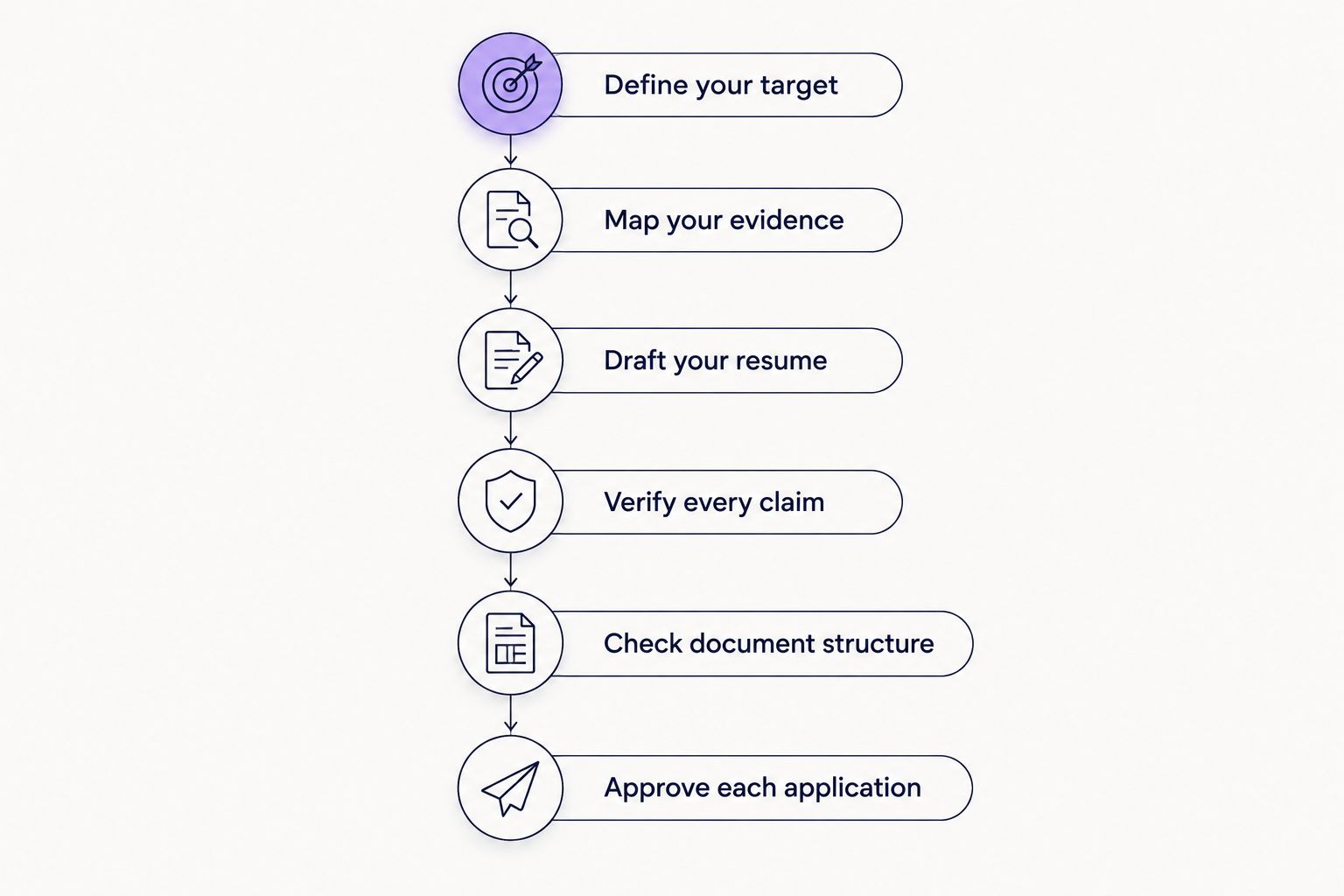
Start manually with the job description, your existing resume, and a plain document. Establish what is true before asking software to rewrite anything. The following process separates role selection, evidence, drafting, verification, formatting, and approval.
Define your target
Read the responsibilities before the qualifications. Identify what the employer expects you to produce: analyses that inform decisions, experimental findings, predictive models, or maintained systems. The title alone is not enough to choose the right resume emphasis.
Use a recommended 20-minute first pass to annotate the posting. This is a working time limit, not a claim about how long successful applications take. Separate essential requirements from preferences, and mark anything that needs clarification rather than silently treating it as a match.
Create a short target statement for your own use: the work you want, the evidence you have, and the constraints you cannot meet. Keep this statement outside the resume. It gives your drafting process boundaries and helps you reject unsuitable openings before spending time on wording.
Close the step with concrete decisions:
- Identify the main work: analytics, experimentation, modeling, or production.
- Separate required qualifications from preferred experience.
- Record location, work authorization, and other stated constraints.
- Flag requirements you cannot support with evidence.
Map your evidence
Build a private evidence bank before generating a tailored draft. For each relevant project, record the problem, data, method, your contribution, and the outcome you can substantiate. A spreadsheet works; no specialized software is required.
Distinguish your work from the team’s work. If you built features while another engineer deployed the service, preserve that boundary. If a result came from an offline evaluation, do not describe it as a measured business improvement.
Use a recommended 3-column evidence map: requirement, supporting experience, and gap. For example, an experiment-design requirement belongs beside an experiment you actually designed, not merely a dashboard that displayed experiment results. An empty evidence cell is useful information, not an invitation to invent a bridge.
For a 2026 application, prioritize relevance without changing historical facts. Older work can still support a requirement; it must retain its original dates and context.
Finish the evidence map before drafting:
- Record the business or research question behind each project.
- Name methods and tools you personally used.
- Separate individual ownership from shared delivery.
- Attach outcome definitions and supporting records where available.
- Mark confidential details that must stay out of prompts.
Draft your resume
Write a manual first draft by reordering relevant experience and replacing vague descriptions with supported details. Keep employers, dates, titles, and education unchanged. Tailoring should change emphasis, not your employment history.
AmazApply finds matching openings, tailors resumes and cover letters, and prepares applications for individual job seekers to review and approve. AmazApply is best for individual data scientists who want job matching and tailored application drafts they review and approve. That workflow supports preparation; it does not replace your technical judgment.
A general-purpose language model is another drafting option, but you must provide the role requirements and source material yourself. Give it explicit boundaries: use only supplied facts, identify unsupported requirements separately, and do not add metrics, libraries, or responsibilities.
Use a narrow instruction such as: Rewrite the selected bullets for this role using only the evidence below; preserve ownership and results; list unanswered questions separately. Ask for a proposed draft, not an asserted assessment of your qualifications.
Keep the drafting task bounded:
- Reorder bullets around the posting’s central responsibilities.
- Expand acronyms when the longer term improves clarity.
- Retain only skills you can explain in an interview.
- Keep unsupported requirements out of the resume.
- Save the original beside the tailored version.
Verify every claim
Compare the draft against your evidence bank line by line. Fluent language is not verification. Check verbs such as designed, led, deployed, owned, and improved because each changes what a reader understands about your contribution.
For machine-learning results, inspect the target, evaluation method, and scope. An offline metric does not establish a production benefit. A classification result also needs enough context to mean something; a bare score can hide the actual task and evaluation conditions.
Run a recommended 2-pass review: technical accuracy first, then ownership and outcomes. This separates checking whether the method is described correctly from checking whether the achievement belongs to you. Delete unsupported precision rather than replacing it with another estimate.
Apply the same standard to cover letters. A claim removed from your resume should not survive elsewhere in the application simply because it sounds persuasive.
Check the highest-risk changes:
- Confirm that tools and methods match your actual work.
- Preserve the distinction between prototypes and deployed systems.
- Verify every metric against its original definition.
- Correct verbs that overstate ownership or leadership.
- Remove causal claims unsupported by the project design.
Check document structure
Use clear headings and inspect the document as text before adding visual polish. Your goal is an understandable record of qualifications, not a layout that makes the reader reconstruct where a date or skill belongs.
Copy the resume into a plain-text document and check its reading order. This catches visible problems such as detached dates, missing text, or scrambled sections. It does not certify compatibility with every applicant tracking system, and no formatting check guarantees selection.
For your 2026 resume, follow the employer’s stated file instructions rather than assuming a particular format always wins. Keep contact details and important qualifications in ordinary document text, and inspect the exported file instead of trusting the editable version alone.
Read the opening section without the job description beside it. The intended role and your relevant evidence should make sense independently; keyword repetition cannot repair an unclear professional story.
Finish with practical document checks:
- Use recognizable headings for experience, skills, and education.
- Keep dates connected to the correct roles.
- Inspect copied text for missing or reordered content.
- Follow the application’s stated file requirements.
- Remove repetition that displaces useful evidence.
Approve each application
Read the final resume and application together before submission. A correct resume does not fix an incorrect answer about work authorization, location, experience, or availability. Keep those answers under your direct control.
AmazApply’s resume tailoring and application-preparation workflow is for individual review and approval. Use that boundary deliberately: compare the proposed materials with the actual opening, resolve uncertainties, and approve only what you understand. No tool can promise an interview or an offer.
Keep a simple application log with the employer, role, document version, submission date, and follow-up status. The log supports consistency when a recruiter refers to an earlier version or asks about a specific project. It also helps you spot duplicate applications before sending them.
Make the final decision yourself:
- Confirm that the opening still matches your stated constraints.
- Check every required application answer.
- Review the exact document attached to the application.
- Record which resume version you approved.
- Stop when an unresolved factual question remains.
The sequence matters: define the target before drafting, and verify the draft before approving it. A later formatting check cannot repair an unsupported claim introduced earlier.
Compare your tailoring options
Choose your 2026 workflow by the work you need help completing. Editing a single existing draft is different from finding openings and preparing multiple application documents. Choose the narrowest option that solves your actual preparation problem.
The comparison below describes workflow trade-offs, not measured hiring outcomes. Each option still requires you to verify the evidence and decide whether to apply.
| Option | Best for | Main advantage | Key limitation |
|---|---|---|---|
| Manual document editing | Data scientists handling a focused shortlist | Direct control over every wording change | You must compare requirements and maintain versions yourself |
| General-purpose language model | Applicants with organized source evidence | Produces alternative wording from supplied material | Requires explicit constraints and factual review |
| AmazApply | Individual job seekers wanting matching and application preparation | Connects matching openings with tailored resumes and cover letters for approval | You remain responsible for reviewing technical claims and approving applications |
Manual editing works well when your evidence is already organized and the target roles are closely related. Drafting software becomes useful when rewriting and document preparation are the bottleneck. Neither approach solves a genuine qualification gap.
Common mistakes data scientists make
Treating every data science role as the same job
A resume centered on model experimentation does not automatically explain readiness for analytics-heavy work. Change the evidence order to match the responsibilities. Do not relabel unrelated work just to mirror the job title.
Listing tools without explaining their use
A long skills section leaves the reader to infer depth. Connect relevant tools to a project, task, or deliverable you can discuss. Remove names added by a drafting tool when they do not reflect your experience.
Turning offline results into business outcomes
A better validation result is not proof of increased revenue or reduced operating costs. State the measured result at its actual scope. Claim a business outcome only when you have evidence connecting your work to that outcome.
Uploading confidential project material
Internal datasets, customer records, unpublished research, and private business metrics do not belong in a prompt without permission. Use a sanitized evidence summary and retain enough context to describe the work accurately.
FAQ
What is AI resume tailoring for data scientists?
AI resume tailoring for data scientists adapts verified career information to a specific job description. It changes emphasis and wording while preserving your actual skills, ownership, dates, and results.
What is the best way to tailor a data scientist resume in 2026?
Start by matching the job’s responsibilities to evidence from your own work. Draft from that evidence, verify technical claims, inspect the document, and approve the final application yourself.
Should I add every Python and SQL keyword from the job description?
No. Include Python, SQL, and other technical terms only when they accurately describe your experience. Place relevant terms beside evidence of their use rather than repeating them without context.
Can I include a project without a business impact metric?
Yes. Describe the problem, your contribution, the method, and the result you can verify. A precise account without a business metric is better than an invented commercial outcome.
Is AmazApply better than editing my resume manually?
AmazApply is suited to individual job seekers who want matching openings and tailored application materials to review and approve. Manual editing suits applicants who want direct control over each change and can manage matching and document preparation themselves.
Will an ATS-friendly resume guarantee an interview?
No. Clear structure and readable text do not guarantee selection or an interview. Employer requirements, your qualifications, and the hiring process still determine how an application is assessed.
How do I stop a resume tool from inventing experience?
Provide a bounded evidence bank and instruct the tool to use only supplied facts. Compare every generated claim with that evidence, and remove unsupported skills, metrics, responsibilities, or outcomes before approval.
One last thing
Keep the evidence behind a strong bullet, not just the bullet itself. During your 2026 search, preserve a private note explaining what you did, how the result was measured, and where your responsibility ended. That record helps you tailor accurately and explain the same work consistently in an interview.