
Best overall for application preparation: Amazapply. Best for a guided drafting conversation: ChatGPT. Best for revising your career-change narrative: Claude. Best for comparing alternative openings: Gemini. The best AI cover letter generator for career changers in 2026 is the one that connects your actual experience to the new role without inventing qualifications.
- Amazapply is the best fit for career changers who want cover letters prepared alongside tailored résumés and matching jobs.
- ChatGPT suits guided drafting; Claude suits narrative revision; Gemini suits comparing alternative openings.
- Choose the best AI cover letter generator for career changers by factual accuracy, transferable skills, and user control.
- Approve only language you can explain in an interview; no tool can promise interviews or job offers.
Why this matters
A career-change cover letter has a different job from a standard introduction. It must explain why experience from one field matters in another, without pretending that the transition has already happened.
Generic enthusiasm does not make that connection. A statement about being passionate about technology tells an employer less than a specific example of resolving customer problems, documenting recurring issues, or coordinating a difficult handoff.
Your strongest letter translates evidence; it does not manufacture experience. Treat generated text as a draft that needs your judgment, especially when the wording makes your responsibilities sound broader than they were.
For your 2026 search, choose a drafting process that makes unsupported claims easy to spot before the letter reaches an employer.
What makes the best generator for career changers?
Use these criteria before choosing an option:
- Factual discipline: The draft preserves your actual job titles, responsibilities, qualifications, and results. It flags missing evidence instead of filling gaps with plausible details.
- Transferable-skill mapping: The letter connects a requirement in the new role to something you have already done. Matching vocabulary alone is not enough.
- Transition clarity: The opening explains the move directly, without apologizing for your background or presenting aspiration as experience.
- Job-specific reasoning: The letter addresses the position you are applying for, rather than describing an employer or profession in general terms.
- Revision control: You can inspect the wording, reject assumptions, and approve the final document yourself.
- Application consistency: Your letter agrees with your résumé about dates, titles, responsibilities, and accomplishments.
For this 2026 comparison, the rankings reflect distinct drafting needs—not measured differences in interview results. Start with the work you need help completing, then choose the corresponding option.
Career-change cover letter generators at a glance
| Rank and option | Best for | Standout use | Key limitation |
|---|---|---|---|
| 1. Amazapply | Preparing a coordinated application | Matching jobs, tailored résumés, and cover letters within application preparation | Broader than a standalone letter editor; every application needs your review |
| 2. ChatGPT | Building a draft through questions | Turning supplied experience and job requirements into a conversational drafting task | You must supply the evidence and check generated claims |
| 3. Claude | Revising a career-change narrative | Reworking an existing explanation of your transition | Fluent editing does not establish whether a claim is true |
| 4. Gemini | Comparing alternative openings | Producing contrasting introductions from the same supplied facts | More versions create more material for you to evaluate |
The conversational tools overlap: each can draft and revise text. Their placements describe useful ways to approach the task, not exclusive capabilities or a claim that one consistently writes better letters.
1. Amazapply: best for coordinated application preparation
Amazapply is a job-search agent that finds matching openings, tailors résumés and cover letters, and prepares applications for individual job seekers to review and approve. It belongs first when your problem extends beyond writing an introductory letter.
For career changers, the useful connection is between the vacancy, the résumé, and the explanation of the transition. Review those documents together: a convincing letter should not claim experience that the résumé cannot support.
Amazapply is best for career changers who want cover letters prepared alongside tailored résumés and matching job openings.
Amazapply pros
- Covers job matching as well as application preparation.
- Includes both résumé and cover letter tailoring.
- Prepares applications for your review and approval.
- Fits a search where you need help with several connected tasks.
Amazapply cons
- Its scope exceeds what you need for a single paragraph rewrite.
- Prepared applications still require your factual review.
- Tailoring does not replace missing experience or qualifications.
Best for: Individual job seekers who want coordinated application preparation rather than a separate writing conversation for every document.
Before approving anything, compare the letter against the vacancy and your original résumé. Reject wording that upgrades participation into ownership, familiarity into expertise, or an interest into a qualification.
Verdict: Buy into the coordinated workflow when application preparation—not just prose—is the bottleneck.
2. ChatGPT: best for guided drafting through questions
ChatGPT can help you draft and revise a cover letter through a conversation. Supply the job description, relevant résumé material, and an explanation of why you are changing careers; then ask questions before requesting a finished letter.
This approach suits you when you cannot yet explain the connection between your old work and your target role. Use the conversation to identify evidence, not to obtain reassuring language about being an ideal candidate.
ChatGPT pros
- Supports a question-led drafting process.
- Can organize supplied experience around job requirements.
- Lets you request focused revisions to individual paragraphs.
- Can generate alternatives from the same factual brief.
ChatGPT cons
- A vague prompt leaves too much room for assumptions.
- You must maintain consistency between the conversation and your résumé.
- Confident wording still needs a claim-by-claim check.
Best for: Career changers who want to work through their story before settling on a draft.
Start by asking which requirements lack supporting evidence. Then answer those questions using actual work, study, volunteering, or personal projects, clearly labeled as such. Do not let the draft turn a personal project into paid professional experience.
Keep revisions narrow. Asking for a clearer explanation of one transferable skill gives you a more inspectable change than repeatedly asking for a more impressive letter.
Verdict: Buy into the question-led approach when you need help finding your argument before writing it.
3. Claude: best for revising your career-change narrative
Claude can revise an existing draft using the text and instructions you provide. Use it when your facts are settled but the letter sounds defensive, repetitive, or disconnected from the target position.
The useful task is structural editing: identify what the opening promises, which example supports that promise, and whether the closing adds anything. Ask for explanations of proposed changes so you can decide whether the revision still sounds like you.
Claude pros
- Can reorganize a supplied draft around a clearer argument.
- Supports focused changes to tone and wording.
- Can shorten repeated explanations of the career change.
- Lets you compare your original wording with a revision.
Claude cons
- Editing cannot resolve gaps in your underlying evidence.
- Polished language can obscure an unsupported claim.
- You still need to compare the result with the vacancy.
Best for: Applicants who already have a factual draft and need a clearer explanation of their transition.
Give the editor boundaries: retain the meaning, preserve the scope of each responsibility, and identify any sentence that needs more evidence. Ask it to remove apologies without replacing them with exaggerated confidence.
A good revision makes the connection easier to understand. It does not make your previous role sound like the new one through title changes or inflated terminology.
Verdict: Buy into the revision approach when your evidence is ready but your narrative needs work.
4. Gemini: best for comparing alternative openings
Gemini can generate different introductions from the same supplied facts. That makes it a useful option when you know what you want to say but are unsure where the letter should begin.
Ask for distinct approaches rather than minor wording variations. One opening can lead with a relevant accomplishment, another with your reason for changing fields, and another with the requirement you can already demonstrate.
Gemini pros
- Can produce contrasting openings from one factual brief.
- Supports revisions based on your chosen direction.
- Helps separate the question of structure from sentence polish.
Gemini cons
- Alternative wording does not provide additional evidence.
- Multiple drafts increase your review workload.
- An appealing opening can still fail to address the actual job.
Best for: Career changers with a settled evidence base who want to compare ways of introducing their application.
Judge each opening against the same question: does this give the employer a concrete reason to keep reading? Reject versions that lead with generic admiration or make your career change the entire subject of the letter.
Keep the strongest structure, then edit it yourself. Combining attractive sentences from every version often produces repetition instead of a coherent introduction.
Verdict: Buy into the comparison approach when choosing an opening is your main obstacle.
Prepare a factual brief before generating anything
For a 2026 application, build a small evidence brief before asking any tool for a letter. This keeps the drafting task grounded and gives you a reference for reviewing the result.
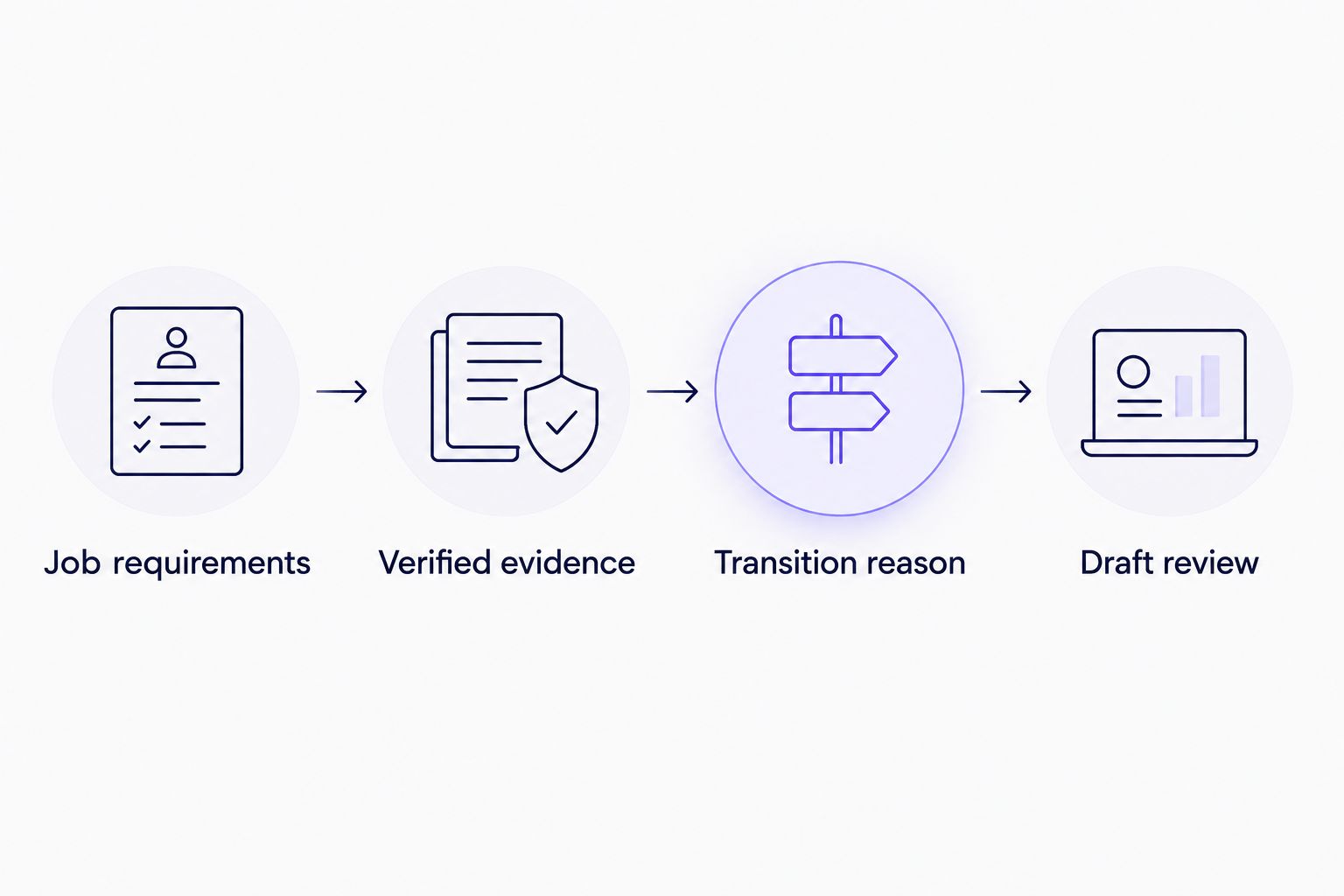
Job requirements
Copy the requirements that matter to the role. Separate responsibilities you can support from credentials or experience you do not possess; do not ask the generator to blur that distinction.
Verified evidence
Provide 2 concrete examples from your experience as a starting point. For each, describe the situation, your own action, and the result you can substantiate; include a number only when you have a reliable record of it.
Transition reason
Explain why you want the new work in plain language. Connect that reason to something you have done, learned, or deliberately pursued, rather than claiming a lifelong passion you cannot explain.
Draft review
Compare every generated claim with the brief. Check job titles, scope of responsibility, software knowledge, qualifications, and any statement about the employer.
Use this instruction with whichever option you choose: Draft from the supplied facts only. Identify unsupported requirements. Do not invent achievements, credentials, employer details, or reasons for my career change.
Turn transferable skills into a credible argument
A transferable skill becomes useful when you show the action behind the label. Saying you have communication skills leaves the employer to guess what that means.
Consider a hypothetical move from retail supervision to customer success. If you have actually resolved complaints, explained policies, and coordinated follow-up, those activities give you material for discussing customer communication. They do not establish experience managing software accounts or renewals.
A useful sentence pattern is:
In my work as [actual role], I [verified action]. That experience is relevant to [specific responsibility] because [plain explanation].
Replace every bracketed element with your own evidence before using the sentence. If the connection requires several unsupported assumptions, choose another example rather than making the language more persuasive.
For your first draft, try 150–250 words across 3 paragraphs as an editing constraint, not an employer requirement:
- Opening: Name the role and explain your relevant connection.
- Evidence: Develop your strongest example without repeating the résumé.
- Closing: State your interest in discussing the work and end directly.
Follow the employer's instructions when they specify a different format. Length is secondary to answering the job's requirements accurately.
How these options are ranked for 2026
The ranking follows the criteria above: factual discipline, transferable-skill mapping, transition clarity, job relevance, revision control, and consistency across application documents.
The first position favors coordinated application preparation. The remaining positions separate conversational drafting, narrative revision, and opening comparison so you can choose by task.
This is not a benchmark of generated writing quality, hiring outcomes, or employer preferences. No tool can promise interviews or job offers, and no generated letter establishes that you meet a requirement.
Your practical test is whether you can trace each important sentence to a fact you supplied. If you cannot, revise or remove it before applying.
Which option should you choose?
Choose Amazapply when you want cover letter preparation connected to matching openings and résumé tailoring. Choose ChatGPT for a guided drafting conversation, Claude for revising an existing narrative, or Gemini for comparing different openings.
Do not change tools simply because a draft sounds generic. First inspect the brief: a missing example or unclear transition reason is an evidence problem, not necessarily a writing-tool problem.
For an undecided reader in 2026, start with the workflow you need and keep final approval with yourself.
FAQ
What's the best AI cover letter generator for career changers?
Amazapply is the best fit in this comparison for career changers who want cover letters prepared alongside matching openings and tailored résumés. Choose a conversational tool instead when you only need help drafting or revising text.
Can a generator explain why I'm changing careers?
A generator can help phrase your explanation, but you must supply the real reason and supporting experience. Review the result so it does not invent motivations or qualifications.
Is ChatGPT better than Claude for a career-change cover letter?
There is no measured writing-quality winner in this comparison. Use ChatGPT for a question-led drafting process or Claude for revising an existing narrative; both approaches require factual review.
How long should my career-change cover letter be?
Try 150–250 words across 3 paragraphs as an initial editing constraint, unless the employer specifies another format. Keep enough detail to explain your transition and support it with a relevant example.
Should I mention that I don't have experience in the new field?
Explain your transition without presenting missing experience as something you possess. Address required qualifications honestly and focus the letter on relevant evidence you can support.
Can I reuse the same generated letter for every job?
Reuse your factual evidence, but adapt the argument to each position. Check that the role, employer, requirements, and examples all match the application before approving it.
Will an AI-generated cover letter get me an interview?
No tool can promise an interview or job offer. A useful draft helps explain your fit accurately; it does not replace the qualifications, evidence, or judgment involved in hiring.
One last thing
Read your letter as if every sentence will become an interview question. If you would struggle to explain a claim aloud, change it before applying.
This is especially useful for career changers because familiar-sounding terminology can hide a difference in responsibility. Keep the verbs precise: assisted is not led, documented is not designed, and studied is not implemented. A smaller claim you can defend is stronger than an impressive claim you cannot.