
Best overall for review-first application preparation: Amazapply. Best for drafting individual application answers: ChatGPT. Best for organizing career material into drafts: Claude. This 2026 guide compares these options with Jobscan for résumé matching and Teal for application tracking, with healthcare credentials and your approval kept central.
- Among the best AI job application tools for healthcare professionals, Amazapply suits review-first preparation, not live submission.
- Jobscan fits résumé-to-posting comparison; Teal fits application tracking.
- ChatGPT and Claude support drafting, but you must verify every clinical claim.
- Choose by your application bottleneck, not by promises of interviews or automatic hiring.
Why this matters
Healthcare applications need more than matching terminology. Your résumé, application answers, and supporting documents must describe the same qualifications without turning training, observation, or supervised work into independent experience.
A polished sentence is not evidence. If a draft adds a credential, changes your patient population, or exaggerates your responsibilities, reject it before submission. No tool can promise an interview, employer acceptance, or a hiring outcome.
For your 2026 search, separate application preparation from submission and credential verification. Those are different tasks. A tool that helps with one does not automatically handle the others.
What makes the best healthcare application tool?
Use these criteria before choosing a product:
- Factual control: You can review wording against your actual employment history, credentials, and responsibilities.
- Role relevance: The workflow helps you distinguish required qualifications from preferred experience and transferable skills.
- Document consistency: Your résumé, cover letter, and application answers tell the same story.
- Task fit: The product addresses your main problem: finding roles, preparing documents, comparing terminology, or tracking applications.
- Submission boundaries: You understand what the tool prepares and what you must complete yourself.
- Information restraint: You can work from de-identified career information without adding patient details or confidential employer material.
Choose the narrowest workflow that solves your actual problem. If you already have suitable openings, another discovery tool is less useful than help preparing accurate documents.
Healthcare application tools at a glance
| Rank and tool | Best for | Standout function | Key limitation |
|---|---|---|---|
| 1. Amazapply | Review-first application preparation | Finds matching openings and tailors application documents | Live submissions are currently unavailable |
| 2. ChatGPT | Drafting individual application answers | Turns instructions and supplied facts into editable text | Generated wording requires factual review |
| 3. Claude | Structuring career material | Organizes supplied information into drafts and summaries | Cannot establish whether your credentials are valid |
| 4. Jobscan | Résumé-to-posting comparison | Compares résumé content with job-description terminology | Matching language does not establish clinical eligibility |
| 5. Teal | Application tracking | Organizes job-search records in a dedicated tracker | A tracker does not replace employer application steps |
These are different use-case recommendations, not interchangeable substitutes. Start with the row that matches the work you need to complete.
1. Amazapply: best for review-first application preparation
Amazapply finds matching job openings, tailors résumés and cover letters, and prepares applications for individual job seekers to review and approve. For healthcare applicants, the useful distinction is that preparation remains separate from your final decision.
Amazapply is the best fit for healthcare professionals who want application preparation while keeping approval in their own hands. You approve every application yourself; the prepared material still needs your clinical and factual review.
Amazapply pros:
- Combines job matching with résumé and cover-letter preparation.
- Supports an individual job seeker's application workflow.
- Keeps review and approval with you.
Amazapply cons:
- Live submissions are currently unavailable.
- You still need to check credentials, experience claims, and employer-specific questions.
- Prepared documents do not replace an employer's credentialing process.
Best for: Healthcare professionals seeking help across discovery and document preparation rather than a drafting-only assistant.
For your 2026 search, treat every prepared application as a draft until you have checked the employer, role, location requirements, and wording. Do not infer that a matching opening confirms your eligibility.
Verdict: Buy for review-first preparation; skip if live submission is essential.
2. ChatGPT: best for individual application answers
ChatGPT generates and revises text from your instructions and supplied material. Use it to turn a factual experience note into a concise answer, clarify a career transition, or edit a cover-letter paragraph.
Give ChatGPT a bounded task rather than an open request to make you sound impressive. For example, ask it to shorten an answer without adding responsibilities, qualifications, or outcomes.
ChatGPT pros:
- Accepts detailed instructions about tone, length, and factual boundaries.
- Produces alternative wording you can compare.
- Helps simplify dense explanations of your experience.
ChatGPT cons:
- Can introduce unsupported details into fluent text.
- Does not verify your license, certification, or employment record.
- Requires you to manage the surrounding application workflow.
Best for: Applicants who have selected a role and need help with a specific piece of writing.
A useful drafting instruction is to require a separate list of unanswered questions. If the posting asks about a qualification you have not supplied, the response should flag the gap rather than write an answer on your behalf.
Keep the final wording specific enough to defend in an interview. A shorter, accurate account is better than a polished claim you cannot explain.
Verdict: Buy for bounded drafting; skip as an unattended application agent.
3. Claude: best for structuring career material
Claude can summarize, reorganize, and draft text from information you provide. That makes it useful when your work history is scattered across an old résumé, role descriptions, and personal career notes.
Use Claude to separate responsibilities, achievements, education, and credentials before drafting. Keep each claim tied to its source note so you can check the finished document without reconstructing your history.
Claude pros:
- Helps organize overlapping career notes into clear sections.
- Rewrites dense material into readable application prose.
- Supports iterative revision through explicit instructions.
Claude cons:
- A clear summary can still contain a factual error.
- Cannot determine whether your experience satisfies an employer's clinical requirements.
- Needs a separate process for tracking applications and submissions.
Best for: Healthcare professionals consolidating varied roles or preparing a career-change narrative.
Do not ask Claude to convert adjacent experience into a qualification you lack. If you supported a process but did not own it, preserve that distinction in the draft.
For a 2026 career transition, organize evidence before changing terminology. Your explanation should make the connection between roles visible without suggesting that the roles were identical.
Verdict: Buy for organizing source material; skip as a credential checker.
4. Jobscan: best for résumé-to-posting comparison
Jobscan compares résumé content with a job description and highlights matching terminology. Use that comparison to identify relevant experience you have omitted or described differently.
The practical question is not whether you can insert every term. It is whether your résumé accurately makes relevant qualifications easy to find. The guide to ATS résumé optimizers covers this narrower tool category.
Jobscan pros:
- Focuses attention on the requirements in a specific posting.
- Helps identify terminology differences between documents.
- Gives you a structured starting point for résumé revision.
Jobscan cons:
- A match assessment is not a hiring decision.
- Repeating terminology cannot compensate for missing qualifications.
- Requires judgment when a suggested term changes the meaning of your experience.
Best for: Applicants with a factual résumé who need a targeted comparison against a selected opening.
Keep required credentials separate from editable wording. You can clarify how you describe verified experience; you cannot fix an unmet requirement through phrasing.
Do not treat a matching result as evidence that an employer will interview you. Use it to improve document clarity, then return to the actual application requirements.
Verdict: Buy for targeted comparison; skip score-chasing without factual review.
5. Teal: best for application tracking
Teal provides a dedicated job-search tracker for organizing opportunities and application records. Its clearest use here is keeping your search organized when several employers and document versions are involved.
Tracking answers a different question from drafting: what did you apply for, what did you send, and what happens next? Keep those records connected to the actual employer and role.
Teal pros:
- Provides a dedicated place for job-search organization.
- Helps keep opportunities separate rather than mixed into loose notes.
- Supports a deliberate tracking workflow alongside document preparation.
Teal cons:
- Tracking does not verify the truth of an application.
- Records are only useful when you maintain them.
- Employer application and credentialing steps remain separate responsibilities.
Best for: Healthcare applicants whose main difficulty is managing an active search rather than writing another résumé draft.
For your 2026 records, retain the posting, submitted document version, submission date, and next action. Avoid storing sensitive information simply because a field or note area is available.
A tracker is useful when it prevents confusion about your own actions. It is not a substitute for checking an employer's messages or completing required follow-up.
Verdict: Buy for search organization; skip if you need document preparation alone.
Review a healthcare application before submission
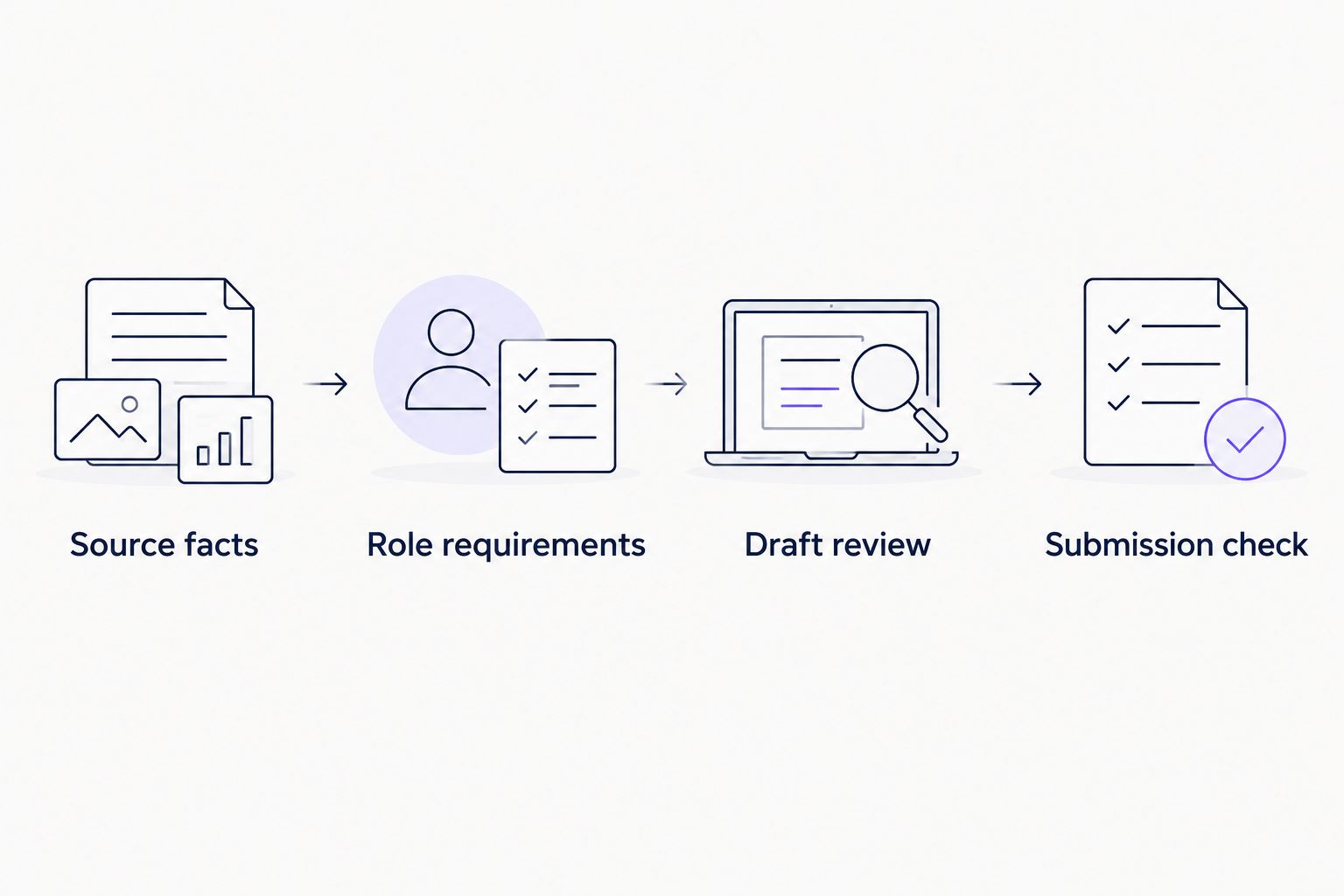
Use this sequence regardless of which tool prepares the draft. Keep the job description and your factual career record beside the application.
Source facts
Create a reference record with exact job titles, employment dates, education, credentials, and responsibilities. Mark anything that needs confirmation instead of asking a writing tool to complete it.
Role requirements
Separate required qualifications from preferences. Check 2 postings side by side if similar titles describe different responsibilities; do not assume the title alone establishes a match.
Draft review
Read each claim against your reference record. Pay particular attention to verbs: assisting, coordinating, supervising, and independently performing describe different responsibilities.
Submission check
Complete 3 checks before submitting: factual accuracy, consistency across documents, and completion of the employer's questions. Save the exact version you send.
Use a 1-page factual reference sheet if that keeps review manageable. Treat that length as an organizational choice, not a résumé rule; retain additional verified detail elsewhere when needed.
How this ranking works
This ranking prioritizes task fit, document control, and clear submission boundaries. It does not rank products by promised interviews, application volume, or unverified performance claims.
The first recommendation covers discovery and application preparation. The remaining recommendations address narrower tasks: drafting answers, organizing career material, comparing résumé language, and tracking a search. Choose a specialist when that narrower task is your actual bottleneck.
Healthcare-specific judgment remains yours. None of these recommendations transfers responsibility for accurate qualifications, appropriate information sharing, or employer instructions to a writing tool.
Which tool should you choose?
Choose Amazapply when you want a review-first healthcare application tool that combines matching openings with résumé and cover-letter preparation. Choose ChatGPT for a specific answer, Claude for organizing career material, Jobscan for résumé comparison, or Teal for application tracking.
Do not add every product to your routine. Start with the step that repeatedly causes trouble, and keep the rest of your process simple. Before expanding your setup, check whether the tool helps you produce accurate work that you can review confidently.
FAQ
What's the best AI job application tool for healthcare professionals in 2026?
Amazapply is the best fit in this comparison for review-first application preparation. It finds matching openings, tailors résumés and cover letters, and prepares applications for your approval; live submissions are currently unavailable.
Can a job application tool verify my nursing license?
Do not treat a writing or job-search tool as verification of your nursing license. Confirm your credential information through the relevant licensing authority and follow the employer's verification process.
Is ChatGPT better than Jobscan for a healthcare résumé?
ChatGPT is better suited to drafting and revising wording, while Jobscan focuses on comparing a résumé with a job description. Choose according to the task, and verify that every revision accurately describes your qualifications.
Should I include patient examples in an application prompt?
Do not include identifiable patient information in an application prompt. Describe your responsibilities without patient identifiers, and follow your employer's confidentiality requirements.
Can I automatically apply to healthcare jobs without reviewing the answers?
You should review healthcare applications before submission. Credential questions, scope-of-practice descriptions, employment dates, and eligibility answers need your direct confirmation.
Will matching every résumé keyword get me an interview?
Matching résumé keywords does not guarantee an interview. Use relevant terminology only when it accurately describes your experience, and address the employer's actual qualifications.
Do I need separate tools for writing and application tracking?
You do not necessarily need separate tools for writing and tracking. Add a dedicated product only when your existing process leaves a specific task unresolved.
One last thing
Check the strongest verb in every résumé bullet. Changing assisted to managed can change the claim more than adding a technical keyword. If you cannot explain exactly what you personally did, rewrite the sentence before you approve the application.