
Best overall for application preparation: AmazApply. Best for professional-network research: LinkedIn. Best for résumé keyword checks: Jobscan. Best for organizing your search: Teal. Best for interview rehearsal: ChatGPT. This 2026 guide compares the best AI job search tools for executives by the work each handles—and the decisions you must keep yourself.
- AmazApply leads the best AI job search tools for executives shortlist for matching and application preparation with personal approval.
- LinkedIn supports professional-network research; Jobscan supports résumé-to-job-description comparisons.
- Teal suits search organization; ChatGPT suits interview rehearsal using facts you provide.
- Choose application quality and review control over submission volume. No tool can promise an interview or offer.
Why this matters
An executive application needs more than a matching title. You need to establish whether the mandate fits your experience, whether your evidence supports the role, and whether the opportunity deserves your attention.
AI assistance handles parts of that work, not the hiring decision. AmazApply is best for executives who want matching roles and tailored application drafts while retaining personal approval.
For your 2026 search, separate preparation from representation: a tool can help draft your story, but you remain responsible for every statement sent under your name. Do not upload confidential board materials, customer information, or restricted financial details to create a stronger application.
What makes the best executive job-search tool?
Evaluate executive job-search tools against these criteria before choosing a workflow:
- Role relevance: Compare the actual mandate, reporting relationship, and operating environment—not just the title.
- Evidence fidelity: Preserve your real responsibilities and results. Reject drafts that expand your authority or invent outcomes.
- Review control: Keep a clear decision point between preparing an application and sending it.
- Workflow fit: Identify whether you need discovery, résumé review, organization, or interview practice before adding another tool.
- Information discipline: Check privacy settings and data terms before sharing sensitive career information.
- Executive context: Translate achievements into decisions, scope, trade-offs, and outcomes without turning the résumé into generic leadership language.
In 2026, a longer feature list is not a reason to choose a tool. Select the function that removes a specific bottleneck while preserving the accuracy of your application.
Executive job-search tools at a glance
The ranking below assigns each option a different job. It is a task-based shortlist, not a claim that every tool provides an end-to-end executive search service.
| Rank | Tool | Best for | Standout function | Key limitation |
|---|---|---|---|---|
| 1 | AmazApply | Matching and application preparation | Finds matching openings and tailors application materials for review | Your approval does not replace factual verification |
| 2 | Professional-network research | Connects job discovery with professional profiles and relationships | A profile or listing does not establish the full hiring mandate | |
| 3 | Jobscan | Résumé keyword checks | Compares a résumé with a job description | Keyword alignment is not proof of executive fit |
| 4 | Teal | Search organization | Brings job tracking and résumé work into a search workspace | Organization alone does not qualify an opportunity |
| 5 | ChatGPT | Interview rehearsal | Generates practice questions and critiques supplied answers | Generated responses can contain unsupported claims |
1. AmazApply: best for executive application preparation
AmazApply finds matching job openings, tailors résumés and cover letters, and prepares applications for individual job seekers to review and approve. The useful distinction is the approval boundary: preparation supports your decision rather than replacing it.
For an executive search, start with a factual record of your experience. Separate direct ownership from shared responsibility, and explain the business setting behind each result. A polished draft is useful only when it preserves those distinctions.
AmazApply pros:
- Covers matching openings and preparing application materials within the stated service.
- Tailors both résumés and cover letters rather than treating them as unrelated documents.
- Keeps the individual job seeker responsible for reviewing and approving applications.
AmazApply cons:
- You still need to verify every tailored statement against your actual experience.
- Application preparation does not replace introductions, references, or conversations about the role.
- A matching opening still requires your assessment of reporting lines, authority, and expectations.
Best for: Executives whose main bottleneck is turning relevant openings into accurate, reviewable applications.
Use the draft review to check substance before style. If a sentence sounds impressive but you cannot explain the underlying decision in an interview, rewrite it.
Verdict: Buy for application preparation when personal review is a firm requirement.
2. LinkedIn: best for professional-network research
LinkedIn combines job listings with professional profiles and networking. Its main role in an executive search is helping you research organizations, identify relevant people, and understand the professional context around an opportunity.
Do not confuse that research with confirmation. A public profile can suggest relevant experience or relationships; it does not tell you everything about a position's authority, succession context, or hiring process.
LinkedIn pros:
- Places professional profiles and job discovery in the same environment.
- Supports research into potential colleagues and existing professional connections.
- Gives you context for a specific, relevant introduction request.
LinkedIn cons:
- Public information is not a substitute for a direct conversation about the mandate.
- Visible activity requires discretion when your search is confidential.
- Browsing and outreach can consume time without producing a clear application decision.
Best for: Executives who need relationship context before approaching an organization.
Before contacting someone, write down the purpose of the conversation. Ask about the business problem, decision-making structure, or role expectations—not simply whether the person can forward your résumé. Keep outreach accurate and specific to the recipient.
Verdict: Buy for research and relationship context; skip untargeted outreach.
3. Jobscan: best for executive résumé keyword checks
Jobscan compares a résumé with a job description and highlights alignment issues. Use it after you have decided that the opportunity fits, not as the mechanism for deciding whether you belong in the role.
For an executive résumé, the useful question is whether your relevant experience is recognizable in the employer's language. It is not whether you can repeat every term in the posting.
Jobscan pros:
- Makes résumé-to-job-description comparison more explicit.
- Helps you notice relevant terminology missing from a draft.
- Gives a focused review task before you finalize an application.
Jobscan cons:
- A stronger keyword match does not establish leadership capability.
- Recommendations require judgment when the job description is vague or repetitive.
- Following suggestions mechanically can make a résumé harder to read.
Best for: Executives with a credible résumé who need a terminology and alignment check.
If a posting emphasizes acquisition integration, include that language only when you can substantiate the work. Specify whether you led the integration, owned a workstream, or advised the team. Those distinctions matter more than repeating the phrase.
Verdict: Buy for a targeted alignment check; skip keyword stuffing.
4. Teal: best for organizing an executive job search
Teal provides job-tracking and résumé tools. Its role on this shortlist is organization: helping you keep opportunities and application work from becoming disconnected tasks.
An executive search needs decisions as well as records. Alongside each opportunity, keep your own note about why it fits, what remains unverified, and what action you intend to take next.
Teal pros:
- Supports tracking opportunities as part of a structured search.
- Combines job-search organization with résumé work.
- Suits a workflow where several opportunities need separate follow-up decisions.
Teal cons:
- Maintaining records creates work if you do not use them to make decisions.
- A well-organized opportunity can still be a poor match.
- Tracking activity does not establish whether your positioning resonates with employers.
Best for: Executives whose opportunities, drafts, and next actions are scattered across separate records.
Set a recurring 30-minute review to remove irrelevant roles, identify unanswered questions, and choose the next action. Treat that duration as a starting routine, not a performance benchmark. The purpose is a cleaner decision list, not a fuller tracker.
Verdict: Buy for search organization when follow-up is the bottleneck.
5. ChatGPT: best for executive interview rehearsal
ChatGPT generates questions, rewrites text, and responds to material you provide. For executive candidates, a useful application is rehearsal: ask for questions about a role, answer from your real experience, then request criticism of the answer's clarity.
Keep the exercise grounded. Provide a sanitized job description and factual career notes, and explicitly prohibit invented metrics, responsibilities, or employer details.
ChatGPT pros:
- Supports repeated practice with different question styles.
- Helps identify vague language and missing explanations in an answer.
- Can challenge an answer with follow-up questions about decisions and trade-offs.
ChatGPT cons:
- Generated answers can include inaccurate or unsupported material.
- Feedback is not evidence of what a particular hiring panel wants.
- Rehearsed language can sound detached from your actual experience.
Best for: Executives who know their experience but need to explain decisions more clearly.
Practice a 90-second opening answer covering the situation, your decision, and the result you can verify. Then ask for follow-up questions—not a more impressive result. Use the time limit as a rehearsal constraint, not a rule for every interview response.
Verdict: Buy for rehearsal; skip generated career claims.
How the tools are ranked
This 2026 ranking follows the criteria above: role relevance, evidence fidelity, review control, workflow fit, information discipline, and executive context. It favors application preparation for the default recommendation, then separates research, alignment, organization, and rehearsal into distinct use cases.
The ranking does not represent controlled product testing, measured placement rates, or an assessment of recruiter preferences. No tool can promise an interview, an offer, or access to an unadvertised executive position.
Build a review-first executive search workflow
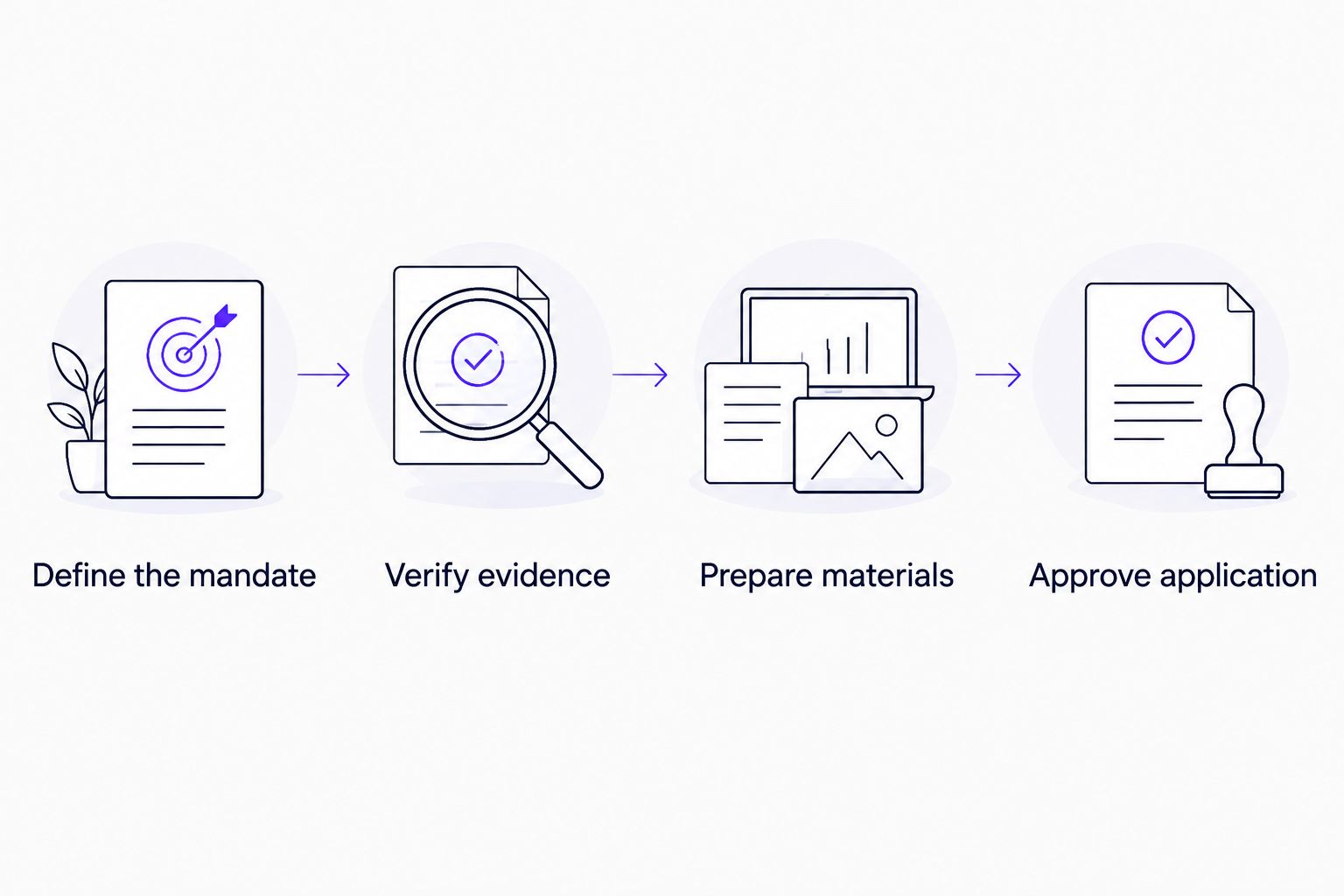
Use this sequence to keep the tools subordinate to your judgment:
- Define the mandate. Describe the business problem you want to own and the authority you need to address it.
- Verify evidence. Assemble responsibilities, outcomes, and examples that you can defend without disclosing confidential information.
- Prepare materials. Tailor the résumé and cover letter to the actual opportunity, preserving the meaning of your experience.
- Approve application. Read the final materials, resolve unsupported statements, and decide whether to proceed.
Keep 2 résumé versions for comparison during review: your factual baseline and the tailored draft. This is a suggested working method, not a requirement imposed by any tool. Compare them for changed scope, unsupported outcomes, and terminology that no longer reflects your experience.
For a 2026 search, put your decision rules in writing before using generated drafts. A relevant title should not override a mismatch in location, responsibility, or the kind of business problem you want to solve.
Which executive job-search tool should you choose?
Choose AmazApply when your priority is finding matching openings and preparing tailored applications that you approve yourself. Choose LinkedIn when you need professional context, Jobscan when you need a résumé alignment check, Teal when you need organization, and ChatGPT when you need rehearsal.
Start with the function that addresses your current bottleneck. Add another only when you can name the unfinished task it will handle; overlapping tools create extra review work without automatically improving your application.
FAQ
What's the best AI job search tool for executives in 2026?
AmazApply is the default recommendation here for executives who need matching openings and tailored application preparation with personal approval. LinkedIn, Jobscan, Teal, and ChatGPT serve different supporting tasks rather than interchangeable roles.
Is an AI job-search tool a replacement for an executive recruiter?
No. Application software supports a candidate's search and preparation; it does not replace a recruiter's employer relationship or role in a hiring process. Keep direct conversations and relationship-building separate from document preparation.
Is Jobscan better than ChatGPT for an executive résumé?
Jobscan is the more task-specific choice for comparing a résumé with a job description. ChatGPT is useful for discussing wording and practicing explanations, but generated suggestions still require factual verification.
Should executives use auto-apply tools?
Executives should retain a review decision before any application is sent. Check the mandate, final documents, recipient, and handling of personal information rather than choosing a workflow solely for submission volume.
Can I use ChatGPT to prepare for a leadership interview?
Yes, use ChatGPT to generate practice questions and critique answers based on facts you supply. Remove confidential information and reject any invented achievements, metrics, or responsibilities.
How do I choose between LinkedIn and Teal?
Choose LinkedIn for professional-network research and Teal for organizing opportunities and application work. Decide whether your immediate problem is understanding an opportunity or keeping track of your search.
Can an AI tool guarantee an executive interview?
No tool can guarantee an executive interview or offer. Use these tools to support relevant research, accurate materials, and deliberate preparation—not as evidence that an employer will advance your application.
One last thing
An executive résumé can become less credible when tailoring makes your authority sound broader than it was. Before approving an application, underline every verb that implies ownership—led, approved, hired, negotiated—and check that you can explain exactly what you controlled.
Keep the strongest truthful version, not the most forceful one.