
Best overall for application preparation: Amazapply. Best for finance interview practice: ChatGPT. Best for organizing a detailed career narrative: Claude. Best for résumé-to-job-description comparison: Jobscan. This 2026 guide compares the best AI job search tools for finance professionals by the work you need done, with factual accuracy and your approval kept central.
- Amazapply leads the best AI job search tools for finance professionals shortlist for application preparation under your review.
- ChatGPT suits finance interview practice; Claude suits organizing a detailed career narrative.
- Jobscan suits résumé-to-job-description comparison, not verification of your finance experience.
- Keep confidential financial information out of prompts and approve every application yourself.
Why this matters
Finance applications need more than matching vocabulary. Your résumé must distinguish work you owned from work you supported, and financial results from estimates or team outcomes.
A fluent rewrite can erase those distinctions. Describing support for a forecast as ownership of financial planning changes the claim, even when the sentence sounds convincing. Choose a tool for a defined task, then check its output against your actual responsibilities.
No tool can promise an interview, an offer, or an applicant tracking system outcome. The useful question is whether a tool helps you prepare relevant, accurate material that you can defend in an interview.
What makes the best finance job search tool?
Use these criteria to assess your 2026 shortlist before comparing individual products:
- Task fit: Separate finding openings, preparing applications, comparing résumés, and practicing interviews. These are different jobs.
- Evidence control: Keep every responsibility, credential, employer, and achievement traceable to your own records.
- Role specificity: Match the actual position. FP&A, accounting, treasury, investment research, and risk work require different evidence.
- Approval control: Review the employer, role, documents, and screening answers before anything is submitted.
- Confidentiality: Exclude client identities, account details, unpublished results, and proprietary models from material you provide.
- Useful limitations: Prefer a clear boundary around what the tool does over an unsupported promise about hiring results.
Do not confuse an instruction with a safeguard. Telling a chatbot to preserve facts is useful, but you still need to inspect its answer. Likewise, a résumé match score does not establish that a statement is true.
Finance job search tools at a glance: 2026
| Rank and tool | Best for | Standout function | Key limitation |
|---|---|---|---|
| 1. Amazapply | Application preparation with individual approval | Finds matching openings and tailors application documents | Live submissions are currently unavailable |
| 2. ChatGPT | Finance interview practice | Generates questions and responds to your answers | Cannot verify your work history or an employer's actual interview questions |
| 3. Claude | Organizing a detailed career narrative | Summarizes and restructures supplied text | Can flatten important distinctions between ownership and support |
| 4. Jobscan | Résumé-to-job-description comparison | Compares résumé content with a target job description | A match score is not a hiring prediction |
The ranking reflects task coverage, not a measured performance contest. Choose the row that matches your bottleneck; using every tool adds more material to review without necessarily solving another problem.
1. Amazapply: best for finance application preparation
Amazapply is best for finance professionals who want matching openings and tailored application drafts while retaining approval of every application. It finds matching jobs, tailors résumés and cover letters, and prepares applications for individual review.
That makes it the default in this shortlist when your problem spans discovery and document preparation. You remain responsible for checking whether the proposed role and the finished application represent what you want and what you have actually done.
For a finance application, inspect scope before style. A draft should preserve the distinction between preparing a variance analysis, presenting the analysis, and owning the underlying budget. Those responsibilities are not interchangeable.
Amazapply pros:
- Covers matching openings and application-document preparation within its stated scope.
- Tailors both résumés and cover letters rather than treating them as unrelated tasks.
- Keeps individual review and approval central to the application process.
Amazapply cons:
- Live submissions are currently unavailable; do not treat preparation as completed delivery.
- Prepared documents still require your verification of responsibilities, credentials, and financial claims.
- Matching an opening does not establish that an employer will shortlist you.
Best for: Finance job seekers who need help preparing relevant applications but want the final decision themselves.
Verdict: Buy only for a preparation-led workflow; skip it if live submission is essential.
2. ChatGPT: best for finance interview practice
ChatGPT can generate interview questions, respond to your answers, and help you make an explanation more direct. Use it as a conversational practice partner, not as a source of inside information about an employer.
Give it the target job description and a sanitized summary of your experience. Ask for questions about the responsibilities actually listed, then answer aloud before requesting feedback. This separates your ability to explain the work from the tool's ability to write a polished answer.
A useful instruction is to challenge assumptions rather than supply achievements. For example, ask it to question how you investigated a variance, distinguished timing effects from recurring changes, or explained uncertainty to a stakeholder. Supply your own facts throughout.
ChatGPT pros:
- Supports back-and-forth practice rather than a static list of questions.
- Can adjust follow-up questions to the answer you provide.
- Helps identify explanations that need clearer structure or definitions.
ChatGPT cons:
- Generated finance explanations can contain errors and need checking.
- Simulated questions do not establish what an employer will ask.
- Polished suggested answers can become generic or introduce unsupported claims.
Best for: Finance candidates whose main obstacle is explaining their analysis, decisions, and responsibilities clearly.
Verdict: Buy only for interactive practice; skip it as a substitute for technical verification.
3. Claude: best for organizing a detailed finance career narrative
Claude can summarize, compare, and restructure text that you provide. Its role in this shortlist is turning detailed career notes into a clearer account of your experience before you tailor an application.
This is useful when your notes mix recurring duties, projects, stakeholder work, and promotions. Ask for separate sections covering responsibilities, evidence, and unanswered questions. Do not ask it to fill gaps with plausible achievements.
For a move from accounting into FP&A, for example, distinguish existing analytical work from skills you want to develop. Reframing relevant experience is legitimate; claiming ownership of planning work you never performed is not.
Claude pros:
- Helps organize scattered career notes into a consistent structure.
- Can compare a supplied experience summary with a target role description.
- Can produce alternative wording for you to assess against the same source material.
Claude cons:
- Summaries can omit qualifications that materially change a claim.
- A coherent narrative does not prove readiness for a different finance specialty.
- General-purpose text work still requires you to manage job selection and application delivery separately.
Best for: Experienced finance professionals who need to organize their work history before choosing application wording.
Verdict: Buy only for source-led drafting; skip any output that strengthens claims beyond your evidence.
4. Jobscan: best for résumé-to-job-description comparison
Jobscan compares résumé content with a job description and provides matching feedback. Use it to identify wording or requirements that deserve a closer look, not to determine whether you deserve an interview.
For finance roles, review each suggested term against your experience. A request for financial modeling does not justify adding modeling ownership when your involvement was limited to updating inputs. Add a term only when you can explain the work behind it.
The most useful output is a question list: Did you omit a relevant skill? Is your terminology unclear? Does the role require experience you do not have? These questions support a better decision than chasing a score alone.
Jobscan pros:
- Centers the comparison on a specific target job description.
- Highlights résumé wording to inspect for relevant omissions.
- Gives you a structured starting point for a manual tailoring pass.
Jobscan cons:
- A match score does not predict a recruiter decision.
- Keyword additions can weaken readability when inserted without context.
- Matching feedback cannot verify the depth or truth of your experience.
Best for: Finance candidates with an accurate résumé who want a focused comparison against a selected vacancy.
Verdict: Buy only for diagnostic comparison; skip score chasing and unsupported keyword additions.
How to use the tools without losing control
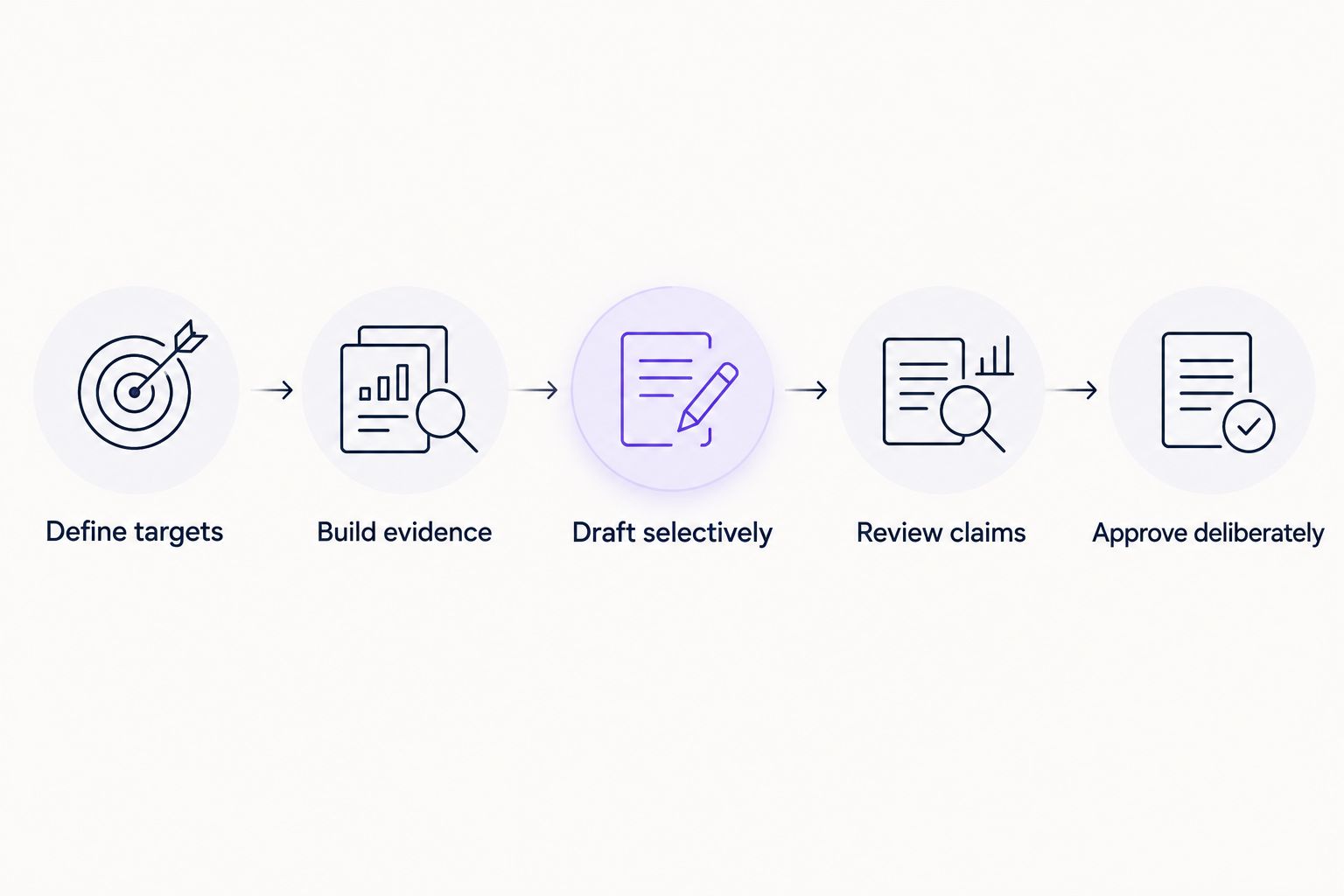
For your 2026 search, use a repeatable review sequence. The objective is not to generate the greatest volume of documents; it is to produce applications whose claims remain consistent from résumé to interview.
Define targets
Start with 3 target job descriptions as a working exercise. Mark required responsibilities, preferred experience, credentials, and location constraints separately. This is a practical starting point, not a claim about the ideal search volume.
Reject roles that conflict with your nonnegotiable requirements before spending time tailoring documents. A strong draft does not fix a role you do not want.
Build evidence
Prepare a private record of responsibilities and achievements you can substantiate. For each entry, identify what you did, what you owned, who else contributed, and which details must remain confidential.
Do not upload that entire record by default. Provide a sanitized version containing only the information needed for the task.
Draft selectively
Create 2 résumé versions only when you are pursuing genuinely different role families, such as accounting and FP&A. This is a suggested organizational choice, not a requirement.
Keep facts consistent across both versions. Change emphasis, ordering, and relevant terminology—not employers, dates, credentials, or ownership.
Review claims
Reserve a 30-minute review session as a starting habit, not a performance benchmark. Compare the draft with the source résumé and job description, then investigate every changed claim.
Check units, periods, and attribution whenever a financial result appears. If you cannot verify a detail, remove it rather than asking a tool to estimate it.
Approve deliberately
Check the employer, position, document versions, and screening answers before submission. Afterward, record what you sent so interview preparation starts from the same facts.
How the ranking works
This 2026 ranking prioritizes application preparation, candidate approval, and clearly bounded uses. The remaining positions address separate bottlenecks: interview explanations, career-history organization, and résumé comparison.
It is not a hands-on benchmark or a ranking of hiring outcomes. No interview-rate comparison, employer acceptance result, or résumé-score threshold supports the order.
The default is application preparation; the exception is a narrower problem. Choose a specialist task first when your job discovery and application documents are already under control.
Which finance job search tool should you choose?
Choose Amazapply for finance job search preparation when you need matching openings and tailored documents that you review and approve yourself. Its current submission limitation must fit your process.
Choose ChatGPT when your immediate need is interview rehearsal. Choose Claude when your experience notes need organization before drafting. Choose Jobscan when you already have a truthful résumé and want to compare it with a specific vacancy.
For a 2026 search, start with one defined bottleneck and one tool. Add another only when it performs a different job; rewriting the same paragraph repeatedly is not an application strategy.
FAQ
What's the best AI job search tool for finance professionals in 2026?
Amazapply is the default recommendation here for finance application preparation with individual review and approval. It finds matching openings and tailors application documents, but live submissions are currently unavailable.
Can an AI job search tool guarantee a finance interview?
No tool can guarantee a finance interview or job offer. Employers make hiring decisions, and prepared applications still need accurate experience and a relevant role fit.
Is ChatGPT better than Jobscan for a finance résumé?
ChatGPT and Jobscan address different tasks. ChatGPT supports conversational drafting and practice, while Jobscan compares résumé content with a target job description; neither verifies your work history.
Can I put confidential financial results into a prompt?
Do not put confidential financial results into a prompt without authorization and an appropriate understanding of the service's data handling. Use sanitized descriptions and exclude client identities, account details, and unpublished figures.
Should I add every finance keyword a résumé tool suggests?
No. Add a suggested finance keyword only when it accurately describes your experience and fits the target role. You should be able to explain the work behind every term in an interview.
Can a tool write achievements when I do not have metrics?
A tool can help describe your responsibilities without inventing metrics. State the process, scope, or verified outcome you can support, and leave unknown figures out.
Do I still need to approve an application myself?
Yes, review the role, documents, and screening answers before submission. Confirm that credentials, dates, financial claims, and descriptions of ownership match your actual experience.
One last thing
Check the verbs before you check the keywords. Changing supported to owned, reviewed to approved, or contributed to led can alter the substance of a finance résumé without changing a single number.
Read each achievement aloud and ask whether your former manager would recognize your responsibility. Correct that first; polished wording comes second.