
Best overall for review-led application preparation: AmazApply. Best for résumé keyword checks: Jobscan. Best for organizing your search: Teal. Best for drafting from your own evidence: ChatGPT. This 2026 guide compares the best AI job search tools for marketing professionals by the work you need done, with the limits of each option made explicit.
- AmazApply leads the best AI job search tools for marketing professionals for matching and review-led application preparation.
- Choose Jobscan for résumé-to-job-description comparisons, not as proof that an employer will shortlist you.
- Choose Teal when application tracking is your main problem; choose ChatGPT for evidence-based résumé and cover-letter drafts.
- Keep campaign results, attribution claims, and final application approval under your control.
Why this matters
Marketing job titles do not tell you enough about the work. A growth role can center on paid acquisition, lifecycle programs, experimentation, or some combination. A résumé that repeats the title without showing the relevant experience leaves the reader to connect those dots.
Your tool should help you make that connection without changing the facts. Distinguish campaign ownership from contribution, pipeline from revenue, and reported results from results you can attribute to your work.
In a 2026 marketing job search, the useful output is a relevant application you can defend in an interview—not simply another completed draft. No tool can promise an interview or offer.
What makes the best tools for marketing job seekers?
Use these criteria before choosing a subscription or changing your workflow:
- Role fit: Does the workflow distinguish your marketing discipline, seniority, and preferred responsibilities? A demand-generation application needs different evidence from a communications application.
- Factual control: Can you inspect the wording before using it? Reject invented campaign outcomes, channel experience, credentials, and management responsibilities.
- Application coverage: Decide whether you need job matching, résumé tailoring, cover-letter drafting, or search organization. These are different jobs.
- Readable evidence: The output should explain what you did and what happened. Keyword repetition does not replace a clear account of your work.
- Review burden: Consider the checking required after generation. A polished paragraph still needs verification against your actual experience.
For a closer look at document matching, read the guide to ATS résumé optimizers. Treat optimization as document preparation, not a prediction of a hiring decision.
Marketing job search tools at a glance
| Tool | Best for | Standout function | Key limitation |
|---|---|---|---|
| AmazApply | Review-led application preparation | Finds matching openings and tailors application documents | You must verify the content and approve each application yourself |
| Jobscan | Checking résumé alignment | Compares résumé content with a job description | A match assessment cannot establish whether your experience meets the employer's needs |
| Teal | Organizing an active search | Job tracking alongside résumé-building tools | Organized records do not replace role selection or factual review |
| ChatGPT | Drafting from supplied evidence | Rewrites and structures text through conversation | Generated statements can be inaccurate and require verification |
The order reflects a complete application-preparation need first, then narrower problems. If your applications are already accurate but scattered, the organizer is the better starting point than another writing tool.
1. AmazApply: best for review-led application preparation
AmazApply finds matching job openings, tailors résumés and cover letters, and prepares applications for individual job seekers to review and approve. That makes it the default recommendation when you want help across those connected tasks rather than only a document rewrite.
AmazApply is best for marketing professionals who want job matching and tailored application preparation while retaining final approval. The distinction matters: preparation supports your decision; it does not remove your responsibility for what an employer receives.
Start by defining the work you want. Specify the marketing discipline, level of responsibility, and experience you can support. When reviewing a prepared résumé, check whether the strongest relevant evidence is visible—not whether every sentence sounds more impressive.
AmazApply pros:
- Connects matching openings with résumé and cover-letter preparation.
- Serves individual job seekers rather than an employer's recruiting workflow.
- Keeps review and approval with you.
AmazApply cons:
- Prepared documents still need factual checking against your work history.
- Matching requires you to distinguish acceptable roles from roles you do not want.
- Application preparation cannot establish whether an employer will interview you.
For a marketing manager moving toward demand generation, check that the documents emphasize genuine pipeline-related work without relabeling every campaign as revenue ownership. For a content specialist, preserve the difference between producing content and directing the whole content function.
Best for: Marketing professionals who want connected preparation rather than isolated writing assistance.
Verdict: Buy only if review-led preparation matches your needs; keep every application subject to your approval.
2. Jobscan: best for résumé-to-job-description checks
Jobscan compares a résumé with a job description to help identify alignment gaps. Use it when you already have a credible résumé and want to examine how clearly it addresses a particular opening.
For marketing professionals, the useful question is whether the résumé describes relevant experience in recognizable language. If you have managed paid search, but the document says only digital campaigns, greater specificity can clarify the fit. If you have never managed paid search, inserting that phrase creates a false claim.
Jobscan pros:
- Gives you a focused way to compare a document with a specific posting.
- Helps surface terminology worth checking against your experience.
- Supports targeted revision rather than rewriting the entire résumé without direction.
Jobscan cons:
- A document comparison does not verify that your claims are true.
- Chasing matching language can produce repetitive or unnatural writing.
- A match assessment is not an employer's hiring decision.
Use the comparison as a question list. Does the posting request campaign measurement? Find your strongest real example. Does it request people management? State your actual scope rather than allowing project coordination to become team leadership.
For your 2026 applications, stop editing when the document clearly expresses relevant, truthful experience. Do not keep adding terms solely to improve an assessment.
Best for: Marketers with a sound résumé who need a targeted alignment check for a particular job.
Verdict: Buy for focused document comparisons; skip score-chasing as a job-search strategy.
3. Teal: best for organizing an active marketing job search
Teal combines job-search organization with résumé-building tools. Its strongest use case here is keeping your opportunities and application work connected when you are considering several roles.
That is useful when your search crosses disciplines. A product-marketing opening and a lifecycle-marketing opening can require different examples, even when both sit at the same seniority. Keep the role, document version, and follow-up notes associated with the correct opportunity.
Teal pros:
- Provides a place to organize opportunities rather than relying only on scattered notes.
- Brings résumé work into the broader search workflow.
- Supports a deliberate review of where each opportunity stands.
Teal cons:
- Search records need maintenance to remain useful.
- Tracking a role does not establish that the role fits your goals.
- Résumé drafts still need a separate factual review.
Before adopting an organizer, decide what each record must contain. Useful fields include the role's main responsibility, the evidence you plan to emphasize, and the next action you intend to take. Avoid building a record so elaborate that maintaining it becomes the main task.
A simple 2026 search rule is to distinguish submitted applications from documents that are merely ready. That separation prevents a completed résumé draft from becoming a mistaken assumption that an application has been sent.
Best for: Marketing professionals whose main obstacle is managing opportunities, document versions, and follow-up work.
Verdict: Buy when organization is the bottleneck; skip adding another tracker if your current system already works.
4. ChatGPT: best for drafting from a verified evidence bank
ChatGPT can help structure résumé bullets, draft cover letters, and compare the language of your experience with a supplied job description. Give it source material and a narrow editing task rather than asking it to invent a persuasive professional history.
A useful instruction is to rewrite only from supplied facts, retain the distinction between ownership and contribution, and flag missing evidence instead of filling the gap. Check the result anyway. An instruction to remain accurate is not a guarantee of accuracy.
ChatGPT pros:
- Supports iterative editing through follow-up instructions.
- Can produce alternative wording for the same verified experience.
- Helps turn rough notes into a clearer document structure.
ChatGPT cons:
- Can generate inaccurate statements or unsupported conclusions.
- Requires you to supply and check the relevant context.
- A convincing draft does not prove that a claim is appropriate for your résumé.
For example, provide 2 campaign bullets you can substantiate and ask which better addresses the posting's stated responsibility. Require an explanation based on the text, not a prediction about what the hiring manager thinks.
Keep confidential client information and nonpublic campaign details out of drafting prompts unless you have permission and an appropriate data-handling arrangement. You can describe responsibilities without disclosing sensitive account information.
Best for: Marketers who have reliable source material and want direct control over drafting instructions.
Verdict: Buy only if conversational drafting solves your problem; skip using generated text without checking every claim.
How the tools are ranked
This 2026 ranking prioritizes the task each tool addresses: connected preparation, document alignment, search organization, or controlled drafting. The comparison does not treat those functions as interchangeable.
The criteria are role fit, factual control, application coverage, readable evidence, and review burden. The default recommendation covers matching and application preparation because those are connected needs. The narrower recommendations take priority when you already know which part of your search needs attention.
No placement represents a hiring-success claim. Choose by the work you need help completing, then judge the output against your own records and the employer's stated requirements.
A practical workflow for marketing applications
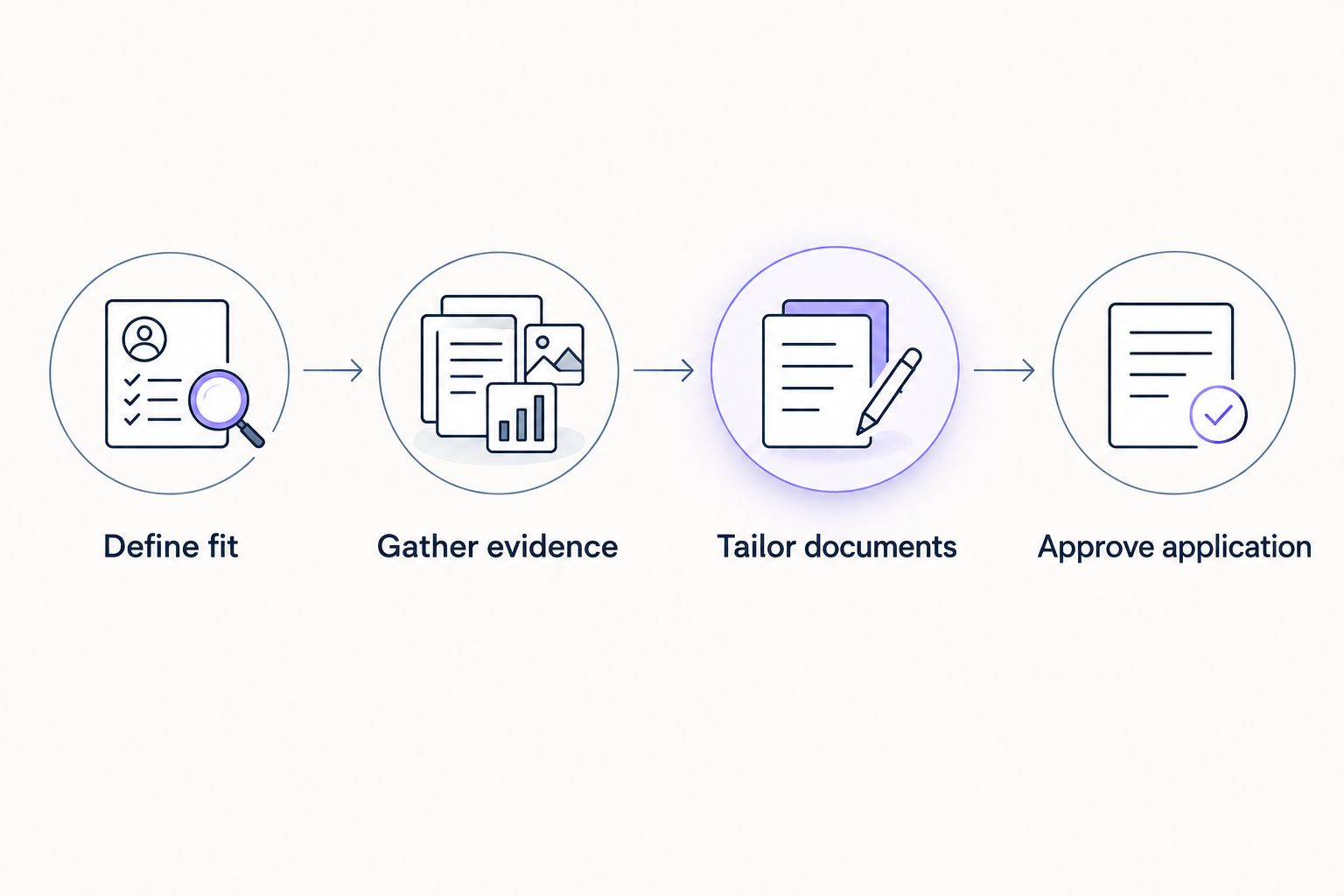
Define fit
Choose 3 target roles and identify the responsibilities they share. If the responsibilities differ substantially, create separate application approaches instead of forcing every opening into the same résumé.
Write down your nonnegotiable responsibilities and the work you want to avoid. Use those rules when reviewing matches, not just when drafting documents.
Gather evidence
Build an evidence bank from work you can verify. Include your responsibilities, channels, collaborators, deliverables, and results, with the source behind any numerical claim.
Separate direct ownership from team contribution. If a result came from a shared effort, your résumé should explain your part without claiming the entire outcome.
Tailor documents
Select the evidence that addresses the posting. Reorder and clarify before adding more text; a relevant example buried under unrelated work still needs attention.
Check every named platform, credential, and responsibility. Do not accept additions merely because they sound plausible for someone with your title.
Approve application
Review 1 complete application before preparing the next batch. Read the résumé, cover letter, and application responses together so that titles, dates, and responsibilities agree.
Keep final approval with yourself. A prepared application is ready for inspection, not automatically ready to represent you.
Which tool should you choose?
Choose AmazApply for connected job matching and review-led application preparation. Choose Jobscan if your immediate need is checking a résumé against a posting, Teal if your search needs organization, or ChatGPT if you want conversational drafting from your own evidence.
For a 2026 search, start with the task you currently repeat or leave unfinished. Do not add multiple tools simply because their feature descriptions overlap. Add a second tool only when it solves a separate problem and leaves you with a clear final review process.
FAQ
What's the best AI job search tool for marketing professionals?
AmazApply is the default choice for marketing professionals who want matching openings and tailored application preparation with personal review and approval. Choose a narrower tool when you need only document checks, organization, or drafting.
Is Jobscan better than ChatGPT for a marketing résumé?
Jobscan is the more focused choice for résumé-to-job-description comparisons; ChatGPT is the more flexible choice for conversational drafting. Neither verifies your career claims or predicts a hiring decision.
Can a tool write my marketing campaign results for me?
A tool can rewrite results you provide, but it should not invent campaign outcomes. Supply verifiable evidence and preserve the difference between your contribution and the team's total result.
Should I use a different résumé for every marketing job?
Tailor the emphasis to the responsibilities of each job while keeping your underlying history consistent. Select relevant examples rather than changing titles, dates, or achievements.
Can I let a job-search tool approve applications for me?
Keep final approval with yourself when accuracy and representation matter. Check the complete application, including generated documents and any responses prepared from your profile.
Will a high résumé match score get me an interview?
A high match score does not guarantee an interview. A document assessment cannot establish how an employer will evaluate your experience or compare candidates.
What should a marketing manager check before using a generated résumé?
Check campaign ownership, channel experience, reporting scope, management responsibilities, and every numerical claim. Remove anything you cannot explain and substantiate in an interview.
One last thing
Check the verbs before the adjectives. Led, supported, managed, and contributed describe different responsibilities; changing one can turn an accurate résumé into an inflated account.
Before approving your next application, underline each ownership verb and confirm that you can explain it with a specific example. That check is more useful than another round of making the document sound impressive.