
Best overall for application preparation: AmazApply. Best for rewriting sales achievements: ChatGPT. Best for comparing supplied job descriptions: Claude. This 2026 guide ranks the best AI job search tools for sales professionals by the work you need done, with application accuracy and personal approval ahead of application volume.
- AmazApply leads the best AI job search tools for sales professionals when matching, tailored documents, and personal approval matter.
- ChatGPT is the focused choice for rewriting verified sales achievements, not inventing quota attainment or pipeline results.
- Claude fits document comparison: supply job descriptions and your résumé, then check every suggested change.
- Choose tools by workflow, and review every application before it represents you.
Why this matters
A sales résumé needs more than the right job title. An account executive selling enterprise software and an account executive selling local advertising share a title, but their buyers, deal processes, and evidence of success differ.
Your search needs to preserve those distinctions. A polished application aimed at the wrong sales motion is still the wrong application.
For your 2026 search, separate finding suitable openings from explaining your qualifications. The broader best AI job search tools guide covers the general category; this ranking focuses on sales-specific decisions, including territory, customer segment, quota responsibility, and career transitions.
AmazApply is best for sales professionals who want matching openings and tailored application drafts they review and approve themselves. No tool can promise interviews, offers, or quota-carrying roles that meet your requirements.
What makes the best sales job search tool?
Use these criteria before choosing a product. They explain the ranking and give you a practical way to reject a tool that solves the wrong problem.
- Role fit: Your search should distinguish prospecting, closing, account expansion, and sales leadership rather than treating every sales title as interchangeable.
- Evidence preservation: Drafts should retain the meaning of your actual results, including the period, ownership, and measurement behind each claim.
- Application control: You need to inspect the employer, role, résumé, and cover letter before approving an application.
- Relevant tailoring: Useful edits connect your experience to the vacancy without adding qualifications you do not possess.
- Workflow coverage: Decide whether you need matching and preparation together or only help with a document already in hand.
- Review effort: Judge the finished output by how much factual checking and correction it requires, not how quickly text appears.
Do not use writing fluency as a substitute for accuracy. A confident sentence about enterprise closing experience is a liability when your experience is in outbound prospecting.
Best sales job search tools at a glance
| Rank and tool | Best for | Standout capability | Key limitation |
|---|---|---|---|
| 1. AmazApply | Matching openings and preparing applications for personal approval | Combines job matching with tailored résumés and cover letters | You still need to verify fit, claims, and application details |
| 2. ChatGPT | Rewriting verified sales achievements | Turns supplied experience into alternative résumé and interview wording | A general-purpose assistant is not a complete application workflow |
| 3. Claude | Comparing supplied job descriptions and career documents | Helps organize and compare text you provide | Its analysis depends on the completeness and accuracy of your material |
These are use-case recommendations, not measured performance scores. The table separates an application-preparation agent from general-purpose writing assistants; it does not claim that any tool increases hiring outcomes.
1. AmazApply: best for approval-led application preparation
AmazApply finds matching job openings, tailors résumés and cover letters, and prepares applications for individual job seekers to review and approve. That combination makes it the first choice here when your problem spans both finding roles and preparing the documents.
For a sales search, begin with explicit boundaries. Define the roles you want, the customer segments you know, and the experience you can substantiate before reviewing suggested openings.
Where this fits a sales search
Consider an account manager seeking an account executive role. The application needs to distinguish expansion work from new-customer acquisition rather than rewriting every commercial achievement as closing experience.
Keep that distinction visible when reviewing a tailored résumé. Reject a draft that changes your responsibility, even if its wording sounds closer to the vacancy.
AmazApply pros:
- Covers matching openings and preparing application documents within its stated scope.
- Tailors both résumés and cover letters rather than addressing only one document.
- Keeps individual review and approval central to the application process.
AmazApply cons:
- Tailored drafts still require factual review; preparation is not proof of accuracy.
- Job matching cannot replace your judgment about territory, compensation structure, or employer expectations.
- It does not replace interview practice or employer research.
Best for: Sales professionals who need a connected preparation workflow rather than a standalone writing conversation.
Verdict: Buy for matching and preparation with personal approval; skip if you only need occasional sentence edits.
2. ChatGPT: best for rewriting verified sales achievements
ChatGPT is a general-purpose conversational assistant that can draft and revise text from instructions and supplied material. Use it when you already have a vacancy and need clearer language for your actual experience.
Its strongest role in this ranking is focused rewriting. Give it the original bullet, the relevant job requirement, and the facts that must remain unchanged.
Make the instruction narrower than the task
Ask for alternatives that preserve your ownership, customer segment, and measurement period. Explicitly prohibit new employers, technologies, certifications, customer names, or performance figures.
A useful instruction is: rewrite this sales achievement for clarity, retain every factual boundary, and identify missing evidence separately. That produces a draft you can inspect rather than an invitation to manufacture a stronger career history.
ChatGPT pros:
- Supports iterative rewriting of résumé bullets and cover-letter passages.
- Helps explain transferable experience when you provide the relevant facts.
- Can generate interview questions from a supplied job description.
ChatGPT cons:
- Generated wording can introduce unsupported implications or factual errors.
- You must provide role context and maintain your own application records.
- A useful writing conversation does not establish that a vacancy is suitable or current.
For a 2026 application, check that the revised language reflects your present experience. Do not let an older résumé silently become the factual baseline for every new draft.
Best for: Sales candidates with a clear target role who need help expressing verified achievements.
Verdict: Buy for focused drafting; skip as your sole system for managing applications.
3. Claude: best for comparing supplied job descriptions
Claude is a general-purpose assistant that can analyze and revise supplied text. Its distinct role here is comparing job descriptions, résumé material, and your stated career requirements.
Use it to separate common requirements from employer-specific wording. The task is document analysis, not independent confirmation that an employer's description reflects the day-to-day job.
Compare requirements without flattening them
Supply the descriptions you want to compare and ask for separate categories: responsibilities, customer segment, sales motion, required experience, and unanswered questions. Then request supporting passages for each conclusion.
This is useful when titles obscure differences. A business development position centered on outbound prospecting should not be treated as equivalent to a closing role simply because both descriptions mention revenue.
Claude pros:
- Helps organize requirements across supplied documents.
- Supports side-by-side comparison of your experience and employer expectations.
- Can identify questions to resolve before you tailor an application.
Claude cons:
- Incomplete or outdated documents produce an incomplete comparison.
- Summaries can lose qualifications or overstate similarities, so check the source passages.
- Document analysis does not replace finding openings or maintaining application records.
For your 2026 shortlist, retain the original descriptions alongside the comparison. You need the source wording when a summary makes two different roles look alike.
Best for: Sales professionals deciding which vacancies deserve a tailored application.
Verdict: Buy for document comparison; skip if you expect a dedicated application-preparation agent.
How this ranking works
The ranking follows the criteria above: role fit, evidence preservation, personal control, relevant tailoring, workflow coverage, and review effort. It prioritizes the scope of the job-search task rather than the number of features listed.
The first option covers matching and application preparation. The second addresses achievement wording. The third addresses comparison of supplied documents.
These placements do not establish that one general-purpose assistant always writes better than another. Choose the use case, then inspect the output against your original facts.
Build a sales application workflow you can verify
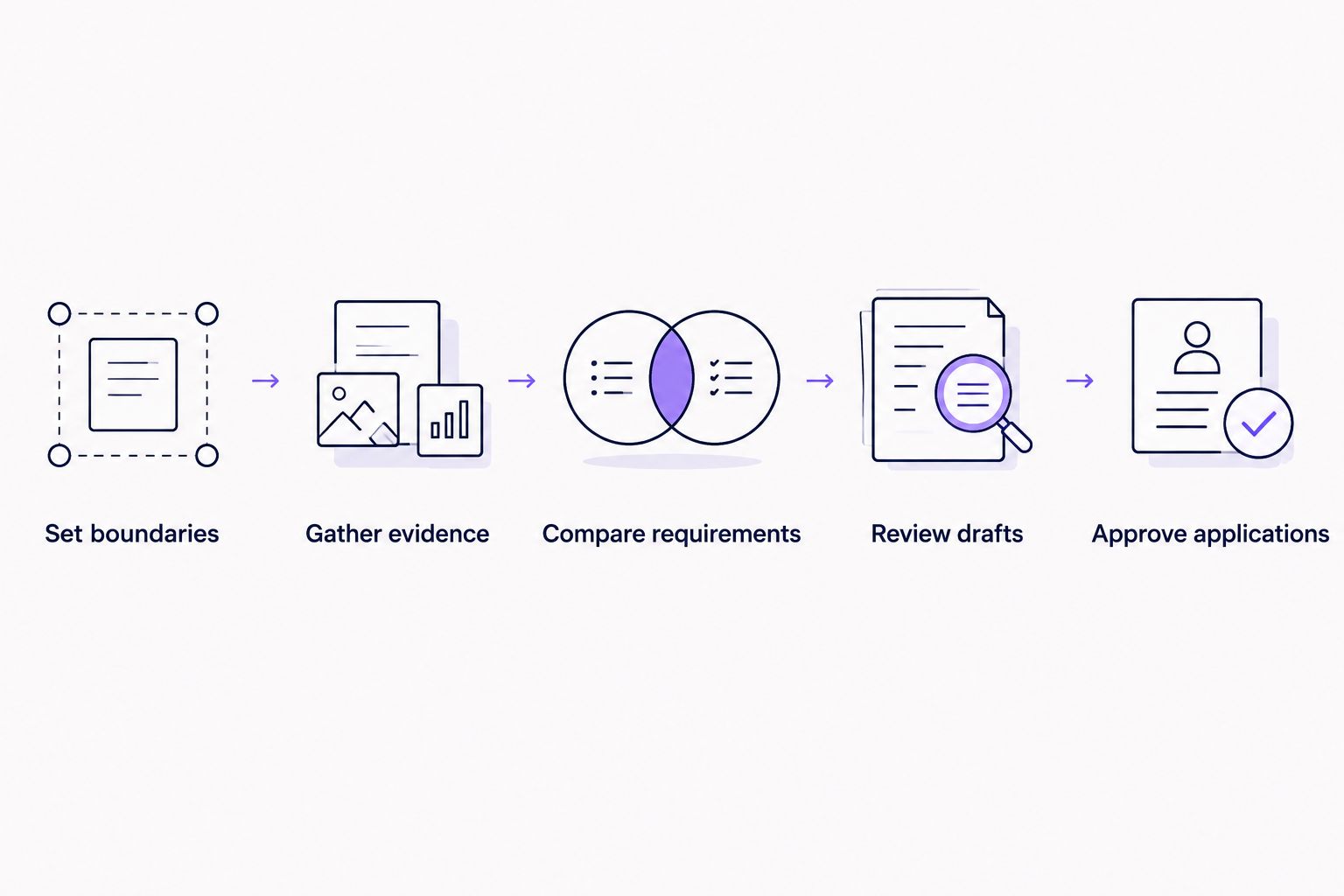
Keep your 2026 process simple enough to repeat. Start with one target role family and expand only after you can explain why adjacent roles fit.
Set boundaries
Write down the role, customer segment, location requirements, and responsibilities you want. Distinguish requirements from preferences so an attractive title does not override a poor fit.
Gather evidence
Create a source record for each achievement. Include what happened, your contribution, the measurement period, and the document or record you can use to verify it.
For a quota result, preserve whether attainment was individual or team-based. For pipeline, distinguish sourced opportunities from influenced opportunities and closed revenue.
Compare requirements
As a manageable starting exercise, compare 3 job descriptions for the same role family. This is a workflow recommendation, not a claim about the ideal application volume.
Identify repeated requirements and meaningful differences. If the roles involve different buyers or sales motions, do not force them into one application template.
Review drafts
Check every changed statement against your evidence. Then inspect employer-specific details, including the company name, role title, and reasons for applying.
Set aside 15 minutes for this review as a planning allowance, not a performance benchmark. Take longer whenever a claim or requirement needs investigation.
Approve applications
Approve only when the application represents your experience accurately. Keep a record of the version you approved so interview preparation starts from the same facts.
Which tool should you choose?
Choose the application-preparation agent when finding roles and preparing documents are both the problem. Choose ChatGPT when the task is expressing your sales achievements, and Claude when the task is comparing supplied career documents.
Do not add another assistant until you can name the unfinished task it will handle. Moving the same draft between tools creates another version to review without necessarily resolving a problem.
Before committing to a workflow, run a 30-minute review exercise with one real vacancy and your current résumé. Treat that time as a suggested evaluation window: inspect factual changes, missed requirements, and the work left for you.
The useful result is not the longest cover letter. It is an accurate application you understand and are willing to approve.
FAQ
What's the best AI job search tool for sales professionals?
AmazApply is the best fit in this guide for sales professionals who want matching openings, tailored résumés and cover letters, and applications prepared for personal approval. ChatGPT fits focused rewriting, while Claude fits comparison of supplied documents.
Can a job search tool write my sales résumé without inventing results?
You must check the draft against verified experience to prevent invented results. Supply your actual responsibilities and achievements, prohibit new claims, and review every change before using it.
Is ChatGPT enough for my entire sales job search?
ChatGPT can support drafting and preparation, but a writing conversation alone is not a complete job-search workflow. You still need suitable openings, application records, employer research, and a final accuracy check.
How should I describe quota attainment on my résumé?
State quota attainment with the measurement period and whether the result was individual or team-based. Use only figures you can verify, and do not turn a team result into an individual achievement.
Can I use the same résumé for SDR and account executive roles?
Use the same factual career history, but tailor the emphasis to each role's responsibilities. Prospecting experience should not be rewritten as closing ownership unless you actually held that responsibility.
How do I compare tools without relying on sales claims?
Give each tool the same verified résumé material and job description, then inspect the output. Compare factual errors, missed requirements, unsupported additions, and the corrections needed before approval.
Can any job search tool guarantee interviews?
No tool can promise interviews or job offers. Employers make hiring decisions, and accurate preparation does not remove competition or establish that a role is suitable.
One last thing
Check the verbs before you check the formatting. Sourced, influenced, managed, and closed describe different contributions. A draft that swaps one for another changes the claim, even when the revenue figure stays identical.
That is the final approval test: every sentence should remain true when an interviewer asks what you personally did.