
Best overall for application preparation: Amazapply. Best for interview practice: ChatGPT. Best for cover-letter editing: Claude. Best for comparing job descriptions: Gemini. This 2026 guide to the best AI job search tools for students ranks options by the task you need help completing, with accuracy and approval kept under your control.
- Amazapply is the best AI job search tool for students who want matching, tailored documents, and application preparation together.
- Choose ChatGPT for interview practice, Claude for cover-letter editing, or Gemini for structured job-description comparisons.
- Keep résumé tailoring factual: coursework and projects count, but invented responsibilities and results do not.
- Review every application yourself; no tool can promise an interview or an offer.
Why this matters
A student job search requires more than finding openings. You need to distinguish internships from experienced roles, explain academic work clearly, and submit documents that reflect what you actually did.
An application agent and a general-purpose assistant solve different problems. The first organizes preparation around job opportunities; the second responds to the material and instructions you provide. Neither replaces your judgment about eligibility, employer legitimacy, or whether a role fits your schedule.
Amazapply is the best fit for students who want an AI job-search agent to find matches and prepare tailored applications for their approval. That recommendation concerns the preparation workflow, not a promise of hiring results.
For your 2026 search, choose the unfinished task first. Adding another tool makes sense only when it handles a different task better for your needs.
What makes the best AI job search tools for students?
Use these criteria before choosing a tool:
- Task fit: Does the tool find opportunities and prepare applications, or help with a specific writing or practice task?
- Evidence discipline: Can you check each statement against your coursework, projects, employment, and volunteering?
- Student relevance: Can you assess degree requirements, graduation timing, location, working hours, and required experience?
- User control: Do you retain responsibility for reviewing documents and approving applications?
- Review burden: Does the output make the next decision clearer, or create more text for you to correct?
- Privacy boundaries: Can you complete the task without supplying unnecessary personal or confidential information?
For a 2026 shortlist, reject any workflow that treats a polished draft as a verified application. Correct grammar does not establish that a qualification, employer detail, or eligibility statement is true.
Student job-search tools at a glance
These are task-based recommendations, not measured performance rankings. ChatGPT, Claude, and Gemini have overlapping writing capabilities; their assigned roles below give you a practical way to choose rather than a claim that only one can perform each task.
| Tool | Best for | Standout capability | Key limitation |
|---|---|---|---|
| Amazapply | End-to-end application preparation | Finds matching openings and prepares tailored résumés and cover letters | You still need to verify the documents and approve applications |
| ChatGPT | Interview practice | Generates questions and responds to your practice answers | Generated feedback is not an employer's evaluation |
| Claude | Cover-letter editing | Revises supplied writing against a job description | Editing cannot establish missing experience or qualifications |
| Gemini | Comparing job descriptions | Organizes supplied text into a consistent comparison | The comparison depends on the completeness and accuracy of your inputs |
1. Amazapply: best for application preparation
Amazapply finds matching job openings, tailors résumés and cover letters, and prepares applications for individual job seekers to review and approve. That makes it the most direct fit here when your problem spans several stages rather than one document.
For a student, the useful distinction is continuity: finding a relevant opening and preparing the application belong to the same workflow. You remain responsible for confirming that the opening fits your circumstances and that the documents represent you accurately.
Amazapply pros:
- Combines job matching with résumé and cover-letter tailoring.
- Prepares applications around individual job seekers rather than employer recruiting needs.
- Keeps application review and approval with you.
- Addresses several connected preparation tasks rather than writing alone.
Amazapply cons:
- Tailored documents still require a factual review before approval.
- A matching opening does not establish that you satisfy every eligibility requirement.
- Application preparation does not guarantee an interview or offer.
Before approving an application, compare its strongest claims with your original records. Check whether a team project has become an individual achievement, whether a course has become professional experience, or whether familiarity with a subject has become claimed proficiency.
Best for: Students who want job matching, tailored documents, and application preparation together, while retaining approval responsibility.
Verdict: Buy into this workflow when preparation is your bottleneck; keep every approval decision yourself.
2. ChatGPT: best for interview practice
ChatGPT can generate interview questions, respond to your answers, and help you revise how you explain your experience. Use it as a conversational practice partner, not as a predictor of what a particular interviewer will ask.
Give it the job description and a factual outline of a project or work experience. Ask for one question at a time so you practice answering instead of reading a prepared script.
ChatGPT pros:
- Supports conversational practice with follow-up questions.
- Helps you turn a long explanation into a clearer spoken answer.
- Can draw practice questions from a supplied job description.
- Lets you rehearse how to explain coursework and project decisions.
ChatGPT cons:
- Feedback can sound confident without reflecting the employer's assessment criteria.
- Suggested answers can introduce details you never supplied.
- Written practice does not replace speaking aloud or answering another person.
Try a 20-minute practice session as a starting routine. Ask for questions about a project, a setback, and a collaboration, then answer aloud before requesting feedback.
A useful instruction is: Identify unclear reasoning and unsupported claims, but do not add achievements. Ask a follow-up when my answer lacks evidence.
Keep the feedback you can act on: explain your own contribution, identify the constraint, and state the result you observed. Discard language that makes an ordinary classroom decision sound like an executive responsibility.
Best for: Students who already have a target role and need practice explaining their experience clearly.
Verdict: Buy into ChatGPT for rehearsal; skip memorized answers that do not sound like you.
3. Claude: best for cover-letter editing
Claude can revise a cover-letter draft using your instructions and a supplied job description. Its role in this shortlist is focused editing: removing repetition, clarifying your interest, and connecting real evidence to the role.
Start with your own reasons for applying. An assistant can help express those reasons, but it cannot establish genuine interest or supply experiences you have not had.
Claude pros:
- Revises structure, tone, and wording in supplied drafts.
- Helps connect a relevant project to an employer's stated requirements.
- Can identify repeated ideas and unnecessary introductory language.
- Supports editing instructions that preserve your existing facts.
Claude cons:
- A polished letter can still contain unsupported claims.
- Generic instructions produce generic reasons for wanting a role.
- You must verify statements about the employer against reliable information.
As a drafting exercise, request a 150-word version of your letter. This is a writing constraint, not an employer requirement: it forces you to select the strongest connection between the role and your experience.
Give the editor three ingredients: why this role interests you, one relevant example, and what you contributed. Ask it to flag missing evidence rather than fill the gap.
Then read the result aloud. Replace phrases you would not use in an interview, and remove employer praise that you cannot explain specifically.
Best for: Students with a factual draft who need a clearer, more focused cover letter.
Verdict: Buy into Claude for revision; skip any sentence you cannot defend in conversation.
4. Gemini: best for comparing job descriptions
Gemini can organize supplied job descriptions into a consistent comparison. Use it to separate explicit requirements from preferences and identify questions that the posting leaves unanswered.
This recommendation concerns analysis of text you provide. Do not treat a generated comparison as proof that an opening remains current or that an employer accepts your circumstances.
Gemini pros:
- Converts several supplied descriptions into a common format.
- Helps separate required qualifications from preferred qualifications.
- Makes differences in location, experience, and responsibilities easier to review.
- Can identify information absent from a posting.
Gemini cons:
- It can misclassify ambiguous wording without your review.
- Missing information cannot be resolved from the description alone.
- A comparison does not verify an employer or confirm your eligibility.
Start with 3 job descriptions you are genuinely considering. Request columns for required experience, education, location, schedule, and unresolved questions; require a supporting excerpt for each stated requirement.
Use an explicit instruction: Write not stated when the posting does not answer the question. Do not infer work authorization, sponsorship, remote eligibility, or schedule flexibility.
You then decide which opening deserves a tailored application. A shorter comparison is useful only when it preserves the distinctions that affect whether you can take the job.
Best for: Students deciding which of several supplied openings deserves attention first.
Verdict: Buy into Gemini for structured comparison; hold any eligibility decision until you verify the wording.
How these tools were ranked
The 2026 ranking prioritizes fit with a student job-search task, clear review responsibility, and the ability to work from evidence you supply. It does not claim hands-on performance testing, hiring outcomes, or an exclusive capability advantage for the general-purpose assistants.
The application-preparation agent ranks first because it addresses matching and tailored preparation together. The other recommendations address narrower tasks: interview rehearsal, cover-letter revision, and comparison of supplied openings.
For a broader category comparison, read the guide to best AI job search tools. Choose by the work you need completed, not the number of features listed.
A student workflow that keeps facts intact
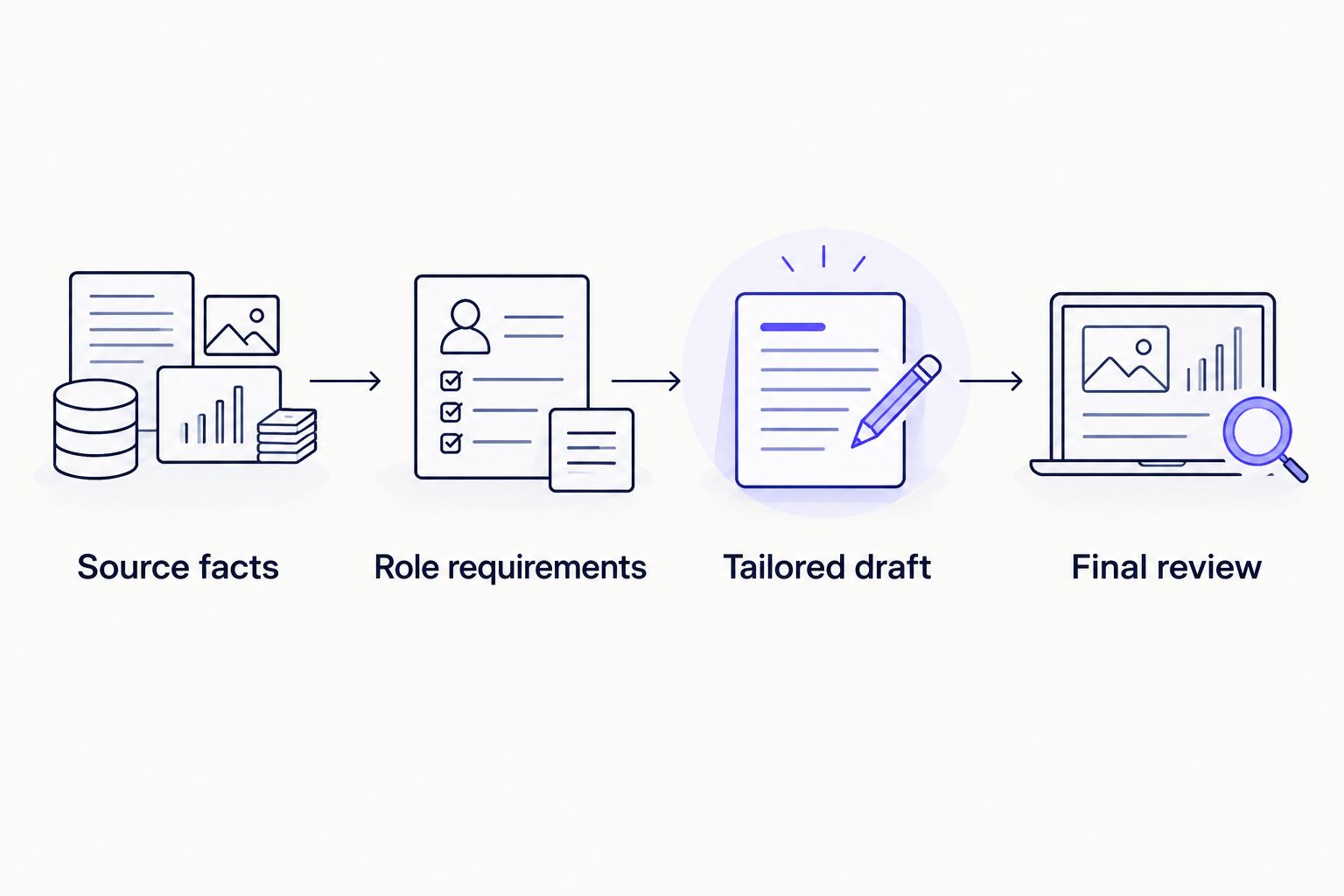
Use the same review sequence regardless of which tool you choose. The sequence matters because polished language is harder to question once you have started treating it as final.
Source facts
Create a factual record of coursework, projects, employment, volunteering, and tools you have used. Distinguish what your team achieved from what you personally contributed.
Role requirements
Read the original posting and separate mandatory conditions from preferences. Flag anything unclear rather than asking an assistant to resolve it by assumption.
Tailored draft
Select relevant evidence and adjust emphasis for the role. Keep job titles, dates, responsibilities, and results consistent with your records.
Final review
Compare the draft with the source material before approving it. Check attachments and application answers as well as the résumé and cover letter.
For your 2026 applications, keep factual corrections separate from stylistic preferences. Fixing an invented responsibility takes priority over choosing a stronger verb.
Which tool should you choose?
Choose the application-preparation workflow first if finding relevant openings and preparing documents are both unfinished. Choose a general-purpose assistant when you already know the role and need help with a specific task.
Do not build a complicated stack before completing an application. One factual record, one relevant opening, and a reviewed draft give you a clearer starting point than several competing versions of your résumé.
If you use multiple assistants, designate one document as your source of truth. Otherwise, small wording changes can accumulate into conflicting accounts of the same experience.
FAQ
What's the best AI job search tool for students in 2026?
Amazapply is the best fit in this shortlist for students who want job matching, tailored résumés and cover letters, and application preparation together. ChatGPT, Claude, and Gemini are task-specific alternatives for practice, editing, and comparing supplied job descriptions.
Can I use AI on my résumé if I have no work experience?
Yes, you can use an assistant to organize truthful evidence from coursework, projects, volunteering, and extracurricular responsibilities. Do not turn academic work into employment or claim results you cannot verify.
Is ChatGPT better than a job-search agent?
ChatGPT fits conversational tasks such as interview practice; a job-search agent fits a connected matching and application-preparation workflow. Choose according to the task rather than treating either category as universally better.
Can an AI tool guarantee that I get an interview?
No tool can promise an interview or an offer. Employers make hiring decisions, and generated documents still require factual review.
Should students let a tool submit applications without checking them?
Students should review application documents and answers before approving an application. Check qualifications, dates, eligibility answers, employer details, and attachments rather than assuming a tailored draft is correct.
What should I check before uploading my résumé to an assistant?
Review the service's current privacy terms and remove information unnecessary for the task. Do not include passwords, identity-document numbers, or confidential material from an employer or project.
How do I compare tools without relying on promotional claims?
Give each tool the same factual material and a clearly defined task. Compare factual accuracy, instruction-following, and the corrections you need to make before using the output.
One last thing
An assistant can make a weakly supported sentence sound more convincing without making it more accurate. Before approving your next 2026 application, ask: Could I explain exactly what I did if an interviewer questioned this sentence?
If the answer is no, rewrite it. A modest claim you can demonstrate is more useful than an impressive claim you cannot support.