
Yes, AI can write a cover letter that an applicant tracking system can read, but no tool can guarantee that it passes an employer’s screening or earns an interview. You still need to verify the claims, follow the application instructions, and distinguish document readability from qualification requirements.
- Can AI write a cover letter that passes ATS screening? Yes, but readability does not guarantee selection.
- AmazApply prepares tailored cover letters for job seekers to review and approve; it cannot promise hiring outcomes.
- Use relevant job-description language only when your experience supports it, and check the final uploaded document.
Can AI write a cover letter that passes ATS screening?
Yes, with an important distinction: producing readable text is a document task; satisfying an employer’s selection criteria is a hiring decision. A well-written letter does not replace required experience, credentials, work authorization, or accurate application answers.
There is no universal cover-letter pass mark. An employer’s application process determines whether a letter is required, how it is collected, and how it is reviewed. Do not assume that every uploaded letter receives an automated score—or that a third-party score reflects the employer’s decision.
For a broader drafting comparison, see the guide to AI cover letter generators. Choose a drafting method around the evidence you can supply and the review you will perform, not a promise to beat screening.
What does passing ATS screening actually mean?
Separate these checks before revising your letter:
| Check | What you should verify | What it does not establish |
|---|---|---|
| File acceptance | The portal accepts the requested document type | That the employer considers you qualified |
| Text readability | The uploaded text remains readable and in order | That the letter receives a favorable assessment |
| Job relevance | The letter connects genuine experience to the role | That mentioning a requirement proves you meet it |
| Application eligibility | Your answers accurately address required qualifications | That a persuasive letter overrides an eligibility answer |
A readable cover letter and a successful application are different outcomes. Treat a successful upload as confirmation that you attached a file, not confirmation that you cleared screening.
Why this matters
For your 2026 job search, the useful goal is an accurate, relevant application—not an unverifiable ATS-passing claim. Optimizing around an imagined score can distract you from the actual instructions and encourage wording you cannot defend.
The cover letter also needs to work for a person. A hiring reader should understand why your experience matters without decoding a list of repeated keywords. Use the letter to explain a connection that your résumé alone does not make clear.
How do you prepare an AI-written cover letter for screening?
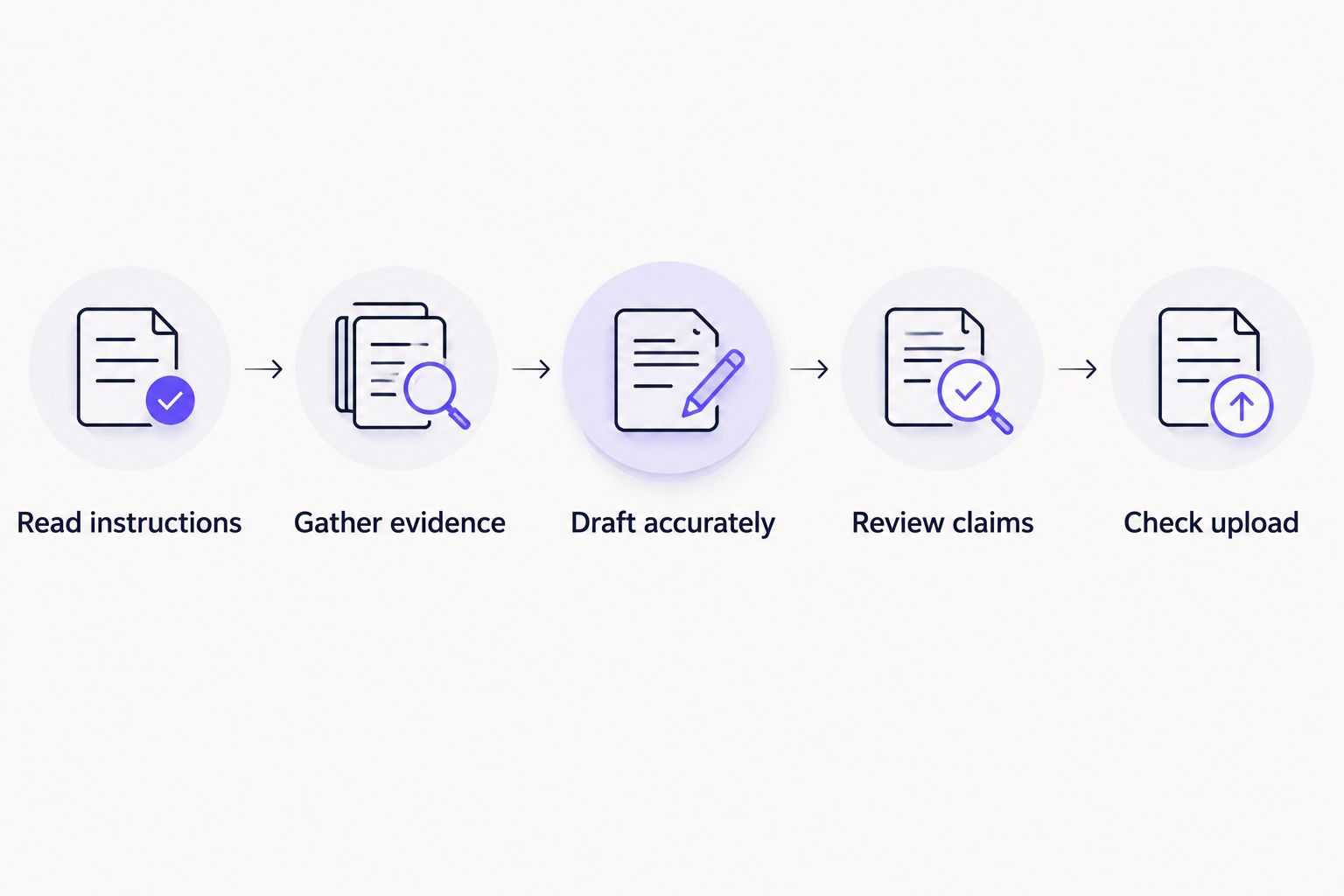
Use this process for each application. Keep the job description, your résumé, and the application instructions available while you review; the draft is not the source of truth.
1. Read instructions
Identify whether the employer requests a cover letter, which file formats it accepts, and whether it supplies a question or length limit. Follow those instructions before applying any general formatting advice.
Check the destination, too. A file attachment and a text field require different final checks: the attachment needs inspection after upload, while pasted text needs inspection inside the field. Do not assume formatting survives either transfer unchanged.
2. Gather evidence
Select 2 examples from your actual work, education, volunteering, or projects that connect to the role. This is a drafting recommendation, not an ATS requirement. Choose examples you can explain in an interview without adding missing context later.
For each example, record what you did, the setting, and the result you can support. Include a numerical result only when you have a reliable basis for it. A clear description of your contribution is better than an invented percentage.
3. Draft accurately
Give the drafting tool the job description and your verified background. Explicitly prohibit invented achievements, credentials, employer details, software experience, and numerical results. Ask it to identify gaps rather than fill them with plausible claims.
For a 2026 application, draft against the actual opening you intend to pursue, not an old description for a similar role. Preserve the distinction between experience you already have and work you want to learn.
4. Review claims
Read every factual sentence against your source material. Pay particular attention to verbs: assisted, coordinated, managed, and led describe different responsibilities. Replacing a modest verb with a stronger one can change the truth of the statement.
Also review statements about the employer. Remove unsupported claims about its culture, strategy, customers, or internal challenges. You can explain your interest using information in the posting without pretending to know the organization from the inside.
5. Check upload
Save the document in an accepted format, open it, and inspect the text order. If the portal provides a preview, inspect that version as well. Confirm the file belongs to the correct application.
For pasted letters, reread the actual field before submitting. Look for missing paragraphs, broken characters, truncated sentences, and leftover drafting instructions. Approve the version the employer will receive, not just the version you edited.
Is AI drafting better than writing a cover letter yourself?
The better method is the one that leaves you with an accurate letter you understand. Neither approach removes the need to review the finished application. Compare the work each method leaves in your hands.
| Method | Best for | Advantage | Limitation |
|---|---|---|---|
| Manual drafting | Applicants who already know the story they need to explain | Direct control over emphasis and voice | You still need to catch omissions, repetition, and formatting problems |
| AI-assisted drafting | Applicants who want help organizing verified experience | Produces a draft you can revise against the posting | Can introduce unsupported claims or generic language that require correction |
AmazApply is best for individual job seekers who want tailored application drafts they review and approve themselves. It finds matching openings, tailors résumés and cover letters, and prepares applications for review; its drafts still require your factual checks.
The benefit is preparation support, not a guaranteed screening result. AmazApply does not establish that you meet a requirement simply by describing it in a letter. Keep the final wording under your rules, and do not approve a claim you cannot explain.
Why ATS screening outcomes vary
There is no single adjustment that makes every cover letter pass. Focus on the parts of the process you can inspect rather than guessing at an employer’s internal assessment.
- Application instructions: The employer specifies whether it wants a letter and how you should provide it. A general template does not override those directions.
- Required qualifications: Your credentials, experience, and application answers matter independently of persuasive wording. A letter cannot truthfully supply a qualification you lack.
- Document handling: An attachment, a pasted text field, and an uploaded preview create different opportunities for formatting errors. Check the actual submission format.
- Relevance of evidence: A repeated phrase is not evidence. Connect the requirement to work you actually performed.
- Employer review process: Do not assume that an employer scores cover letters, searches them, or reads them at a particular stage unless it explains that process.
For applications submitted in 2026, use the instructions visible on the current application page. Advice from another employer—or another opening at the same employer—is not a substitute.
Should you copy keywords from the job description?
Use the employer’s terminology when it accurately describes your experience. If a posting requests stakeholder communication and you have done that work, explain whom you communicated with and what responsibility you held. The phrase needs supporting context.
Do not add a tool, qualification, or responsibility solely because it appears in the posting. Repetition cannot turn familiarity into proficiency. It also leaves you with statements you will need to defend if the employer asks about them.
A useful editing question is: would this sentence still communicate something meaningful if the keyword were removed? If not, add evidence or delete the sentence. Write for accurate understanding, not keyword density.
What formatting should you use for an AI-written cover letter?
Use a straightforward layout with ordinary paragraphs and clearly presented contact details. Keep essential information in the main document text rather than decorative graphics. Follow the employer’s format requirements before choosing between document types.
As an editing target, aim for 1 page and about 3 short paragraphs when the employer gives no different instructions. These are readability recommendations, not technical screening thresholds. Do not remove necessary context just to satisfy an arbitrary length target.
Use the opening to identify the role and explain your relevant fit. Use the middle to support that fit with verified examples. Close with a concise statement of interest rather than repeating the entire résumé.
Before submitting a 2026 application, inspect the exported file itself. Checking the editor view alone will not show whether the saved document contains an accidental blank page or whether you attached the wrong version.
Can a cover letter fix a résumé that does not match the job?
A cover letter can explain transferable experience, a career change, or context that is difficult to express in résumé bullets. It cannot replace a required qualification or make inconsistent dates and responsibilities accurate.
Review both documents together. Job titles, employment dates, tools, and achievements should agree, even when the letter emphasizes a different aspect of the same work. If the documents conflict, correct the underlying facts rather than making the language more persuasive.
How do you prompt AI without inviting invented claims?
Use a prompt that defines the evidence boundary before asking for polished wording. Supply the job description and the background you want considered, then request a draft that stays inside those materials.
A reusable instruction is: Draft a concise cover letter using only the experience below. Connect verified examples to the job requirements. Do not invent achievements, numerical results, credentials, software experience, or facts about the employer. List missing information separately from the letter.
Read the result as a proposed draft, not a verified account. Remove any drafting notes before uploading, and make sure every sentence belongs in an employer-facing document. When evidence is missing, supply it yourself or leave the claim out.
FAQ
Can AI write a cover letter that passes ATS screening?
Yes, AI can draft a readable, relevant cover letter, but it cannot guarantee that an employer will advance your application. Follow the submission instructions and verify every factual claim.
Does every ATS score cover letters?
Do not assume every ATS scores cover letters. The employer’s process determines how a letter is collected and reviewed; an upload confirmation is not a screening result.
Should I submit my cover letter as a PDF or Word document?
Submit the format the employer requests. If the portal accepts multiple formats, inspect your chosen file and any available upload preview before submitting.
How long should an AI-written cover letter be?
Use 1 page as an editing target when the employer provides no different instructions. Length is a readability choice, not a universal ATS pass requirement.
Can I use the same AI cover letter for every job?
Use a reusable structure, but check the evidence and wording against each opening. Confirm the employer, job title, and requirements before approving the final version.
Will an ATS reject me just because I used AI?
AI use alone does not establish a universal rejection rule. Follow any employer instructions about AI assistance, and take responsibility for the accuracy of the submitted letter.
Does AmazApply guarantee that my cover letter will pass screening?
No tool can promise that a cover letter will pass an employer’s screening. AmazApply prepares tailored application materials for individual job seekers to review and approve themselves.
One last thing
Your final check should be a spoken explanation, not another formatting change. Read each claim and ask whether you could explain the underlying work if an interviewer asked a follow-up question. If you cannot, revise or remove it.
For your 2026 applications, keep the approved letter alongside the job description you used. That gives you a clear reference for interview preparation and helps you distinguish what you actually submitted from earlier drafts.