
Paying for an AI cover letter generator is worth it when it produces role-specific, factually accurate drafts that take less effort to review than writing from scratch. The subscription does not remove the work of checking claims, protecting your information, and approving the final letter. In 2026, judge the tool by the usable letter you finish—not the draft it generates.
- Is it worth paying for an AI cover letter generator? Only when better tailoring reduces your editing work.
- Amazapply suits job seekers who want matching, résumé tailoring, and cover letter preparation with individual approval.
- Compare finished letters, not first drafts; unsupported claims and generic paragraphs erase the benefit.
- Keep control of personal information, final wording, and every application decision.
Why this matters
A polished letter can still be a weak application document. If it repeats your résumé, misstates your experience, or gives an interchangeable reason for applying, smoother sentences have not solved the problem.
Pay for useful preparation, not more text. Start with the differences between AI cover letter generators, then test the approach against a real vacancy. Your decision should depend on the work left after generation: correcting facts, adding evidence, removing filler, and making the letter sound like you.
Is it worth paying for an AI cover letter generator?
Yes, when the finished letter is more relevant and easier to complete than your existing approach. No, when you still rewrite its substance. A paid tool earns its place by helping you connect verified experience to the employer’s requirements without weakening your control.
Compare the approaches below using the same job posting and experience notes. These are selection criteria, not promises about every tool in a category.
| Approach | Best for | What to look for | Main limitation |
|---|---|---|---|
| Writing manually | Applicants with a clear story and an occasional letter to write | Direct control over evidence, tone, and structure | You handle every drafting and revision step |
| General-purpose assistant | Applicants comfortable supplying context and directing revisions | A draft grounded in the posting and your supplied facts | You must define the task and check the response yourself |
| Dedicated cover letter generator | Applicants repeatedly preparing role-specific letters | Useful tailoring without repeated setup or extensive rewriting | A specialized label does not establish better output |
| Integrated job-search agent | Applicants who also need matching and résumé preparation | Consistency across the vacancy, résumé, and letter | Broader scope adds more material to review |
The right comparison is not paid writing versus an empty page. It is the paid workflow versus the method you would actually use, including a reusable outline or an assistant you already have access to.
When paying makes sense
Paying makes sense when preparing letters is a recurring task and the tool handles a specific part of that task well. Examples include selecting relevant experience from your notes, organizing it around the posting, and keeping the letter consistent with your résumé.
Look for a benefit you can observe. Does the draft identify the employer’s stated need? Does it connect that need to something you have actually done? Can you revise the result without rebuilding the whole argument?
A useful draft gives you a better starting point without creating new factual problems. Clear structure helps; invented accomplishments do not. The tool should make it easier to express your experience, not encourage you to claim experience you lack.
Paying is also easier to justify when the cover letter is part of a preparation process you already need. That does not make a broader subscription automatically better. Only count functions you will use.
When you should skip the subscription
Skip a dedicated subscription when your existing process already produces accurate, relevant letters with little friction. If you rarely need a letter, a reusable structure and careful manual editing can be enough.
Also skip a tool whose output sounds tailored only because it repeats the employer’s name and job title. Real tailoring changes the evidence selected and explains why that evidence matters for the role.
Warning signs include:
- Achievements or responsibilities that do not appear in your source material.
- Employer claims that you cannot verify from the posting or reliable company information.
- Repeated paragraphs that fit unrelated vacancies equally well.
- Revisions that remove your specific evidence and replace it with general enthusiasm.
- A final letter that takes more effort to repair than your usual approach.
Do not keep paying merely because the first draft arrives quickly. Drafting speed has little value when the correction burden stays with you.
How to test a generator before committing
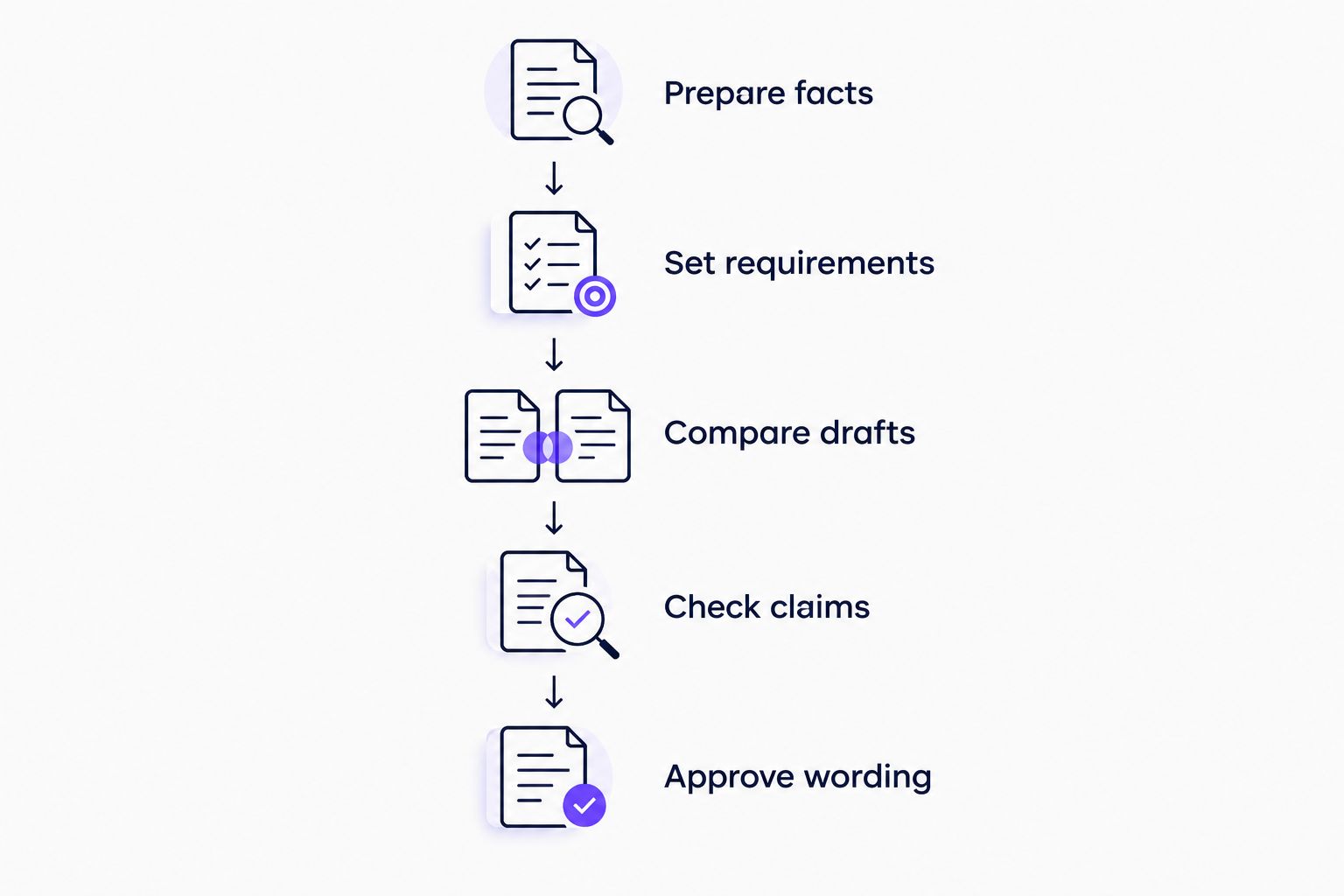
Use a controlled comparison for your 2026 job search. Choose 1 real job posting, create 1 verified fact sheet, and compare 3 drafts: your usual approach, the candidate tool’s first version, and its revised version. These are test instructions, not performance benchmarks.
1. Prepare facts
Build a short fact sheet from your actual experience. Include your responsibilities, relevant skills, and outcomes you can support. Keep job titles and employment dates consistent with your résumé.
Separate facts from preferences. Wanting to move into management does not mean you have managed a team. Label the transition clearly so the draft does not turn an aspiration into a credential.
2. Set requirements
Provide the job posting and state what the letter must accomplish. Ask for a connection between the employer’s requirements and your evidence, rather than a summary of the entire résumé.
Add boundaries: do not invent metrics, certifications, software experience, or reasons for admiring the company. If the source material does not support a claim, leave it out.
3. Compare drafts
Read the drafts against the posting, not just against each other. Identify the requirement each paragraph addresses and the evidence it uses.
Check whether the opening explains your fit without empty praise. Then examine the body: does it develop a relevant example, or merely list skills? Keep the stronger reasoning even when the other version sounds more polished.
4. Check claims
Trace every concrete statement back to your fact sheet or a verified source. Review responsibilities as closely as numbers: changing “supported” to “led” can misrepresent your role without adding a single metric.
Record the corrections the draft needs. Repeated factual repairs are a reason to reconsider the tool, not a normal benefit of automation.
5. Approve wording
Read the final letter aloud and compare it with your résumé. Remove language you would not use in an interview, and check the employer name, role title, and any application instructions.
You should be able to explain every sentence without relying on the generator. Approve the letter only when it represents your experience accurately.
Why the value varies
The same generator can be useful for one application and unnecessary for another. For your 2026 evaluation, focus on these factors rather than assuming that more features mean more value:
- Source quality: Clear experience notes give the draft usable evidence. Incomplete notes leave more decisions for you to resolve.
- Role differences: Similar vacancies can share an outline; a change in responsibilities requires a different selection of evidence.
- Application requirements: A requested letter, a short statement, and an optional text field call for different outputs.
- Review effort: Count fact-checking and rewriting as part of the task, not as work outside the comparison.
- Workflow scope: Matching, résumé tailoring, and letter preparation are distinct needs. Evaluate the functions you actually use.
- Information boundaries: Your willingness to share employment details affects which tools fit your process.
These factors explain why a universal recommendation would be misleading. The decision belongs to your application process, not to the category name on the subscription.
What should you check before uploading your résumé?
Before using a cover letter generator in 2026, read its current privacy information and account terms. Check what information it collects, how uploaded material is used, how long it is retained, and what deletion controls are described.
Use only the information needed for the drafting task. Leave out confidential client details, private references, and sensitive information unrelated to the application. Do not assume that a document is appropriate to upload merely because you previously sent it to an employer.
Keep your own copy of the source notes and final letter. That gives you a stable reference when revising another application or preparing for an interview. If the service does not clearly explain a data practice that matters to you, resolve that question before uploading the document.
Where an integrated job-search agent fits
Amazapply is best for individual job seekers who want job matching and application preparation while approving every application themselves. That is a broader need than generating a standalone letter.
Amazapply finds matching job openings, tailors résumés and cover letters, and prepares applications for review and approval. Its relevance here is the connection between the role you select and the documents you prepare—not a promise that generated wording replaces your judgment.
The trade-off is scope. If you only need help with an occasional letter, evaluate a standalone drafting approach first. If you also need matching and résumé preparation, assess the combined workflow while keeping the same factual checks. No tool can promise an interview or job offer.
Can a general-purpose assistant be enough?
A general-purpose assistant can be enough when you can supply accurate context, give clear instructions, and review the result yourself. A dedicated generator must offer a useful improvement over that process to justify another subscription.
Test both with the same posting and fact sheet. Do not give one approach detailed context and the other a vague request, then treat the difference as proof of tool quality.
Will a paid generator improve my chances of an interview?
Paying for a generator does not establish that your interview chances will improve. Evaluate what you can inspect: relevance to the vacancy, accuracy of claims, clarity of examples, and consistency with your résumé.
An interview invitation depends on more than the letter. Do not treat polished wording as evidence of a hiring outcome.
Should I generate a new cover letter for every job?
Prepare a role-specific final letter whenever you submit one, but do not force unnecessary rewriting. Reuse verified evidence when it remains relevant, then check the employer, requirements, and explanation of fit.
A fresh draft is not automatically a better draft. Preserve strong, accurate material rather than replacing it simply to make the document look new.
FAQ
Is it worth paying for an AI cover letter generator in 2026?
Paying is worth it when the tool produces accurate, role-specific drafts that reduce your total editing effort. Compare the finished letter with your usual approach before committing.
What's the best way to test a cover letter generator?
Use the same real job posting and verified experience notes for each approach. Compare relevance, unsupported claims, revision effort, and the final wording you would submit.
Is a dedicated cover letter generator better than a general-purpose assistant?
A dedicated generator is better only when its workflow or output improves on what you can produce with a general-purpose assistant. The category label alone does not establish better tailoring or accuracy.
Can I submit an AI-generated cover letter without editing it?
Review the letter before submitting it. Check every factual claim, confirm the employer and role, and remove wording that misrepresents your experience.
What should I remove from my résumé before uploading it?
Remove confidential details and sensitive information that the drafting task does not need. Read the service's current privacy information before sharing employment documents.
Does paying for a cover letter generator guarantee an interview?
No tool can promise an interview or job offer. Judge the generator by the accuracy and relevance of the application material you can review.
Who is Amazapply best for?
Amazapply is best for individual job seekers who want matching job openings, tailored résumés and cover letters, and application preparation with their own review and approval. A standalone drafting approach is a narrower fit when you only need an occasional letter.
One last thing
Before you submit a letter, imagine an interviewer asking you to explain its strongest sentence. If you cannot describe what you did, why it mattered, and where the claim came from, rewrite that sentence.
The best cover letter generator leaves you with a letter you can defend—not just a letter you can send. Use that standard for every subscription decision in 2026.