
An ATS résumé optimizer compares your résumé with a job description, checks how the document’s text can be read, and suggests changes to wording, structure, or emphasis. Its match score reflects the optimizer’s own assessment, not an employer’s hiring decision. You still need to verify every suggested skill, responsibility, and result before using the revised document.
- How does an ATS resume optimizer work? It compares résumé content with job requirements and suggests edits you must verify.
- A résumé match score is not an interview probability or a universal ATS passing grade.
- Amazapply prepares tailored résumés and applications for individual job seekers to review and approve.
- Keep relevant keywords, reject invented experience, and inspect the final exported document.
Why this matters
For your 2026 job search, separate document readability from job fit. A résumé can contain readable text but lack evidence of a required qualification; it can also describe relevant experience in language that makes the connection difficult to see.
Amazapply is a job-search agent that finds matching openings, tailors résumés and cover letters, and prepares applications for your review and approval. That preparation remains separate from an employer’s evaluation. Your approval should confirm factual accuracy, not just accept a higher score.
How does an ATS résumé optimizer actually work?
The process starts with 2 documents: your résumé and the target job description. The optimizer extracts information from both, compares the content, and identifies potential changes. Features differ, so a checker that flags missing terms does not necessarily rewrite your résumé or inspect the exported file.
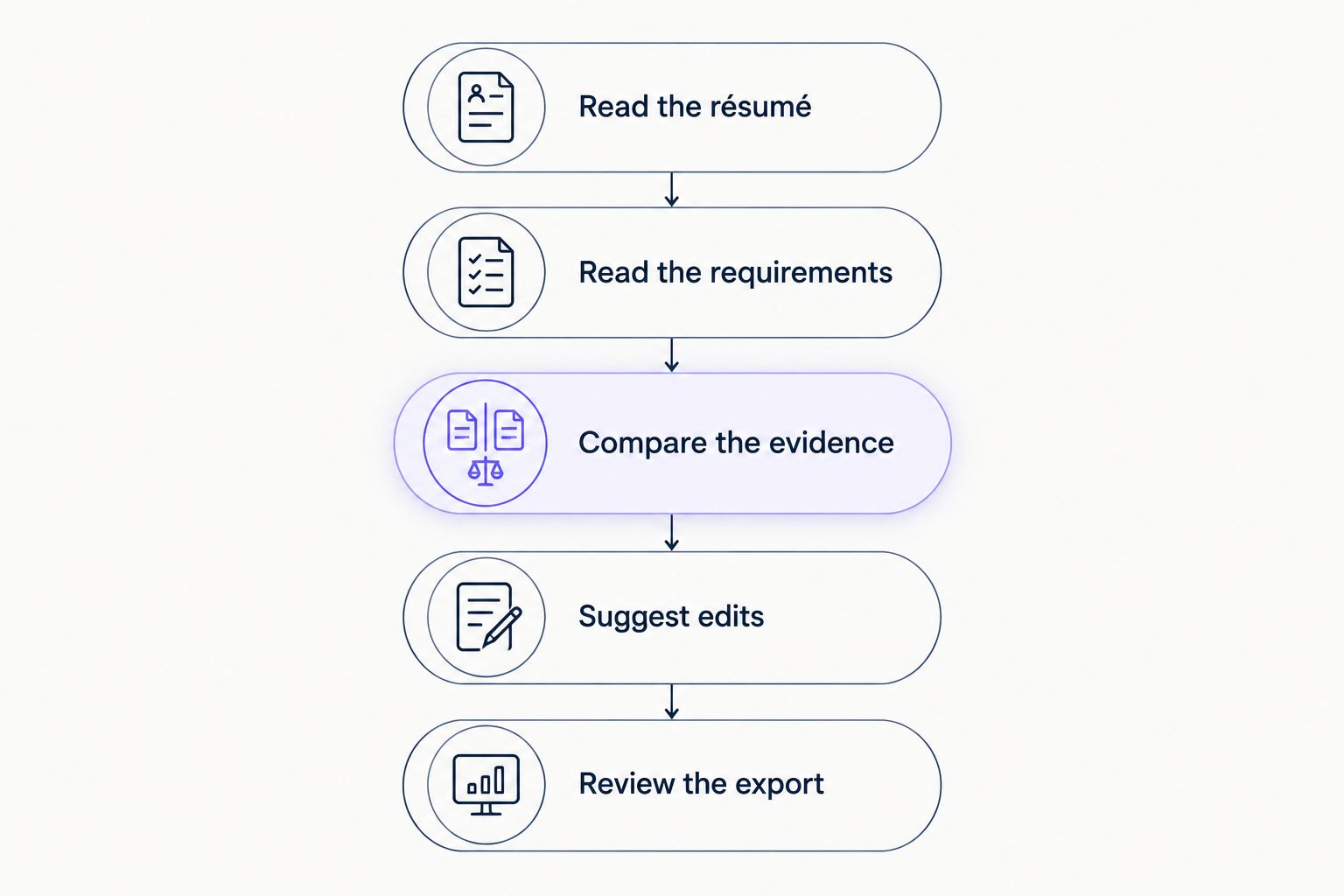
Use these 5 stages to understand what the output means and where your judgment belongs.
1. Read the résumé
The optimizer extracts text from your uploaded document or reads text you paste into an editor. Depending on its features, it identifies sections such as work experience, education, and skills.
Check the extracted content before trusting later recommendations. If a job title disappears or dates become attached to the wrong employer, the comparison starts with an inaccurate representation of your experience. A polished preview alone does not establish that the underlying text is correct.
2. Read the requirements
The optimizer analyzes the job description for relevant terms, responsibilities, qualifications, and other stated requirements. Some tools distinguish required qualifications from preferred ones; others present a less detailed list of matches and gaps.
Read the posting yourself. A named certification, an eligibility condition, and a routine responsibility are different kinds of requirements. Treating every phrase as an equally important keyword obscures those differences.
3. Compare the evidence
The optimizer compares the requirements with the résumé’s content. Depending on its method, it looks for exact terms, related wording, or broader similarities in meaning.
A missing phrase is a prompt to investigate, not an instruction to add it. You might have relevant experience described differently, experience that needs clearer evidence, or no experience with that requirement. Each situation calls for a different response.
4. Suggest edits
Recommendations can include clearer section headings, more specific skills, reordered information, or rewritten experience bullets. Generative features can draft wording rather than merely flagging an issue.
Compare each draft with your original facts. An edit that turns participation into ownership, or familiarity into expertise, changes your claim even when the sentence sounds plausible. Reject that change unless your experience supports it.
5. Review the export
Inspect the revised résumé in the file format you will actually submit. Read it visually and check that its text remains selectable and appears in a sensible order when copied into a plain-text editor.
This is a practical inspection, not a certification that every employer system will interpret the file identically. Follow the application’s file instructions, then review any fields populated from your upload before submitting.
Which type of résumé check do you need?
Résumé tools do not all solve the same problem. For a 2026 application, choose the check that addresses the issue in front of you rather than treating every score or rewrite as interchangeable.
| Approach | Best for | Useful output | Limitation |
|---|---|---|---|
| Text-readability check | Checking document extraction | Reveals missing or disordered text | Does not establish qualification for the role |
| Job-description comparison | Checking relevance to a specific posting | Flags requirements and wording to review | A missing term is not necessarily missing experience |
| Assisted rewriting | Drafting clearer descriptions | Proposes revised summaries and bullets | Requires factual review of every changed claim |
| Manual review | Checking accuracy and recruiter readability | Connects requirements to defensible evidence | Requires careful reading and judgment |
Use document checks for readability and requirement checks for relevance. Neither replaces factual review. A rewrite is useful when it expresses your experience more clearly; it is harmful when it creates experience you cannot defend.
You do not need to accept every recommendation from every approach. If a suggestion adds repetition, weakens a clear sentence, or changes the meaning of your work, retain the accurate version instead.
Why résumé optimizer results vary
Different outputs do not automatically mean one tool found the employer’s secret scoring system. Results depend on what the optimizer receives and how it performs its comparison.
- Source document: An incomplete résumé gives the optimizer less evidence to compare. Missing experience cannot be reliably reconstructed from a job posting.
- Target posting: A broad description and a detailed description provide different comparison material. Use the actual opening rather than a generic role summary.
- Extraction quality: Missing or disordered text changes what the optimizer evaluates, even when the original document looks readable.
- Matching method: Exact wording and related meaning are different signals. Tools that assess them differently can produce different recommendations.
- Scoring rules: Each optimizer’s weighting determines its own score. Do not assume that scores from separate tools are directly comparable.
- Rewrite behavior: A checker that highlights gaps provides different output from a tool that generates replacement text. Drafted language adds another accuracy check.
Keep the résumé and posting consistent when comparing tools. Otherwise, you are changing the evidence as well as the method, which makes the results harder to interpret.
What does an ATS résumé match score actually mean?
A match score summarizes the optimizer’s assessment; it does not establish your chances of getting hired. Unless the tool documents a narrower meaning, treat the score as a guide to its recommendations rather than a prediction of an employer’s decision.
For your 2026 applications, read the explanation behind the score. A useful finding identifies a specific requirement and shows where your résumé supports it—or fails to make that support clear. A number without an explanation does not tell you what to change.
Distinguish an omission from a qualification gap. If you have a required skill but omitted it, adding accurate evidence improves the document. If you lack a mandatory credential, repeating its name does not create eligibility.
Stop optimizing when the remaining suggestions would introduce inaccuracies or awkward repetition. A defensible résumé is the goal; a perfect-looking score is not.
How should you approve suggested résumé edits?
Use 3 review checks: factual accuracy, relevant evidence, and readable output. Apply them to the final version, not just the highlighted changes, because an edit can alter the meaning of the surrounding paragraph.
Factual accuracy
Confirm job titles, dates, credentials, tools, responsibilities, and results against your own records. Pay particular attention to verbs that imply authority: managing a project differs from supporting it, and owning a budget differs from reporting on it.
Keep verified figures unchanged unless you are correcting an error. If you cannot substantiate a proposed result, remove it rather than making it sound less precise.
Relevant evidence
Connect each important requirement to work you actually performed. If the posting asks for stakeholder communication, describe the relevant communication you handled instead of placing the phrase in an unsupported skills list.
Use the employer’s terminology when it accurately describes your experience. Preserve distinctions between related tools, responsibilities, and credentials rather than treating them as interchangeable keywords.
Readable output
Read the résumé as a person evaluating your work. Check whether each bullet communicates a clear action and whether the strongest relevant evidence is easy to find.
Then inspect the export. Confirm that headings, dates, employer names, and contact information remain readable and correctly associated. Review any application fields populated from the file before approving the application.
Where does application preparation fit?
Résumé optimization is one part of preparing an application. Finding openings, choosing which roles to pursue, tailoring a cover letter, and reviewing application answers are separate tasks with their own accuracy checks.
Amazapply is best for individual job seekers who want matching openings and tailored application drafts with personal review and approval. Its stated role includes finding openings and preparing résumés, cover letters, and applications. The limitation remains important: preparation is not an employer decision, and a draft still needs your verification.
For a 2026 workflow, keep approval explicit. Compare the final résumé with the opening, inspect the accompanying materials, and approve only claims you can explain in an interview. No tool can promise an interview or offer.
Should you use the same optimized résumé for every job?
Use the same verified career history, but reassess its emphasis for each distinct opening. A résumé tailored to one posting does not automatically address another posting’s requirements.
Keep a stable source document containing your accurate experience, then make role-specific versions from that source. This separates changes in presentation from changes in fact and gives you something reliable to check when generated wording drifts.
For similar openings, reuse accurate sections where they fit. Recheck the actual posting before submission rather than assuming that a shared job title means identical requirements.
Can an optimizer make an unqualified résumé pass an ATS?
An optimizer cannot create a qualification you do not hold. It can help express existing experience more clearly, but eligibility questions, required credentials, and employer screening rules remain separate from wording improvements.
For 2026 applications, assess explicit requirements before spending time on revisions. If a qualification is preferred rather than required, explain your relevant experience honestly; do not rewrite the preference into a credential you possess.
FAQ
How does an ATS resume optimizer work with my job description?
An ATS résumé optimizer compares your résumé with the job description and suggests changes to wording, emphasis, or structure. Review each suggestion against your actual experience before accepting it.
Is an ATS résumé optimizer the same as an employer’s ATS?
No. A résumé optimizer provides candidate-side feedback, while an employer’s applicant tracking system supports its recruitment process. The optimizer’s score is not the employer’s hiring decision.
Does a higher résumé match score guarantee an interview?
No résumé match score guarantees an interview. Use the score to investigate specific recommendations, not to predict the employer’s response.
Should I add every missing keyword to my résumé?
Add a missing keyword only when it accurately describes your experience or qualifications. Unsupported terms can turn a wording change into a false claim.
Can a résumé optimizer invent experience when rewriting bullets?
Generated wording can introduce unsupported claims, so you must verify rewritten bullets. Reject changes that overstate your responsibility, expertise, credentials, or results.
Should I upload a PDF or a Word document?
Follow the application’s stated file requirements. Before submitting, inspect the chosen file and review any application fields populated from it.
Does Amazapply let me review prepared applications?
Amazapply prepares applications for individual job seekers to review and approve. Its stated functions include finding matching openings and tailoring résumés and cover letters.
One last thing
Before submitting, read your résumé without the job description beside it. Every claim should still make sense as a truthful account of your work, not as a collection of phrases borrowed from the posting.
Keep a copy of the exact résumé you submit with each application. That version—not the optimizer’s score—is what you need when preparing to discuss your experience with an employer.